
Many learners feel confused between “bodies” and “bodys.” These words look very similar, and the difference is only a few letters. Because English spelling rules can sometimes be tricky, students, ESL learners, and beginners often wonder which form is correct.
The confusion usually happens when forming plurals of words that end in “y.” While some nouns simply add “s,” others require a spelling change. Understanding this rule will help you avoid mistakes and write confidently.
The good news is that the answer is simple. This article explains the difference in very easy English so you can understand it clearly on your first read.
Quick Answer
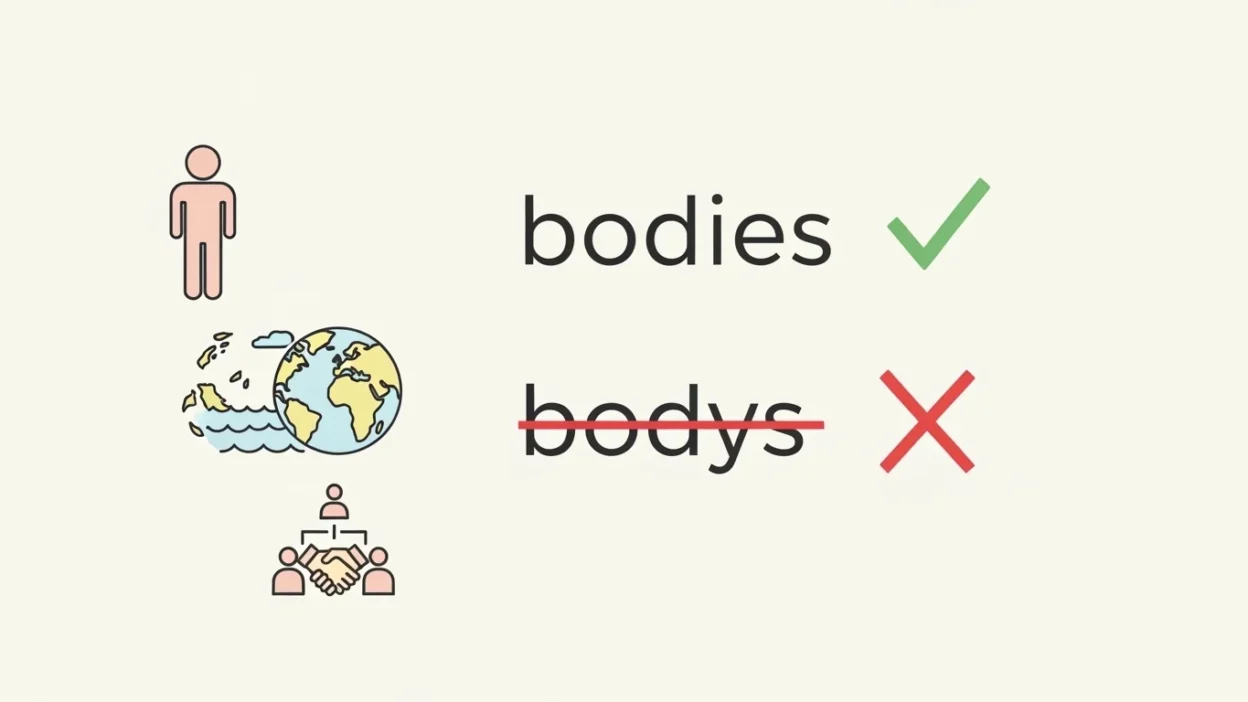
- Bodies = correct plural form of “body”
- Bodys = incorrect spelling
✔ Correct: The doctor examined the patients’ bodies.
❌ Incorrect: The doctor examined the patients’ bodys.
👉 Always use bodies when referring to more than one body.
Simple Origin and Background
What Does “Body” Mean?
The word “body” has several meanings depending on the context:
- The physical form of a person or animal
- Example: Exercise keeps our bodies healthy.
- A group or organization
- Example: A governing body makes important decisions.
- The main part of something
- Example: The body of the essay contains the main ideas.
- A large mass or object
- Example: Earth is a celestial body.
The word comes from Old English and has been widely used for centuries.
Why Does “Bodys” Exist?
The form “bodys” appears because learners try to form the plural by simply adding “s.” While this works for many English nouns, it does not apply to words ending in a consonant followed by “y.”
Therefore, “bodys” is incorrect and not accepted in standard English.
Clear Explanation of the Difference
What Does “Bodies” Mean?
Bodies is the correct plural of body. It is used when referring to more than one physical form, group, or object.
Examples:
- Athletes take care of their bodies.
- Several governing bodies regulate the sport.
- Scientists study celestial bodies.
- Rescue teams recovered the bodies.
What About “Bodys”?
Bodys:
- Is not a correct English word.
- Does not follow standard grammar rules.
- Should never be used in formal or informal writing.
If used in exams, essays, or professional communication, it will be marked incorrect.
Comparison Table
| Feature | Bodies | Bodys |
|---|---|---|
| Meaning | More than one body | No valid meaning |
| Usage | Correct | Incorrect |
| Spelling Rule | “Y” changes to “IES” | Incorrect addition of “S” |
| Grammar | Proper English | Not accepted |
| Use in Exams | Correct | Marked wrong |
| Dictionary Status | Recognized | Not recognized |
Which One to Use and When
Use “Bodies”
Use bodies when referring to more than one body in any context.
Physical Bodies
- Doctors study human bodies.
- Healthy bodies require proper nutrition.
Organizations or Groups
- International bodies promote cooperation.
- Government bodies create policies.
Astronomy
- Planets and stars are celestial bodies.
Writing and Structure
- Essays contain introductions, bodies, and conclusions.
Never Use “Bodys”
Avoid bodys in all situations, including:
- School assignments
- Exams and essays
- Emails and reports
- Books and presentations
- Social media posts
It is always incorrect.
Common Mistakes People Make
1. Adding Only “S” to Form the Plural
Incorrect:
- ❌ bodys
Correct:
- ✔ bodies
2. Forgetting the “Y to IES” Rule
Words ending in a consonant + y change y to ies when forming the plural.
3. Confusing Similar Words
Some words ending in y simply add s because the y follows a vowel.
Examples:
- boy → boys
- toy → toys
- key → keys
- day → days
4. Typing Too Quickly
Simple typing mistakes often lead to incorrect spellings.
Everyday Real-Life Examples
In Emails
Correct:
- The rescue team found the bodies.
- These international bodies will review the proposal.
Incorrect:
- The rescue team found the bodys.
In School and Education
- Students learn about human bodies in biology.
- The essay contains three main bodies.
On Social Media
- Regular exercise strengthens our bodies.
- Scientists study celestial bodies like stars and planets.
In News Reports
- Authorities discovered the bodies after the storm.
- Regulatory bodies introduced new policies.
In Daily Conversations
- Healthy bodies lead to healthy lives.
- Our bodies need rest and proper nutrition.
Short Learning Section for Students and Beginners
Simple Rule to Remember
👉 Body → Bodies (Change “y” to “ies”).
Easy Memory Trick
Think:
👉 “If a word ends in a consonant + y, change y to ies.”
Examples:
- body → bodies
- baby → babies
- city → cities
- story → stories
- country → countries
Practice Sentences
Fill in the blanks:
- Doctors study human ______.
✔ bodies - Astronomers observe celestial ______.
✔ bodies - International ______ work together for peace.
✔ bodies
Mini Exercise
Choose the correct word:
- Human bodys/bodies need water.
✔ bodies - Scientists study celestial bodys/bodies.
✔ bodies - Government bodys/bodies make laws.
✔ bodies - The essay has three bodys/bodies.
✔ bodies
FAQ Section
1. Is “bodys” a real word?
No, it is an incorrect spelling and not accepted in standard English.
2. What is the correct plural of “body”?
The correct plural is bodies.
3. Why does “body” change to “bodies”?
Because nouns ending in a consonant + y change y to ies in the plural form.
4. When do we simply add “s” to words ending in “y”?
When the y follows a vowel, such as boy → boys and toy → toys.
5. Can “bodies” refer to organizations?
Yes, it can refer to groups or official organizations.
6. Can I use “bodys” in exams?
No. It will be marked incorrect.
7. Is “bodies” used in formal writing?
Yes, it is correct in both formal and informal English.
8. How can I remember the correct spelling?
Remember: Consonant + y → change “y” to “ies.”
Conclusion
The difference between bodys and bodies is simple and easy to understand:
- Bodies is the correct plural form of “body.”
- Bodys is incorrect and should never be used.
By remembering the rule—change “y” to “ies” when a word ends in a consonant + y—you can avoid common spelling mistakes and write confidently.
👉 Final Tip: Always write “bodies,” never “bodys.”
This knowledge will help you communicate clearly and accurately in both academic and everyday English.

Michael Anderson is a professional editor and senior contributor with a background in long-form content and strategic writing. He focuses on quality, structure, and credibility across all publications. Michael brings years of experience in content development and ensures high editorial standards for every project.