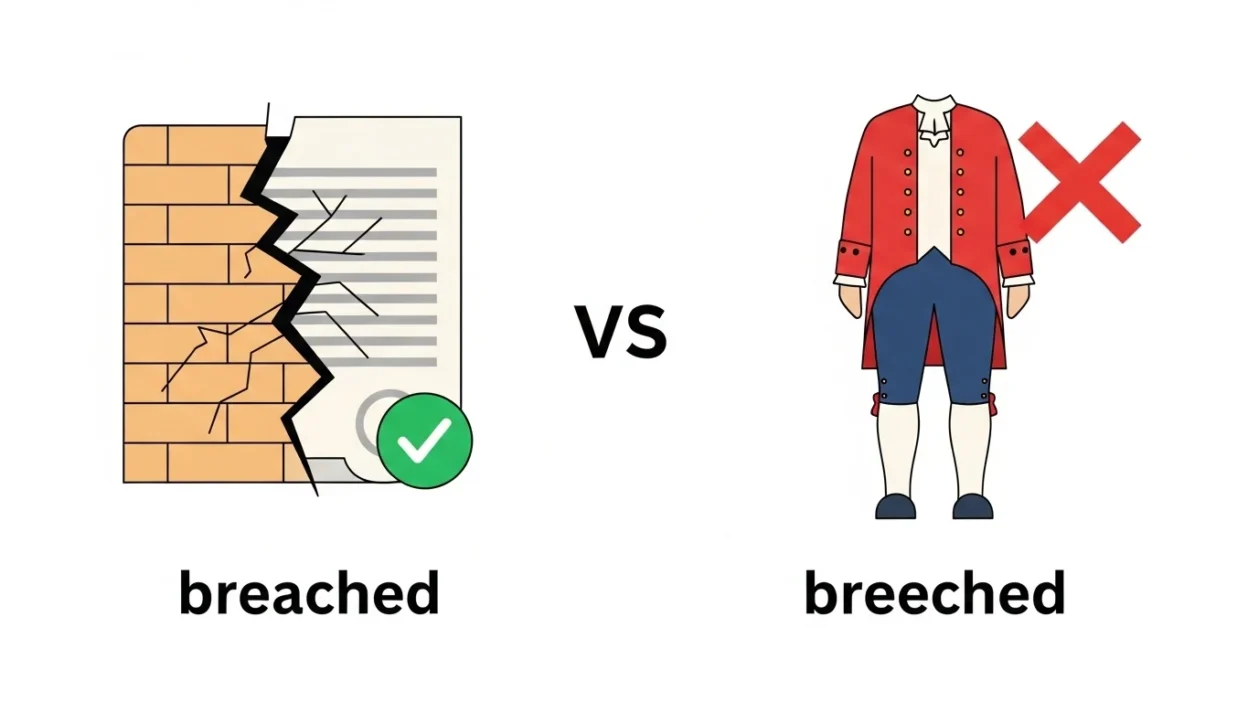
Many learners get confused between “breeched” and “breached.” These words look very similar and sound almost the same. The only difference is the position of the letters “e” and “a.”
Because of this small difference, people often mix them up in writing. But these two words actually have very different meanings, and using the wrong one can completely change your sentence.
Don’t worry—this guide will explain everything in very simple English so you can understand the difference clearly and use the right word every time.
Quick Answer
- Breached = broke a rule, agreement, or barrier
- Breeched = dressed (a child) in breeches (old clothing term)
✔ Correct: The company breached the contract.
✔ Correct (rare): The child was breeched at a young age.
👉 In most cases, you should use breached
Simple Origin and Background
Where Does “Breached” Come From?
The word “breached” comes from the verb “breach.” It means:
- To break something
- To go against a rule or agreement
- To make a gap or opening
This word is very common in modern English, especially in news, law, and daily language.
Where Does “Breeched” Come From?
The word “breeched” comes from “breeches,” which were a type of old clothing (pants).
In the past:
- Boys wore dresses when they were very young
- When they grew older, they started wearing breeches
- This change was called being “breeched”
Today, this word is very rare and mostly used in historical writing.
Clear Explanation of the Difference
What Does “Breached” Mean?
Breached means:
- Broke a rule or agreement
- Violated something
- Created an opening or gap
Examples:
- The company breached the contract.
- He breached the rules.
- The wall was breached during the attack.
It is commonly used in:
- Law
- Business
- News
- Technology (like data breaches)
What Does “Breeched” Mean?
Breeched means:
- A child started wearing breeches (old meaning)
Examples:
- The boy was breeched at the age of five.
Important:
- This word is very rare today
- Most people never use it in daily conversation
Comparison Table
| Feature | Breached | Breeched |
|---|---|---|
| Meaning | Broke a rule or agreement | Wore breeches (old meaning) |
| Usage | Very common | Very rare |
| Context | Law, business, daily English | Historical or old texts |
| Modern use | Yes | Almost never |
| Importance | High | Low |
Which One to Use and When
Use “Breached” in Most Situations
You should use breached when talking about:
- Breaking rules
- Violating agreements
- Security problems
Examples:
- The company breached the contract.
- The data was breached by hackers.
- He breached the agreement.
Use “Breeched” Only in Rare Cases
Use breeched only if:
- You are reading or writing about history
- You are describing old traditions
Most learners will never need to use this word.
Common Mistakes People Make
1. Mixing Up the Spellings
People often write:
- ❌ breeched (when they mean breached)
Correct:
- ✔ breached
2. Not Knowing the Meaning Difference
Some learners think both words mean “to break something.”
But only breached has this meaning.
3. Using “Breeched” in Modern Writing
Using breeched in emails or essays can make your writing confusing or incorrect.
4. Ignoring Context
Always check the meaning of your sentence:
- If it is about rules or agreements → use breached
Everyday Real-Life Examples
In Emails
Correct:
- The company breached the agreement.
- The policy was breached.
Incorrect:
- The company breeched the agreement.
In News
- The system was breached by hackers.
- The law was breached.
In Technology
- A data breach exposed user information.
- The security system was breached.
In Daily Conversation
- He breached the rules.
- They breached the contract.
Rare Historical Use
- The child was breeched in the old tradition.
(This is rarely used today.)
Short Learning Section for Students and Beginners
Simple Rule to Remember
👉 Breached = break rules
👉 Breeched = old clothing word
Easy Memory Trick
Think:
👉 “Breached = break” (both have “ea” sound idea)
Practice Sentences
Fill in the blank:
- The company ______ the contract.
✔ breached - The system was ______ by hackers.
✔ breached - The boy was ______ in old times.
✔ breeched
Mini Exercise
Choose the correct word:
- He breached/breeched the rules.
✔ breached - The data was breached/breeched.
✔ breached - The child was breached/breeched.
✔ breeched
FAQ Section
1. What does “breached” mean?
It means breaking a rule, agreement, or system.
2. What does “breeched” mean?
It means a child started wearing breeches (old clothing term).
3. Which word is more common?
Breached is very common. “Breeched” is very rare.
4. Can I use “breeched” in daily English?
No, it is rarely used and usually not needed.
5. Is “breached” used in business English?
Yes, it is very common in business and legal writing.
6. Why do people confuse these words?
Because they look and sound very similar.
7. Can I use “breeched” instead of “breached”?
No, they have different meanings.
8. How can I remember the difference?
Just remember:
👉 “Breached = break rules”
Conclusion
The difference between breeched and breached is very important:
- Breached means breaking a rule or agreement and is widely used
- Breeched is an old and rare word related to clothing
In modern English, you will almost always need breached.
Remember this simple rule:
👉 If something is broken, use “breached”
This will help you avoid confusion and use the correct word every time.

Emily Carter is a content writer and editor based in the United States, specializing in lifestyle, wellness, and personal development topics. With a passion for clear and engaging storytelling, she creates content that connects with readers and delivers practical value. Emily focuses on making complex ideas easy to understand and relatable.