Many learners feel confused between “countrys” and “countries.” These words look very similar, and the difference is only a few letters. Because of this, students and beginners often wonder which one is correct.
The confusion happens because English has special rules for forming plural nouns, especially words that end in “y.” Without understanding these rules, it is easy to make spelling mistakes.
The good news is that the answer is simple. This article explains everything in clear and easy English so you can understand the difference quickly and use the correct spelling with confidence.
Quick Answer
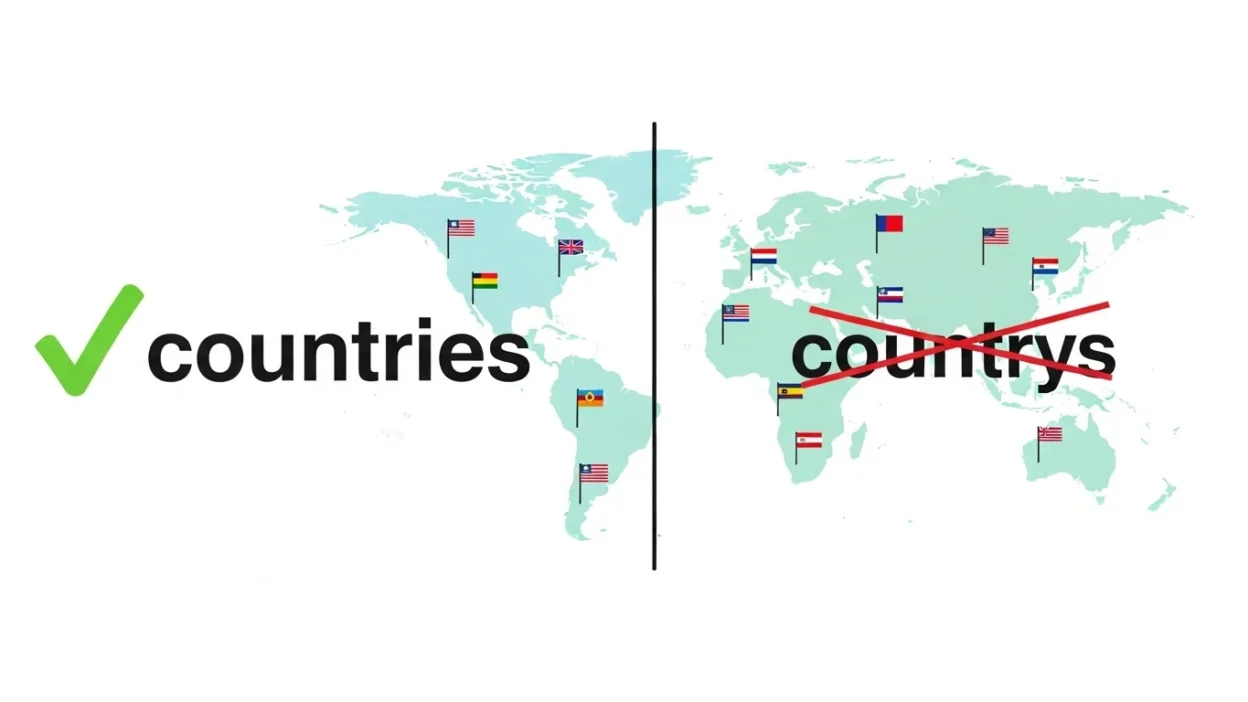
- Countries = correct plural form of “country”
- Countrys = incorrect spelling
✔ Correct: Many countries celebrate national holidays.
❌ Incorrect: Many countrys celebrate national holidays.
👉 Always use countries when talking about more than one country.
Simple Origin and Background
What Does “Country” Mean?
The word “country” refers to:
- A nation or independent state
- A land with its own government, culture, and borders
- A region where people live together under one system of authority
Examples:
- Pakistan is a beautiful country.
- Every country has its own traditions.
- Students learn about different countries in geography.
The word comes from Old French and has been used in English for centuries.
Why Does “Countrys” Exist?
The form “countrys” appears because learners try to create the plural by simply adding “s.” While this works for many words, it does not apply to nouns ending in a consonant followed by “y.”
As a result, “countrys” is a spelling mistake and is not accepted in standard English.
Clear Explanation of the Difference
What Does “Countries” Mean?
Countries is the plural form of country. It is used when referring to more than one nation.
Examples:
- Many countries participate in international events.
- Tourists love visiting different countries.
- Students study the cultures of various countries.
What About “Countrys”?
Countrys:
- Is incorrect and not recognized in standard English.
- Does not follow the correct plural rule.
- Should never be used in formal or informal writing.
Using this form in exams or assignments will result in an error.
Comparison Table
| Feature | Countries | Countrys |
|---|---|---|
| Meaning | More than one country | No valid meaning |
| Usage | Correct | Incorrect |
| Spelling Rule | “y” changes to “ies” | Incorrect addition of “s” |
| Grammar | Proper English | Not accepted |
| Use in Exams | Correct | Marked wrong |
| Dictionary Status | Recognized | Not recognized |
Which One to Use and When
Use “Countries”
Use countries when referring to multiple nations.
Examples:
- Asian countries have diverse cultures.
- European countries attract millions of tourists.
- Developing countries face economic challenges.
- Many countries promote education and innovation.
- The leaders of several countries attended the summit.
Never Use “Countrys”
Avoid countrys in all situations, including:
- School assignments
- Exams and essays
- Emails and reports
- Articles and presentations
- Social media posts
It is always incorrect.
Common Mistakes People Make
1. Adding Only “S” to Form the Plural
Incorrect:
- ❌ countrys
Correct:
- ✔ countries
2. Forgetting the “Y to IES” Rule
Learners often forget to change “y” to “ies” when the word ends in a consonant + y.
3. Confusing Similar Words
Some words simply add “s,” which leads to confusion. For example:
- boy → boys
- toy → toys
These words end with a vowel + y, so they follow a different rule.
4. Typing Too Quickly
Fast typing can lead to simple spelling errors.
Everyday Real-Life Examples
In Emails
Correct:
- We export products to several countries.
- The company operates in many countries.
Incorrect:
- We export products to several countrys.
In School and Education
- Students learn about countries in geography class.
- Different countries celebrate unique festivals.
On Social Media
- Traveling helps you explore new countries.
- Many countries promote cultural diversity.
In News and Reports
- Leaders from various countries attended the conference.
- Climate change affects all countries.
In Daily Conversations
- She dreams of visiting many countries.
- These countries share strong diplomatic ties.
Short Learning Section for Students and Beginners
Simple Rule to Remember
👉 Country → Countries (Change “y” to “ies”).
Easy Memory Trick
Think:
👉 “If a word ends in a consonant + y, change y to ies.”
Examples:
- country → countries
- city → cities
- baby → babies
- story → stories
- lady → ladies
Practice Sentences
Fill in the blanks:
- Many ______ are working together for peace.
✔ countries - She wants to visit different ______.
✔ countries - These ______ share cultural similarities.
✔ countries
Mini Exercise
Choose the correct word:
- Many countrys/countries participated in the event.
✔ countries - She has traveled to several countrys/countries.
✔ countries - African countrys/countries are rich in natural resources.
✔ countries - Developing countrys/countries need support.
✔ countries
FAQ Section
1. Is “countrys” a real word?
No, it is an incorrect spelling and not accepted in standard English.
2. What is the correct plural of “country”?
The correct plural is countries.
3. Why does “country” change to “countries”?
Because nouns ending in a consonant + y change y to ies in the plural form.
4. When do we simply add “s” to words ending in “y”?
When the y follows a vowel, such as boy → boys and toy → toys.
5. Can I use “countrys” in exams?
No. It will be marked incorrect.
6. Is “countries” used in formal writing?
Yes, it is correct in both formal and informal English.
7. What is the singular form of “countries”?
The singular form is country.
8. How can I remember the correct spelling?
Remember: Consonant + y → change “y” to “ies.”
Conclusion
The difference between countrys and countries is simple and easy to understand:
- Countries is the correct plural form of “country.”
- Countrys is incorrect and should never be used.
By remembering the rule—change “y” to “ies” when a word ends in a consonant + y—you can avoid common spelling mistakes and write confidently.
👉 Final Tip: Always write “countries,” never “countrys.”
This knowledge will help you improve your English and communicate clearly in both academic and everyday situations.

Daniel Brooks is a technology and business writer with experience covering innovation, startups, and digital tools. His work emphasizes clarity, accuracy, and real-world application. Daniel aims to help readers understand emerging technologies and make informed decisions in a fast-changing digital landscape.