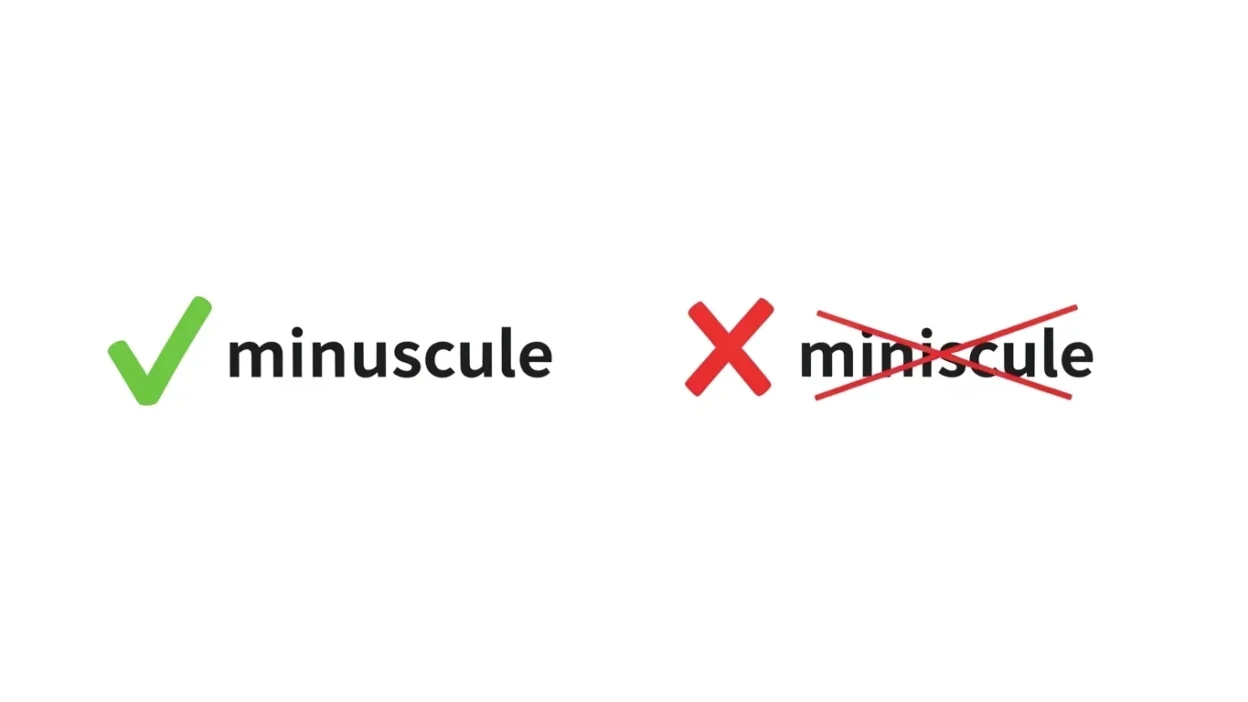
Many learners get confused between “minuscule” and “miniscule.” These two words look almost the same, and the only difference is one letter: “u” or “i.”
Because the words sound similar, people often spell them incorrectly when writing. Even native speakers sometimes make this mistake. But the truth is simple: only one of these spellings is correct in standard English.
In this article, you will learn the difference in very easy English so you can understand it clearly and never get confused again.
Quick Answer
- Minuscule = correct spelling (means very small)
- Miniscule = incorrect spelling (common mistake)
✔ Correct: The details are minuscule.
❌ Incorrect: The details are miniscule.
👉 Always use minuscule
Simple Origin and Background
Where Does “Minuscule” Come From?
The word “minuscule” comes from an old word that means:
- Very small
- Tiny
It is related to the idea of something being so small that it is almost hard to see.
Why Do People Write “Miniscule”?
The spelling “miniscule” is a common mistake because:
- People think of the word “mini” (which means small)
- So they wrongly change “minuscule” to “miniscule”
This makes sense in thinking, but it is not correct in spelling.
Clear Explanation of the Difference
What Does “Minuscule” Mean?
Minuscule is an adjective (a describing word). It means:
- Extremely small
- Very tiny
- Almost too small to notice
Examples:
- The difference is minuscule.
- There is a minuscule amount of sugar left.
- The chances are minuscule.
It is often used in:
- Science
- Daily conversation
- Formal writing
What About “Miniscule”?
Miniscule:
- Is not the correct spelling
- Has no official meaning
- Is a common spelling mistake
If you use “miniscule” in exams or writing, it will be marked wrong.
Comparison Table
| Feature | Minuscule | Miniscule |
|---|---|---|
| Meaning | Extremely small | No correct meaning |
| Usage | Correct and accepted | Incorrect |
| Spelling | Uses “u” | Uses “i” (wrong) |
| Grammar | Proper English | Not accepted |
| Use in exams | Correct | Marked wrong |
Which One to Use and When
Always Use “Minuscule”
Use minuscule when describing something very small.
Examples:
- The error is minuscule.
- The amount is minuscule.
- The object is minuscule.
You can use it in:
- School writing
- Exams
- Daily conversation
- Professional writing
Never Use “Miniscule”
Avoid miniscule in all situations:
- Essays
- Emails
- Messages
- Social media
It is always incorrect.
Common Mistakes People Make
1. Mixing It with “Mini”
Many learners think:
- “Mini” means small → so “miniscule” must be correct
But this is wrong.
2. Spelling by Sound
The word sounds like “mini-skule,” so people write it as miniscule.
3. Not Checking Spelling
This mistake often happens when people write quickly without checking.
4. Assuming Both Are Correct
Some learners believe both spellings are acceptable. This is not true.
Everyday Real-Life Examples
In Emails
Correct:
- The difference is minuscule.
- There is a minuscule error in the report.
Incorrect:
- The difference is miniscule.
On Social Media
- The chances are minuscule.
- The change is minuscule but important.
In Daily Conversation
- The amount is minuscule.
- The impact is minuscule.
In School or Homework
- The student measured a minuscule amount.
- The difference between the numbers is minuscule.
In Science or Reports
- The particles are minuscule.
- The measurement is minuscule.
Short Learning Section for Students and Beginners
Simple Rule to Remember
👉 Minuscule has “u,” not “i”
Easy Memory Trick
Think:
👉 “MinUscule → U for ‘Ultra small’”
Practice Sentences
Fill in the blank:
- The difference is ______.
✔ minuscule - The amount is very ______.
✔ minuscule - The object is ______.
✔ minuscule
Mini Exercise
Choose the correct word:
- The error is minuscule/miniscule.
✔ minuscule - The amount is minuscule/miniscule.
✔ minuscule - The detail is minuscule/miniscule.
✔ minuscule
FAQ Section
1. Is “miniscule” a real word?
No, it is not the correct spelling. It is a common mistake.
2. What does “minuscule” mean?
It means extremely small or tiny.
3. Why do people write “miniscule”?
Because they think of the word “mini,” which leads to confusion.
4. Can I use “miniscule” in exams?
No. It will be marked wrong.
5. Is “minuscule” a common word?
Yes, it is used in both daily and formal English.
6. Is “minuscule” used in science?
Yes, it is often used to describe very small amounts or objects.
7. How can I remember the correct spelling?
Remember:
👉 “Minuscule has ‘u’”
8. What is a simple example?
“The difference is minuscule.”
Conclusion
The difference between minuscule and miniscule is very simple:
- Minuscule is the correct spelling and means very small
- Miniscule is incorrect and should not be used
This mistake happens because of confusion with the word “mini,” but now you know the correct form.
Always remember this rule:
👉 Use “minuscule” with “u”
This will help you write clearly and correctly every time.

Emily Carter is a content writer and editor based in the United States, specializing in lifestyle, wellness, and personal development topics. With a passion for clear and engaging storytelling, she creates content that connects with readers and delivers practical value. Emily focuses on making complex ideas easy to understand and relatable.