Many learners feel confused between “panic” and “panick.” These two words look very similar, and the only difference is an extra “k.” Because English spelling rules can be tricky, people often wonder whether both forms are correct.
This confusion usually happens when learners try to apply spelling rules incorrectly. Some English words add a “k” before certain endings, while others do not. As a result, beginners, ESL learners, and even native speakers sometimes write “panick” by mistake.
The good news is that the answer is simple. Only one of these words is correct in modern English. This article explains the difference in clear, easy English so anyone can understand it on the first read.
Quick Answer
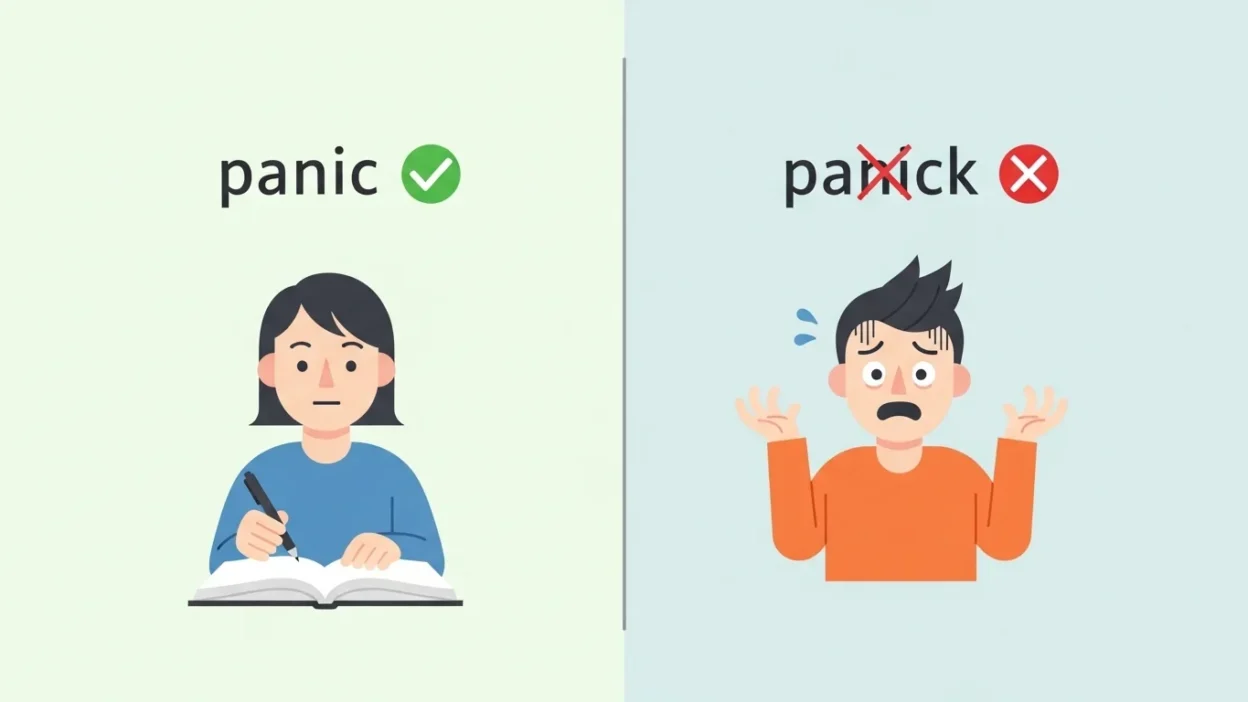
- Panic = correct spelling
- Panick = incorrect spelling
✔ Correct: She began to panic during the storm.
❌ Incorrect: She began to panick during the storm.
👉 Always use panic.
Simple Origin and Background
The Origin of “Panic”
The word “panic” comes from Greek mythology. It is derived from the name of Pan, a Greek god believed to cause sudden fear in travelers. This intense and sudden fear became known as “panic.”
Over time, the word entered the English language and has been widely used to describe extreme fear or anxiety.
Examples:
- The loud noise caused panic.
- People panicked during the emergency.
Why Does “Panick” Exist?
The spelling “panick” is a mistake. It appears because:
- People misunderstand English spelling rules.
- They assume a “k” should be added at the end.
- They confuse it with words like “pick” or “kick.”
- They try to form verb endings incorrectly.
However, “panick” is not a real English word and should never be used.
Clear Explanation of the Difference
What Does “Panic” Mean?
Panic is both a noun and a verb. It refers to sudden, uncontrollable fear.
As a Noun
It describes a strong feeling of fear or anxiety.
Examples:
- There was widespread panic in the city.
- The sudden announcement caused panic.
- He felt a wave of panic before the exam.
As a Verb
It describes the act of becoming afraid suddenly.
Examples:
- Don’t panic during emergencies.
- She panicked when she lost her phone.
- People panic when they hear bad news.
What About “Panick”?
Panick:
- Is not recognized in standard English.
- Has no meaning in dictionaries.
- Is always considered incorrect.
Using “panick” in exams, assignments, or professional writing will result in a spelling error.
Comparison Table
| Feature | Panic | Panick |
|---|---|---|
| Meaning | Sudden fear or anxiety | No meaning |
| Usage | Correct and widely accepted | Incorrect |
| Part of Speech | Noun and verb | Not applicable |
| Spelling | P-A-N-I-C | P-A-N-I-C-K (wrong) |
| Grammar | Proper English | Not accepted |
| Use in Exams | Correct | Marked wrong |
Which One to Use and When
Use “Panic”
Use panic in situations involving fear, stress, or emergencies.
Examples:
- Do not panic during a crisis.
- She began to panic before her presentation.
- The news caused public panic.
- Investors panicked during the market crash.
- Stay calm and avoid panic.
Never Use “Panick”
Avoid panick in all forms of communication, including:
- School assignments
- Exams
- Emails and reports
- Essays and articles
- Social media posts
It is always incorrect and unprofessional.
Common Mistakes People Make
1. Adding an Unnecessary “K”
Many learners mistakenly write:
- ❌ panick
Instead of: - ✔ panic
2. Confusing Verb Forms
When adding endings, learners may try to include an extra “k.” However, the correct forms are:
- panic → panicking
- panic → panicked
Not:
- ❌ panicing
- ❌ paniced
- ❌ panick
3. Spelling Based on Similar Words
People confuse “panic” with words like:
- pick
- kick
- stick
These words follow different spelling patterns.
4. Typing Too Quickly
Fast typing often leads to simple spelling errors.
Everyday Real-Life Examples
In Emails
Correct:
- Please do not panic; we are handling the situation.
- There is no need to panic.
Incorrect:
- Please do not panick.
On Social Media
- Don’t panic—stay calm and safe.
- People tend to panic during emergencies.
In Daily Conversation
- She began to panic before the interview.
- He panicked when he lost his wallet.
In News Reports
- The sudden earthquake caused widespread panic.
- Authorities urged citizens not to panic.
For School or Exams
- Students sometimes panic before tests.
- Try not to panic during your exam.
Short Learning Section for Students and Beginners
Simple Rule to Remember
👉 Panic is correct; panick is wrong.
Easy Memory Trick
Think:
👉 “Panic ends with ‘C,’ so never add a ‘K.’”
Special Spelling Tip
When adding endings:
- panic + ing → panicking
- panic + ed → panicked
The “k” appears only before -ing and -ed, not in the base word.
Practice Sentences
Fill in the blanks:
- Do not ______ during emergencies.
✔ panic - She began to ______ before the exam.
✔ panic - The loud noise caused widespread ______.
✔ panic
Mini Exercise
Choose the correct word:
- Do not panick/panic.
✔ panic - The news caused panick/panic.
✔ panic - She started to panick/panic.
✔ panic - He is panicing/panicking.
✔ panicking - They paniced/panicked during the storm.
✔ panicked
FAQ Section
1. Is “panick” a real word?
No, it is a spelling mistake and not recognized in standard English.
2. What does “panic” mean?
It means sudden and overwhelming fear or anxiety.
3. Is “panic” a noun or a verb?
It can be both a noun and a verb.
4. Why is “panick” incorrect?
Because standard English does not include a “k” at the end of the base word.
5. What is the past tense of “panic”?
The past tense is panicked.
6. What is the present participle of “panic”?
The present participle is panicking.
7. Can I use “panick” in exams?
No. It will always be marked incorrect.
8. How can I remember the correct spelling?
Remember: Panic ends with “C,” not “CK.”
Conclusion
The difference between panic and panick is simple and clear:
- Panic is the correct spelling and refers to sudden fear or anxiety.
- Panick is incorrect and should never be used.
This mistake happens because of confusion with English spelling rules. By remembering that the base word ends with “c,” you can avoid errors and write confidently.
👉 Final Tip: Use “panic” for the base word, and remember “panicked” and “panicking” for its correct forms.
With this knowledge, you can communicate clearly and accurately in both academic and everyday English.

Michael Anderson is a professional editor and senior contributor with a background in long-form content and strategic writing. He focuses on quality, structure, and credibility across all publications. Michael brings years of experience in content development and ensures high editorial standards for every project.