
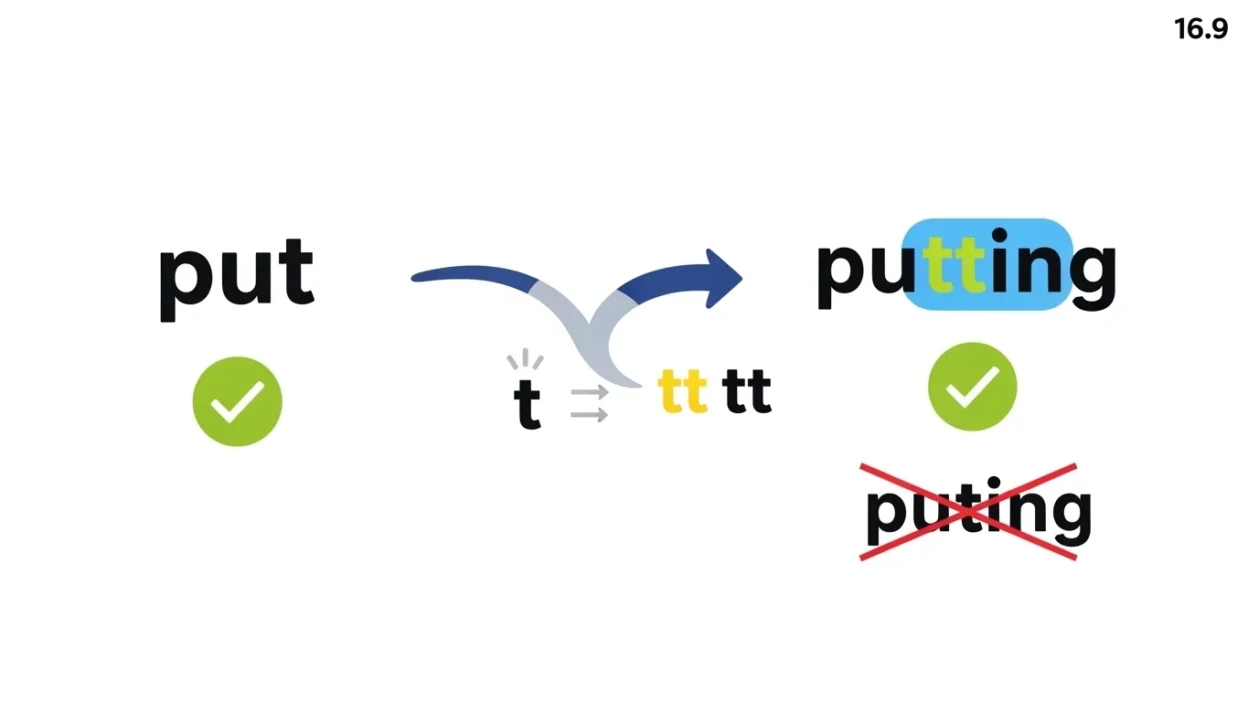
Many learners get confused between “puting” and “putting.” The words look very similar, and the only difference is one extra “t.” Because of this, people often think both spellings are correct.
This confusion usually happens when students are learning how to add -ing to verbs. Some verbs change their spelling when we add -ing, and some do not. This can make things tricky.
Don’t worry—this guide will explain everything in very simple English so you can understand it clearly the first time.
Quick Answer
- Putting = correct spelling (used in modern English)
- Puting = incorrect spelling (not a real word)
✔ Correct: I am putting the book on the table.
❌ Incorrect: I am puting the book on the table.
👉 Always use putting with double t
Simple Origin and Background
The word “put” is a very common verb in English. It means:
- To place something somewhere
- To move something to a position
Examples:
- Put the glass on the table.
- She put her bag on the chair.
When we want to show an action happening now, we add -ing:
- put → putting
But here is the important rule:
When adding -ing to some short verbs, we double the last letter.
That is why:
- put → putting (not puting)
Clear Explanation of the Difference
What Does “Putting” Mean?
Putting is the correct form of the verb put with -ing added.
It is used for:
- Actions happening now
- Continuous tense (present or past)
Examples:
- I am putting my shoes on.
- She is putting food on the table.
- They were putting books in the bag.
What About “Puting”?
Puting:
- Is not correct English
- Is a spelling mistake
- Should never be used in writing or speaking
If you write “puting,” it will be seen as an error.
Comparison Table
| Feature | Putting | Puting |
|---|---|---|
| Meaning | Action of placing something | No meaning |
| Usage | Correct and common | Incorrect |
| Spelling | Double “t” | Single “t” (wrong) |
| Grammar | Follows English rules | Breaks grammar rules |
| Use in exams | Accepted | Marked wrong |
Which One to Use and When
Always Use “Putting”
Use putting when:
- Talking about actions happening now
- Writing sentences in present continuous tense
- Speaking or writing in daily English
Examples:
- I am putting the keys on the table.
- He is putting on his jacket.
- We are putting everything in order.
Never Use “Puting”
Avoid puting in:
- School work
- Exams
- Emails
- Messages
- Any kind of writing
It is always wrong.
Common Mistakes People Make
1. Forgetting to Double the “T”
Many learners write:
- ❌ puting
Instead of:
- ✔ putting
2. Not Knowing the Double Letter Rule
Some verbs need a double letter before adding -ing.
Examples:
- sit → sitting
- run → running
- put → putting
3. Writing Fast and Skipping Letters
Sometimes people type quickly and miss a letter:
- puting (missing one “t”)
Always check your spelling.
4. Thinking “Put” Does Not Change
Some learners think:
“Put is a small word, so it won’t change.”
But it does change when we add -ing.
Everyday Real-Life Examples
1. In Emails
Correct:
- I am putting the files in the folder.
- We are putting the plan into action.
Incorrect:
- I am puting the files in the folder.
2. In Social Media
- Putting my thoughts out here…
- She is putting in a lot of effort.
3. In Daily Conversation
- I am putting the food on the table.
- He is putting his phone away.
4. In School or Homework
- The student is putting answers on the paper.
- She is putting effort into her studies.
5. In News or Articles
- The government is putting new rules in place.
- The company is putting money into new projects.
Short Learning Section for Students and Beginners
Here is a simple rule to remember:
👉 Short verb + vowel + consonant → double the last letter + ing
Example:
- put → putting
Easy Trick
Think:
👉 “Put needs two T’s when adding -ing”
Practice Sentences
Fill in the blank:
- I am ______ the book on the table.
✔ putting - She is ______ her bag on the chair.
✔ putting - They are ______ things in order.
✔ putting
Mini Exercise
Choose the correct word:
- He is puting/putting his shoes on.
✔ putting - We are puting/putting everything away.
✔ putting - She is puting/putting effort into her work.
✔ putting
FAQ Section
1. Is “puting” a real word?
No, it is not a real word. It is a spelling mistake.
2. Why do we write “putting” with double “t”?
Because of the spelling rule: short verbs double the last letter before adding -ing.
3. Can I use “puting” in exams?
No. It will be marked wrong.
4. Is “putting” used in daily English?
Yes, it is very common in speaking and writing.
5. What is the base form of “putting”?
The base form is put.
6. Are there other words like this?
Yes:
- run → running
- sit → sitting
7. What tense uses “putting”?
It is used in continuous tenses (like “is putting,” “was putting”).
8. How can I remember the correct spelling?
Just remember:
👉 “Put” becomes putting with double t
Conclusion
The difference between puting and putting is very simple:
- Putting is the correct spelling
- Puting is wrong and should never be used
This happens because English spelling rules require doubling the last letter in short verbs before adding -ing.
Always remember:
👉 Two T’s = Correct (putting)
If you follow this simple rule, you will never make this mistake again.

Michael Anderson is a professional editor and senior contributor with a background in long-form content and strategic writing. He focuses on quality, structure, and credibility across all publications. Michael brings years of experience in content development and ensures high editorial standards for every project.