Many learners feel confused between “storys” and “stories.” These words look very similar, and the only difference is a few letters. Because of this, students, ESL learners, and beginners often wonder which spelling is correct.
The confusion happens because English has special rules for forming plural nouns, especially words that end in “y.” While some words simply add “s,” others change their spelling before forming the plural. Understanding this rule makes the difference clear and easy to remember.
The good news is that the answer is simple. This article explains everything in very easy English so you can understand it on the first read.
Quick Answer
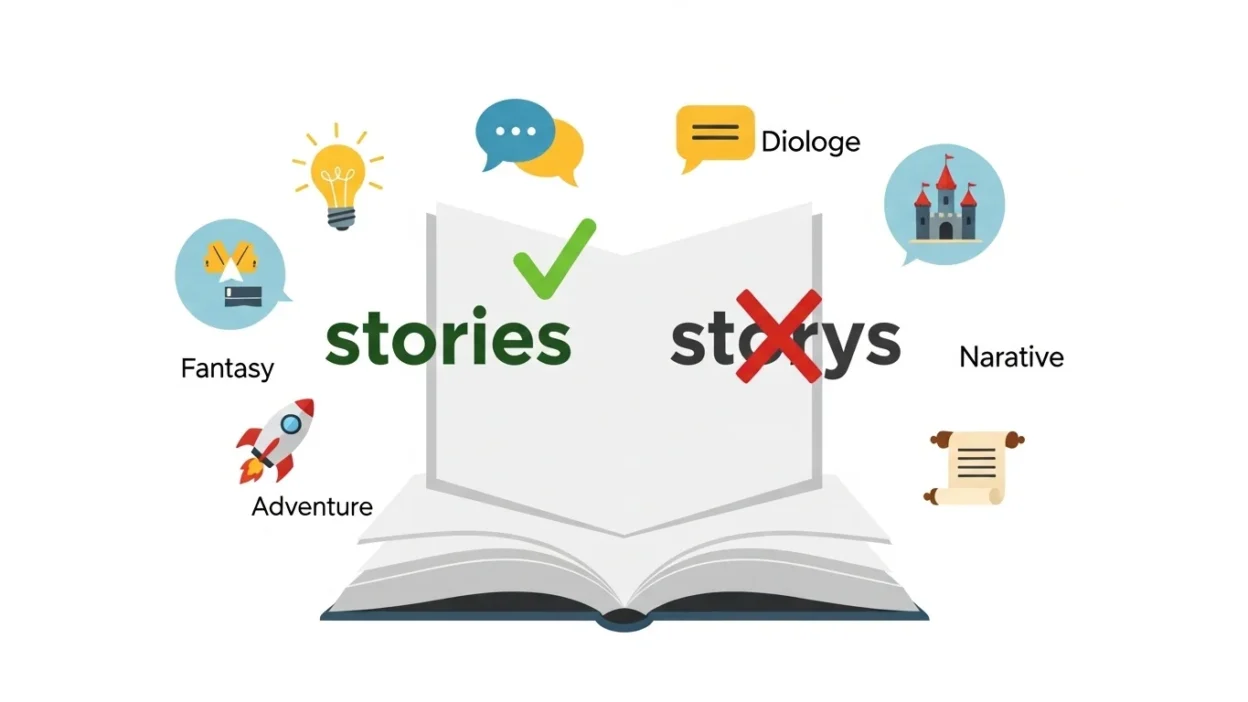
- Stories = correct plural form of “story”
- Storys = incorrect spelling
✔ Correct: She loves reading bedtime stories.
❌ Incorrect: She loves reading bedtime storys.
👉 Always use stories when referring to more than one story.
Simple Origin and Background
What Does “Story” Mean?
The word “story” has two common meanings:
- A tale or narrative
- A description of events, real or imaginary.
- Example: The teacher told an interesting story.
- A level of a building (mainly in American English)
- Example: The building has five stories.
The word has been part of English for centuries and comes from historical terms meaning a narrative or account.
Why Does “Storys” Exist?
The form “storys” appears because learners try to create the plural by simply adding “s.” While this works for many English nouns, it does not apply to words ending in a consonant followed by “y.”
As a result, “storys” is incorrect and not accepted in standard English.
Clear Explanation of the Difference
What Does “Stories” Mean?
Stories is the correct plural of story. It is used when referring to more than one narrative or building level.
Examples:
- Children enjoy listening to fairy stories.
- The book contains inspiring stories.
- The hotel has ten stories.
What About “Storys”?
Storys:
- Is not a correct English word.
- Does not follow standard plural rules.
- Should never be used in formal or informal writing.
Using this form in exams, assignments, or professional communication will be marked incorrect.
Comparison Table
| Feature | Stories | Storys |
|---|---|---|
| Meaning | More than one story | No valid meaning |
| Usage | Correct | Incorrect |
| Spelling Rule | “Y” changes to “IES” | Incorrect addition of “S” |
| Grammar | Proper English | Not accepted |
| Use in Exams | Correct | Marked wrong |
| Dictionary Status | Recognized | Not recognized |
Which One to Use and When
Use “Stories”
Use stories whenever you talk about more than one story.
Examples:
- Grandparents often tell wonderful stories.
- She writes short stories.
- These stories teach important lessons.
- The magazine published several stories.
- The skyscraper has fifty stories.
Never Use “Storys”
Avoid storys in all situations, including:
- School assignments
- Exams and essays
- Emails and reports
- Books and articles
- Social media posts
It is always incorrect.
Common Mistakes People Make
1. Adding Only “S” to Form the Plural
Many learners write:
- ❌ storys
Instead of: - ✔ stories
2. Forgetting the “Y to IES” Rule
Words ending in a consonant + y change y to ies when forming the plural.
3. Confusing Similar Words
Some words ending in y simply add s because the y follows a vowel.
Examples:
- boy → boys
- toy → toys
- key → keys
- day → days
4. Typing Too Quickly
Simple typing mistakes can lead to incorrect spellings.
Everyday Real-Life Examples
In Emails
Correct:
- Please send the success stories for the report.
- I enjoyed reading your travel stories.
Incorrect:
- Please send the success storys.
In School and Education
- Students read moral stories in class.
- Teachers use stories to explain lessons.
On Social Media
- She shares inspiring stories online.
- People love funny stories.
In Books and Literature
- The author writes mystery stories.
- The collection includes classic stories.
In Daily Conversation
- My grandmother tells amazing stories.
- These stories are unforgettable.
Short Learning Section for Students and Beginners
Simple Rule to Remember
👉 Story → Stories (Change “y” to “ies”).
Easy Memory Trick
Think:
👉 “A consonant before ‘y’ means change ‘y’ to ‘ies.’”
Examples:
- story → stories
- baby → babies
- city → cities
- lady → ladies
- country → countries
Practice Sentences
Fill in the blanks:
- Children love bedtime ______.
✔ stories - She writes inspiring ______.
✔ stories - The book contains short ______.
✔ stories
Mini Exercise
Choose the correct word:
- She reads bedtime storys/stories.
✔ stories - The teacher told two storys/stories.
✔ stories - The magazine published several storys/stories.
✔ stories - The building has five storys/stories.
✔ stories
FAQ Section
1. Is “storys” a real word?
No, it is an incorrect spelling and not accepted in standard English.
2. What is the correct plural of “story”?
The correct plural is stories.
3. Why does “story” change to “stories”?
Because nouns ending in a consonant + y change y to ies in the plural form.
4. When do we simply add “s” to words ending in “y”?
When the y follows a vowel, such as boy → boys and toy → toys.
5. Can “stories” refer to building levels?
Yes, especially in American English.
6. Can I use “storys” in exams?
No. It will be marked incorrect.
7. Is “stories” used in formal writing?
Yes, it is correct in both formal and informal English.
8. How can I remember the correct spelling?
Remember: Consonant + y → change “y” to “ies.”
Conclusion
The difference between storys and stories is simple and easy to understand:
- Stories is the correct plural form of “story.”
- Storys is incorrect and should never be used.
By remembering the rule—change “y” to “ies” when a word ends in a consonant + y—you can avoid common spelling mistakes and write with confidence.
👉 Final Tip: Always write “stories,” never “storys.”
This knowledge will help you improve your English and communicate clearly in everyday and academic situations.

Emily Carter is a content writer and editor based in the United States, specializing in lifestyle, wellness, and personal development topics. With a passion for clear and engaging storytelling, she creates content that connects with readers and delivers practical value. Emily focuses on making complex ideas easy to understand and relatable.