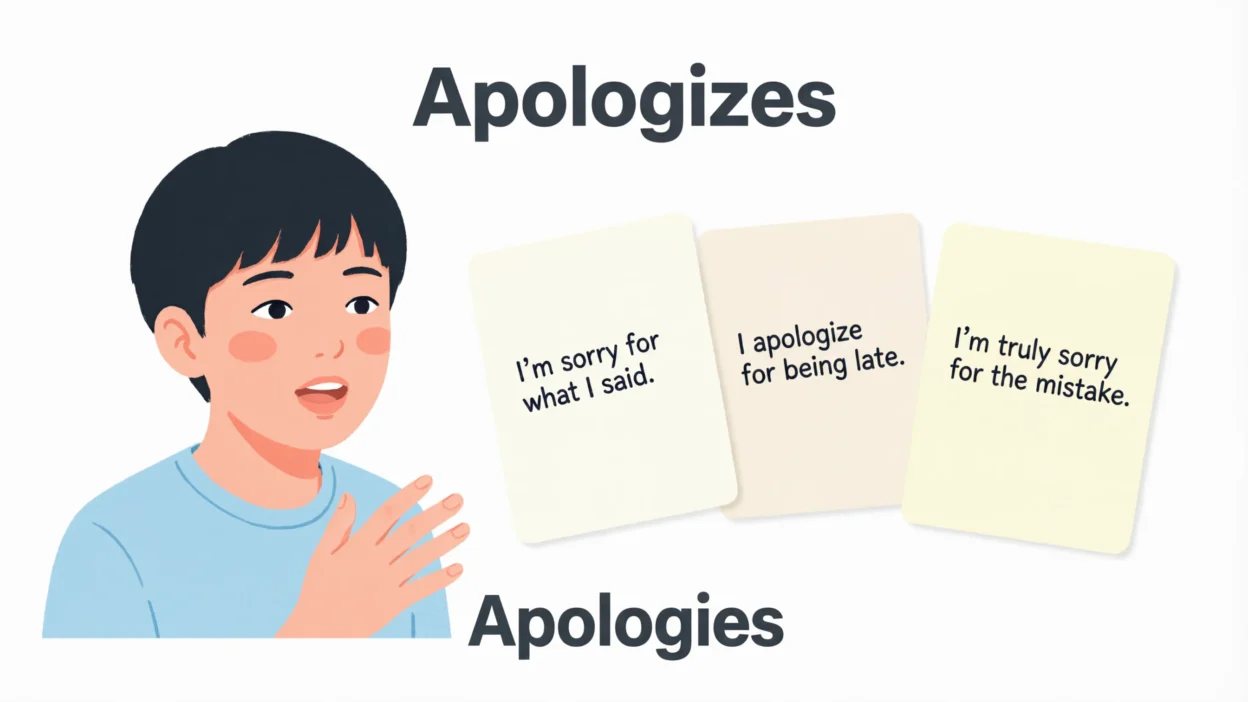
Many English learners confuse “apologizes” and “apologies” because both come from the word “apology.” However, they are used differently in grammar and sentence structure.
The key idea: verb vs noun.
Understanding the difference can help you write and speak more naturally in English.
Quick Answer
- ✅ Apologizes – A verb meaning “says sorry”
- ✅ Apologies – A noun meaning “expressions of regret”
- ✏️ Remember: Apologizes = action, Apologies = thing/message
Clear Explanation
What Does “Apologizes” Mean?
Apologizes is a verb.
👉 It is the third-person singular form of “apologize.”
It means:
- to say sorry
- to express regret for something
Examples:
- She apologizes when she is wrong.
- He apologizes for being late.
- My friend apologizes sincerely.
- The company apologizes for the mistake.
- She apologizes after every argument.
👉 Verb forms:
- apologize
- apologizes
- apologized
- apologizing
What Does “Apologies” Mean?
Apologies is a noun.
👉 It means:
- expressions of regret
- statements saying sorry
Examples:
- Please accept my apologies.
- He sent his apologies.
- Her apologies sounded sincere.
- We offer our apologies for the delay.
- The teacher accepted the student’s apologies.
👉 It can also be used politely:
- “My apologies”
= “I’m sorry”
Key Difference
| Feature | Apologizes | Apologies |
|---|---|---|
| Grammar Type | Verb | Noun |
| Meaning | Says sorry | Expressions of regret |
| Example | She apologizes | My apologies |
Which One to Use and When
Use “Apologizes” When:
- Describing the action of saying sorry
Examples:
- He apologizes quickly.
- She apologizes politely.
- The manager apologizes publicly.
- My brother apologizes often.
- The company apologizes to customers.
Use “Apologies” When:
- Referring to the apology itself
Examples:
- Please accept my apologies.
- His apologies were sincere.
- They offered apologies.
- We received written apologies.
- My apologies for the confusion.
Sentence Structure Difference
Verb Structure
👉 Subject + apologizes
Examples:
- She apologizes.
- He apologizes sincerely.
Noun Structure
👉 apologies + helping words
Examples:
- My apologies
- Their apologies
- Formal apologies
Common Mistakes People Make
1. Using “Apologies” as a Verb
❌ He apologies for the mistake
✅ He apologizes for the mistake
2. Using “Apologizes” as a Noun
❌ Please accept my apologizes
✅ Please accept my apologies
3. Forgetting Grammar Roles
One is an action, the other is a thing.
4. Spelling Confusion
The endings are different:
- -izes
- -ogies
5. Mixing Singular and Plural Forms
“Apologies” is plural in form but commonly used politely.
Easy Memory Trick
👉 Apologizes = action word (verb)
👉 Apologies = sorry messages (noun)
Real-Life Examples
Correct Use of “Apologizes”
- The airline apologizes for the delay.
- She apologizes every time she interrupts someone.
- He apologizes after making mistakes.
Correct Use of “Apologies”
- My apologies for arriving late.
- The company issued formal apologies.
- Please send your apologies to the teacher.
Practice Exercise
Fill in the blanks:
- She ______ for the misunderstanding.
- Please accept my ______.
- The manager ______ publicly.
Answers:
- apologizes
- apologies
- apologizes
Quick Quiz
- Which word is a verb?
a) Apologies
b) Apologizes - Which word is a noun?
a) Apologizes
b) Apologies
Correct Answers:
- b) Apologizes
- b) Apologies
Why This Confusion Happens
English often creates nouns and verbs from the same root word.
Examples:
- advise → advice
- practice → practise (British English)
- apologize → apology
Because the words are closely related, learners sometimes mix them up.
Helpful Tip for Better Writing
If you can replace the word with:
- “says sorry” → use apologizes
- “sorry statement” → use apologies
Conclusion
The difference between “apologizes” and “apologies” is grammatical. Apologizes is a verb showing the action of saying sorry, while apologies is a noun referring to expressions of regret.
👉 Apologizes = action
👉 Apologies = expression/message
Learning this difference will help you avoid common English grammar mistakes and improve your writing accuracy.

Emily Carter is a content writer and editor based in the United States, specializing in lifestyle, wellness, and personal development topics. With a passion for clear and engaging storytelling, she creates content that connects with readers and delivers practical value. Emily focuses on making complex ideas easy to understand and relatable.