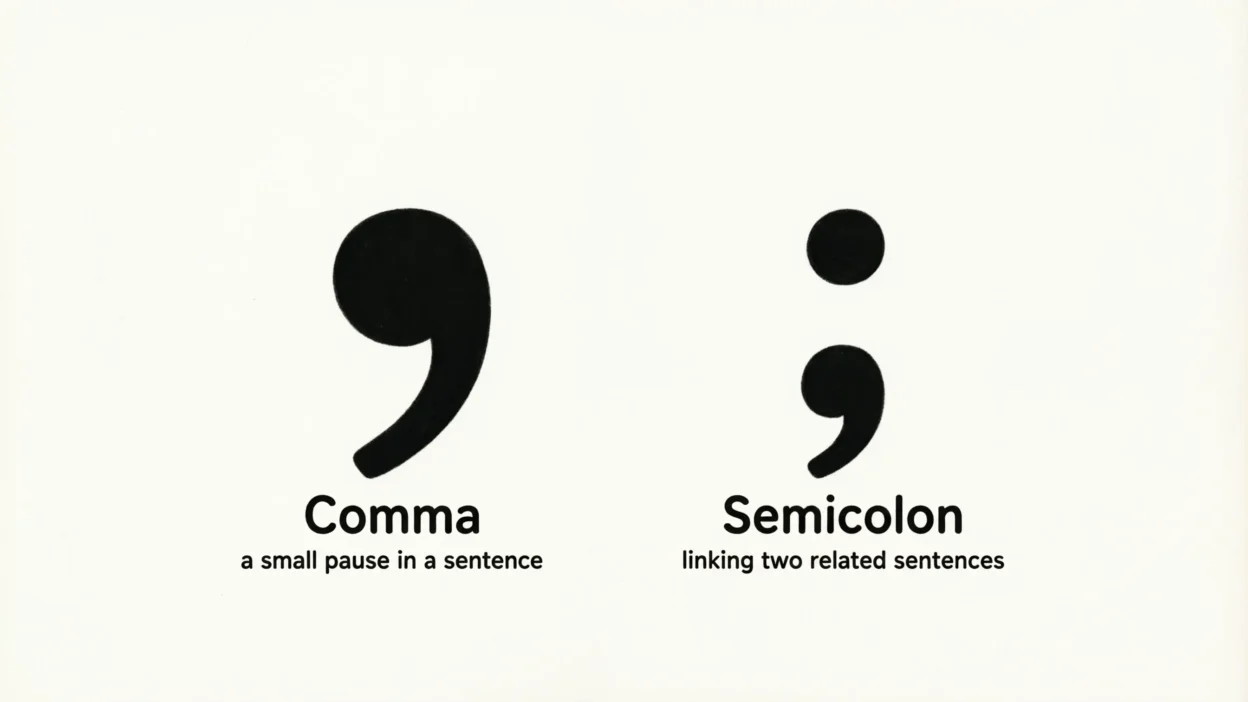
Commas ( , ) and semicolons ( ; ) are both punctuation marks, but they serve different purposes in writing.
The key idea: light pause vs strong connection.
Quick Answer
- ✅ Comma (,) – Small pause, separates items or clauses
- ✅ Semicolon (;) – Stronger pause, links closely related sentences
- ✏️ Remember: Comma = light break, Semicolon = strong link
Clear Explanation
What Does a Comma Do?
A comma creates a short pause and helps organize sentences.
👉 Common uses:
1. In Lists
- I bought apples, bananas, and oranges.
2. With Introductory Words
- After dinner, we went out.
3. Between Clauses (with conjunctions)
- I was tired, so I went to bed.
4. Extra Information
- My brother, who lives abroad, is visiting.
What Does a Semicolon Do?
A semicolon creates a stronger pause than a comma but weaker than a period.
👉 Common uses:
1. Link Related Sentences
- I was tired; I went to bed.
👉 (Both parts could be full sentences)
2. Before Conjunctive Adverbs
- I was tired; however, I kept working.
- She studied hard; therefore, she passed.
3. In Complex Lists
- I visited Lahore, Pakistan; Delhi, India; and Dubai, UAE.
👉 (Used when items already contain commas)
Key Difference
| Feature | Comma (,) | Semicolon (;) |
|---|---|---|
| Pause | Short | Longer |
| Function | Separate | Connect |
| Strength | Weak | Strong |
| Example | Apples, bananas | I came; I saw |
Which One to Use and When
Use a Comma When:
- Making lists
- Adding extra information
- Joining clauses with and, but, so
Examples:
- She is kind, smart, and funny.
- After lunch, we left.
- I was late, so I hurried.
- He, my best friend, helped me.
- We laughed, talked, and relaxed.
Use a Semicolon When:
- Joining closely related sentences
- Using however, therefore, etc.
- Writing complex lists
Examples:
- It was raining; we stayed inside.
- He was tired; however, he continued.
- She studied hard; therefore, she succeeded.
- I visited Paris, France; Rome, Italy; and Berlin, Germany.
- The task was hard; we completed it anyway.
Common Mistakes People Make
1. Using Comma Instead of Semicolon
❌ I was tired, I went to bed
✅ I was tired; I went to bed
2. Overusing Semicolons
Not needed in simple sentences.
3. Forgetting Conjunction with Comma
Comma alone cannot join two full sentences.
4. Misusing in Lists
Use semicolon for complex lists only.
5. Ignoring Sentence Structure
Check if clauses are complete.
Easy Memory Trick
👉 Comma = small pause
👉 Semicolon = “in-between” (stronger than comma, weaker than period)
Practice Exercise
Fill in the blanks:
- I bought apples____ bananas, and grapes.
- I was tired____ I went to sleep.
- He was late____ however, he finished.
Answers:
- ,
- ;
- ;
Quick Quiz
- I was hungry____ so I ate.
a) ,
b) ; - It was late____ we went home.
a) ;
b) ,
Correct Answers:
- a) ,
- a) ;
Conclusion
The difference between comma and semicolon is about strength and purpose. A comma creates a small pause, while a semicolon connects closely related ideas.
👉 Comma = light separation
👉 Semicolon = strong connection

Michael Anderson is a professional editor and senior contributor with a background in long-form content and strategic writing. He focuses on quality, structure, and credibility across all publications. Michael brings years of experience in content development and ensures high editorial standards for every project.