Many learners search for “setup vs set up” because they look almost the same. The only difference is a space but that space changes the grammar and meaning.
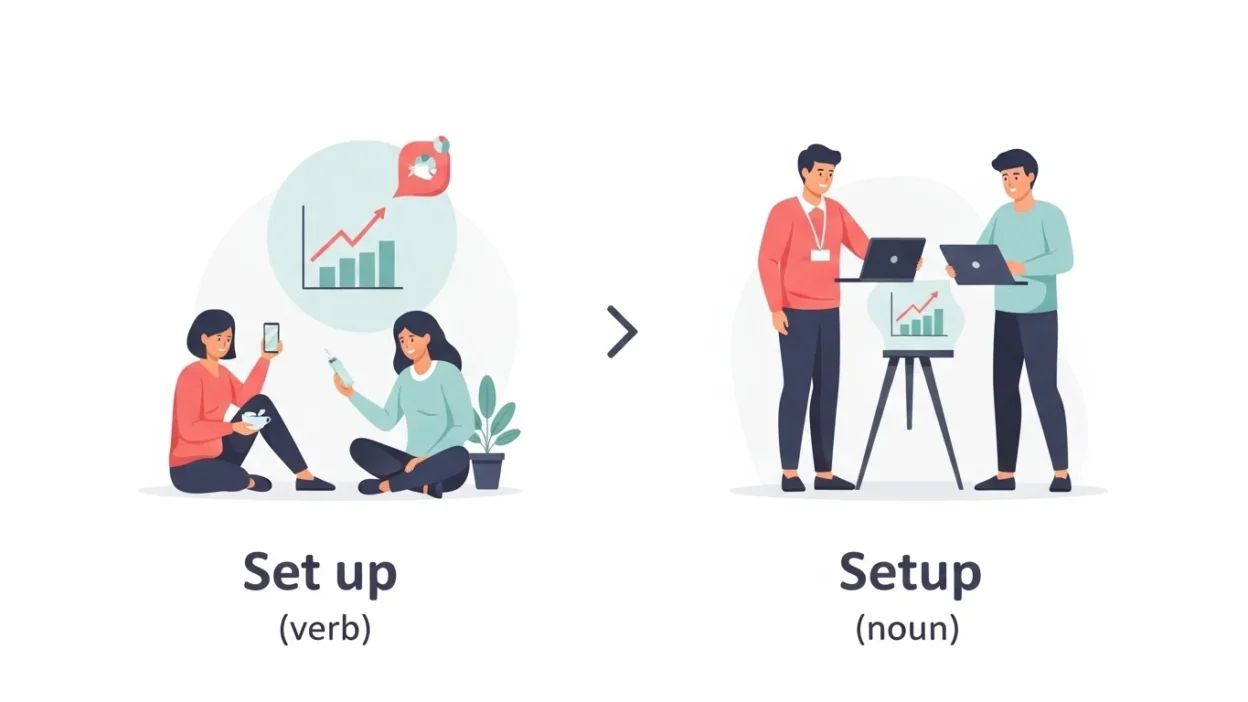
The key idea: one is a noun/adjective, the other is a verb.
Quick Answer
- ✅ Setup – Noun or adjective (a thing or arrangement)
- ✅ Set up – Verb (an action)
- ❌ They are not interchangeable
- ✏️ Remember: Action = two words, Thing = one word
Clear Explanation of the Difference
What Does “Set Up” Mean?
Set up is a verb phrase.
👉 It means:
- to arrange something
- to prepare something
- to install or organize
Examples:
- I will set up the computer.
- She set up the meeting.
- They are setting up the event.
- He set up a new business.
- We need to set up the system.
What Does “Setup” Mean?
Setup is a noun (and sometimes an adjective).
👉 It means:
- an arrangement or system
- the way something is organized
Examples:
- The setup is simple.
- I like your desk setup.
- This is a good setup.
- The setup took hours.
- He showed his gaming setup.
Comparison Table
| Feature | Set up | Setup |
|---|---|---|
| Type | Verb | Noun / Adjective |
| Meaning | Action (arrange, prepare) | Thing or arrangement |
| Usage | Before an object | As a subject or object |
| Example | I will set up the system. | The setup is ready. |
Which One to Use and When
Use “Set Up” When:
- You are describing an action
- You can replace it with “arrange” or “prepare”
Examples:
- I will set up the meeting.
- Please set up the equipment.
- They set up the stage.
- She is setting up her room.
- He set up the account.
Use “Setup” When:
- You are naming a thing or system
- You are describing an arrangement
Examples:
- The setup looks great.
- This setup is easy to use.
- I changed my setup.
- The setup is complete.
- He has a professional setup.
Common Mistakes People Make
1. Using One Word for Action
❌ I will setup the system
✅ I will set up the system
2. Using Two Words for a Thing
❌ The set up is ready
✅ The setup is ready
3. Not Knowing Word Type
Verb vs noun confusion causes errors.
4. Ignoring Context
Meaning depends on sentence use.
5. Fast Typing Errors
Spacing mistakes are common.
Everyday Real-Life Examples
Technology
- “I will set up the computer.”
- “The setup is modern.”
Work
- “Let’s set up a meeting.”
- “The office setup is nice.”
Events
- “They set up the stage.”
- “The setup was impressive.”
Gaming
- “He set up his PC.”
- “His gaming setup is amazing.”
Daily Life
- “I need to set up my room.”
- “The room setup is clean.”
Short Learning Section for Students and Beginners
Easy Rule to Remember
- Set up = action (verb)
- Setup = thing (noun)
Memory Tip
“Two words = do something, One word = something.”
Practice Exercise
Fill in the blanks:
- I will ______ the system.
- The ______ is ready.
- They will ______ the event.
Answers:
- set up
- setup
- set up
Quick Quiz
Choose the correct option:
- I will ______ the meeting.
a) Setup
b) Set up - The ______ is complete.
a) Setup
b) Set up
Correct Answers:
- b) Set up
- a) Setup
Frequently Asked Questions (FAQs)
1. Is “setup” one word?
Yes, when used as a noun or adjective.
2. Is “set up” a verb?
Yes, it is a verb phrase.
3. Can they be used the same way?
No, they have different roles.
4. Is this a common mistake?
Yes, very common.
5. How do I know which to use?
Check if it’s an action or a thing.
6. Can “setup” be an adjective?
Yes, like “setup process.”
7. Is spacing important?
Yes, it changes meaning.
8. How can I remember it?
Remember: Two words = action.
Conclusion
The difference between “setup” and “set up” is simple but important. Set up is a verb used for actions, while setup is a noun used for things or arrangements.
To stay correct, remember:
👉 Set up = action
👉 Setup = thing
This will help you write clearly and confidently every time.

Daniel Brooks is a technology and business writer with experience covering innovation, startups, and digital tools. His work emphasizes clarity, accuracy, and real-world application. Daniel aims to help readers understand emerging technologies and make informed decisions in a fast-changing digital landscape.