
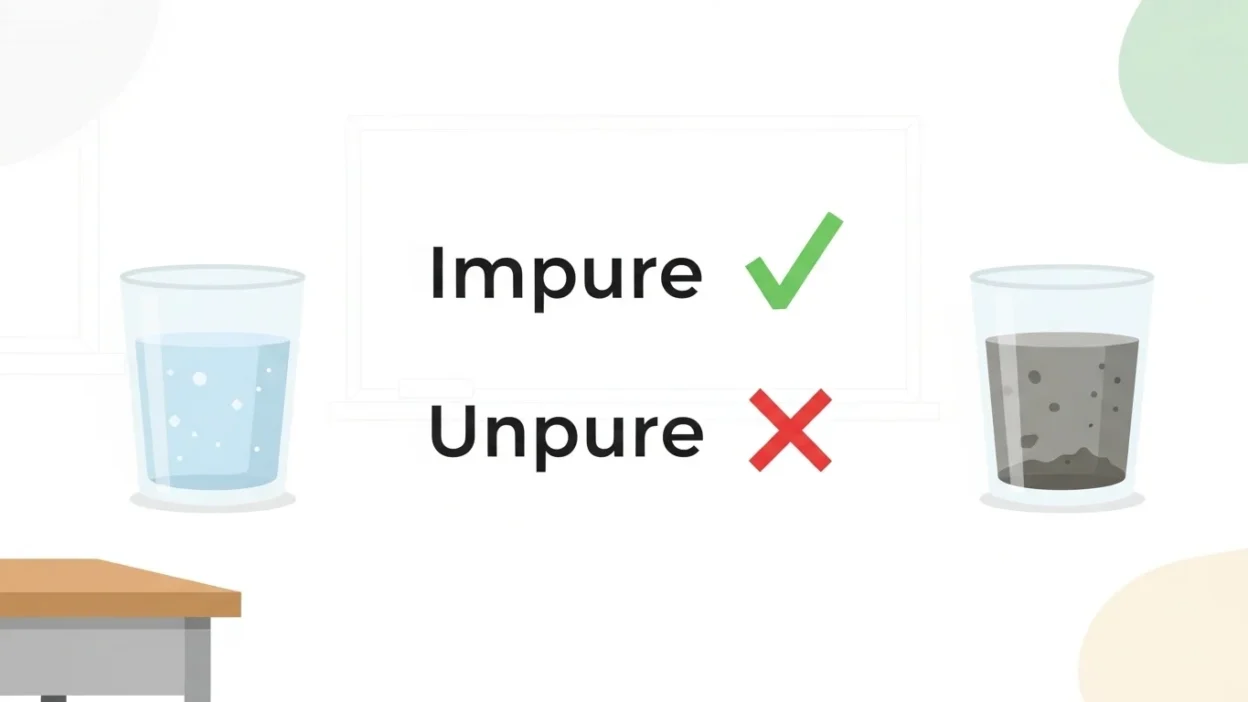
Many learners search for “unpure vs impure” because both forms seem possible. English often uses prefixes like “un-” and “im-” to make negative words. This can make it confusing to choose the correct form.
However, in this case, only one word is standard and widely accepted. This guide explains the difference in very simple English so you can understand it easily and use the correct word with confidence.
Quick Answer
Here is the clear and simple answer:
- ✅ Impure – Correct and standard word; means not pure.
- ❌ Unpure – Incorrect or extremely rare; not used in standard English.
- 📚 Always use impure in writing and speech.
- ✏️ Remember: Use “im-” with “pure,” not “un-.”
Origin and Background
The word pure means “clean,” “not mixed,” or “free from anything unwanted.”
To make it negative, English does not use “un-” here. Instead, it uses the prefix “im-,” which comes from Latin.
- Pure → Impure
Why “Im-”?
In English, the prefix “in-” changes to “im-” before certain letters like p, b, and m.
Examples:
- Possible → Impossible
- Balance → Imbalance
- Pure → Impure
This is why impure is the correct form.
Clear Explanation of the Difference
What Does “Impure” Mean?
Impure is an adjective. It describes something that is not clean, not perfect, or mixed with unwanted elements.
Common Meanings
- Not Clean or Mixed
- The water is impure and unsafe to drink.
- Not Morally Good
- The story describes impure thoughts.
- Not Perfect or Not Original
- The metal is impure because it contains other substances.
What About “Unpure”?
Unpure is not a standard English word. It is considered incorrect or extremely rare and should not be used in normal writing.
❌ Unpure
✅ Impure
Even though “un-” is a common prefix, it does not work with pure in standard usage.
Comparison Table
| Feature | Impure | Unpure |
|---|---|---|
| Spelling | Correct | Incorrect |
| Meaning | Not pure | Not accepted in standard English |
| Part of Speech | Adjective | Not standard |
| Usage | Formal and informal English | Avoid using |
| Dictionary Recognition | Yes | Rare or none |
| Example Sentence | The air is impure. | ❌ The air is unpure. |
Which One to Use and When
Use “Impure” When:
- Describing something not clean or mixed
- Talking about water, air, or materials
- Writing essays, reports, or emails
- Discussing moral or abstract ideas
Examples:
- The water became impure after pollution.
- This metal is impure.
- The air in the city is impure.
- He had impure intentions.
- The sample is impure and needs testing.
Avoid “Unpure”
Never use unpure, as it is not correct in standard English.
Common Mistakes People Make
1. Using the Wrong Prefix
People add “un-” instead of “im-.”
❌ Unpure
✅ Impure
2. Assuming All Words Use “Un-”
Not every word uses the “un-” prefix.
3. Not Knowing Prefix Rules
The prefix changes depending on the first letter of the word.
4. Spelling Based on Guesswork
Learners may guess the form without checking.
5. Lack of Practice
Less exposure to the correct word leads to mistakes.
Everyday Real-Life Examples
Emails
- “The sample appears impure.”
- “The air quality is impure in this area.”
School and Education
- “Students learned about impure substances.”
- “The experiment showed impure results.”
Workplace Communication
- “The material is impure and cannot be used.”
- “Impure data can affect results.”
News and Media
- “The water supply is impure.”
- “Impure fuel caused engine problems.”
Daily Conversations
- “This water looks impure.”
- “The air feels impure today.”
Short Learning Section for Students and Beginners
Easy Rule to Remember
Use “im-” before words starting with “p.”
Memory Tip
“Pure → Impure (not Unpure).”
Pronunciation Guide
- Impure: im-PYOOR
Practice Exercise
Fill in the blanks with the correct word:
- The water is ______.
- This metal is ______.
- The air feels ______ today.
Answers:
- impure
- impure
- impure
Quick Quiz
Choose the correct option:
- The sample is ______.
a) Unpure
b) Impure - The air is ______.
a) Impure
b) Unpure
Correct Answers:
- b) Impure
- a) Impure
Frequently Asked Questions (FAQs)
1. Is “unpure” a correct word?
No, it is not standard English.
2. What is the correct word?
The correct word is impure.
3. What does “impure” mean?
It means not clean or mixed with unwanted elements.
4. Why do we use “im-” instead of “un-”?
Because of English prefix rules based on Latin origins.
5. Is “impure” used in formal writing?
Yes, it is used in both formal and informal contexts.
6. Can “impure” describe moral ideas?
Yes, it can describe thoughts or intentions.
7. How do you pronounce “impure”?
It is pronounced as im-PYOOR.
8. How can I remember the correct form?
Remember: Pure becomes Impure, not Unpure.
Conclusion
The difference between “unpure” and “impure” is very simple. Impure is the correct and standard word, while unpure is incorrect and should not be used.
To avoid mistakes, remember this easy rule:
👉 Use “im-” with “pure.”
Learning this will help you write clearly, correctly, and confidently in everyday and academic English.

Sophia Reynolds is a digital writer and researcher with a focus on modern trends, productivity, and online education. She enjoys exploring new ideas and presenting them in a simple, reader-friendly way. Sophia is committed to creating informative and trustworthy content that helps audiences stay informed and inspired.