
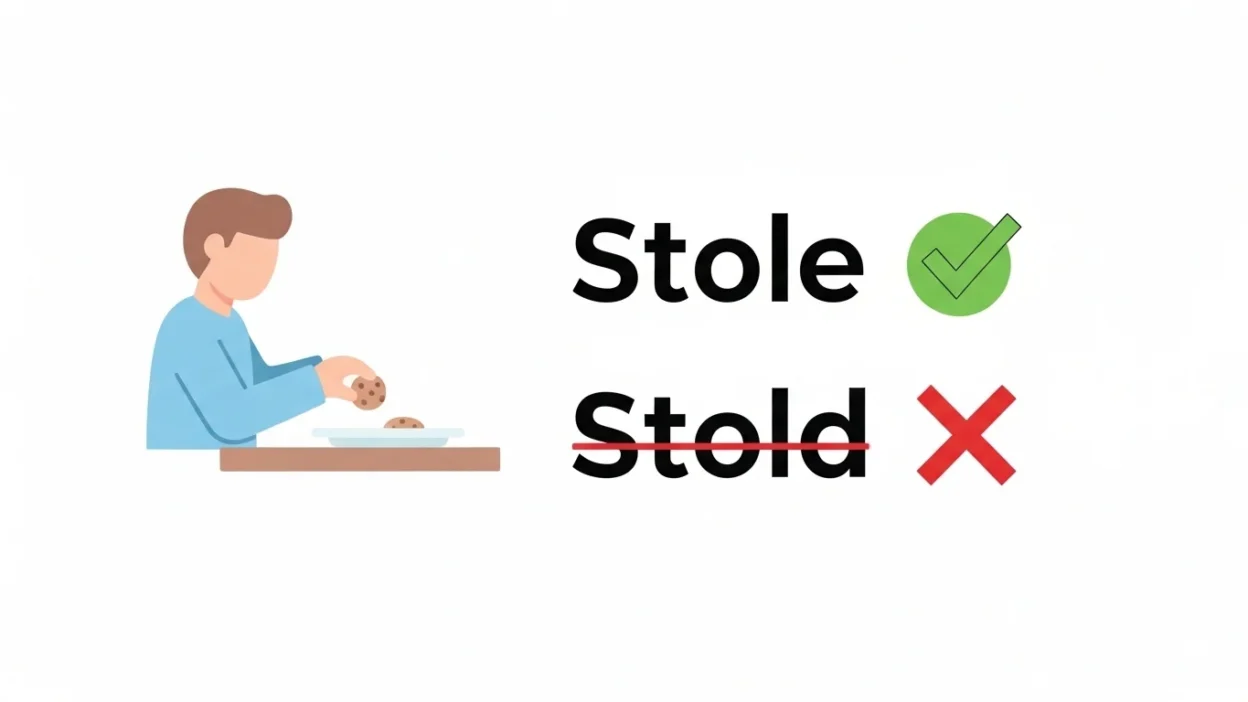
Many learners search for “stold vs stole” because both forms look possible. The confusion happens because English verbs do not always follow one simple rule. Some verbs are irregular, so they change form in a special way.
In this case, one word is correct, and the other is a common mistake.
Quick Answer
Here is the clear and simple answer:
- ✅ Stole – Correct past tense of steal
- ❌ Stold – Incorrect spelling
- 📚 Always use stole in writing
- ✏️ Remember: Steal → Stole (not stold)
Origin and Background
The verb steal means to take something that does not belong to you without permission.
It is an irregular verb, so it does not follow the normal “-ed” rule.
- Steal → Stole → Stolen
This is why “stold” is incorrect.
Clear Explanation of the Difference
What Does “Stole” Mean?
Stole is the past tense of steal. It means someone took something without permission in the past.
Examples:
- He stole my pen.
- She stole the money.
- Someone stole my phone.
- The thief stole a bag.
- They stole the car.
What About “Stold”?
Stold is not a correct English word. It is a spelling mistake caused by trying to add “-ed” to “steal.”
❌ Stold
✅ Stole
You should never use stold in proper writing.
Comparison Table
| Feature | Stole | Stold |
|---|---|---|
| Spelling | Correct | Incorrect |
| Meaning | Past of “steal” | No meaning in English |
| Verb Type | Irregular verb | Incorrect form |
| Usage | Formal and informal English | Considered a spelling error |
| Example | He stole my wallet. | ❌ He stold my wallet. |
Which One to Use and When
Use “Stole” When:
- Talking about past actions of stealing
- Writing stories or news
- Describing events
Examples:
- He stole the money.
- She stole my idea.
- They stole a car.
- Someone stole my bag.
- The thief stole jewelry.
Avoid “Stold”
Never use stold, as it is always incorrect.
Common Mistakes People Make
1. Adding “-ed” to Irregular Verbs
People think all verbs follow the same rule.
❌ Stold
✅ Stole
2. Guessing the Past Form
Learners guess instead of learning irregular forms.
3. Spelling Based on Sound
“Stold” may sound similar in fast speech.
4. Typing Too Quickly
Fast typing can lead to errors.
5. Not Practicing Verb Forms
Irregular verbs need practice.
Everyday Real-Life Examples
Daily Conversations
- “Someone stole my bike.”
- “He stole my lunch.”
News and Media
- “The thief stole jewelry.”
- “They stole a car.”
School and Stories
- “In the story, the villain stole gold.”
- “The character stole something valuable.”
Social Media
- “Someone stole my idea!”
- “He stole my joke.”
Workplace
- “He stole company data.”
- “They stole important files.”
Short Learning Section for Students and Beginners
Easy Rule to Remember
Steal → Stole → Stolen
Memory Tip
“No -ed → use stole.”
Pronunciation Guide
- Stole: STOHL
Practice Exercise
Fill in the blanks:
- He ______ my phone.
- Someone ______ the bag.
- They ______ the car.
Answers:
- stole
- stole
- stole
Quick Quiz
Choose the correct option:
- He ______ my wallet.
a) Stold
b) Stole - Someone ______ the money.
a) Stole
b) Stold
Correct Answers:
- b) Stole
- a) Stole
Frequently Asked Questions (FAQs)
1. Is “stold” correct?
No, it is incorrect.
2. What is the correct past tense of “steal”?
The correct form is stole.
3. What does “stole” mean?
It means took something without permission in the past.
4. Why do people write “stold”?
Because they think verbs take “-ed.”
5. Is “stole” used in formal writing?
Yes, it is used everywhere.
6. How do you pronounce “stole”?
It is pronounced STOHL.
7. Is “steal” a regular verb?
No, it is irregular.
8. How can I remember it?
Remember: Steal → Stole → Stolen.
Conclusion
The difference between “stold” and “stole” is simple. Stole is the correct past tense of steal, while stold is incorrect and should never be used.
To avoid mistakes, remember this easy rule:
👉 Steal → Stole → Stolen (not stold).
Using the correct form will help you write clearly, confidently, and correctly in all situations.

Michael Anderson is a professional editor and senior contributor with a background in long-form content and strategic writing. He focuses on quality, structure, and credibility across all publications. Michael brings years of experience in content development and ensures high editorial standards for every project.