Many English learners confuse “abstain” and “refrain” because both words involve choosing not to do something. However, they are used in different situations and carry slightly different meanings and tones.
The key idea: formal avoidance vs personal restraint.
Understanding the difference between these words will help you improve your English vocabulary, grammar, and writing skills.
Quick Answer
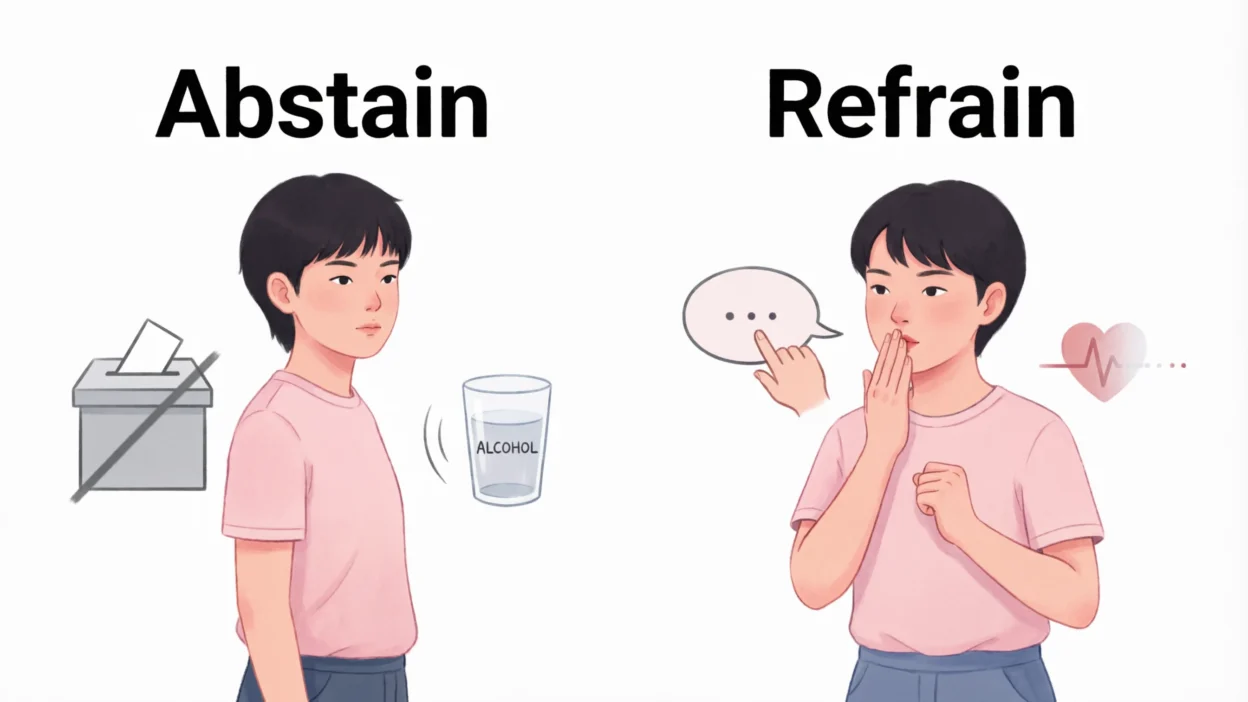
- ✅ Abstain – To formally or intentionally avoid something
- ✅ Refrain – To stop yourself from doing or saying something
- ✏️ Remember: Abstain = formally avoid, Refrain = hold back
Clear Explanation
What Does “Abstain” Mean?
Abstain is a verb.
👉 It means:
- to deliberately avoid doing something
- to choose not to participate
- to stay away from something intentionally
Examples:
- He abstained from voting.
- She abstains from alcohol.
- Several members abstained during the election.
- Doctors advised him to abstain from smoking.
- They abstained from making public comments.
👉 “Abstain” is commonly used in:
- politics
- religion
- health
- formal discussions
Common Uses of “Abstain”
1. Abstain From Voting
This is one of the most common uses.
Examples:
- Three members abstained from the vote.
- She chose to abstain during the election.
👉 Meaning:
They chose not to vote.
2. Abstain From Certain Foods or Activities
Used in health or religious contexts.
Examples:
- He abstains from meat.
- She abstains from sugary drinks.
- They abstained from smoking.
👉 Meaning:
They intentionally avoid those things.
3. Abstain for Moral or Religious Reasons
Examples:
- Many people abstain during fasting periods.
- The group abstains from alcohol for religious reasons.
What Does “Refrain” Mean?
Refrain is also a verb.
👉 It means:
- to hold yourself back
- to avoid saying or doing something
- to exercise self-control
Examples:
- Please refrain from shouting.
- He refrained from criticizing her.
- She refrained from laughing.
- Visitors should refrain from touching the artwork.
- I refrained from answering immediately.
👉 “Refrain” emphasizes:
- self-control
- restraint
- stopping yourself intentionally
Common Uses of “Refrain”
1. Refrain From Speaking or Commenting
Examples:
- Please refrain from rude remarks.
- He refrained from arguing.
- She refrained from making negative comments.
👉 Meaning:
The person controlled themselves and did not speak or react.
2. Refrain From Actions
Examples:
- Please refrain from smoking indoors.
- Students should refrain from cheating.
- Visitors must refrain from touching exhibits.
👉 Meaning:
Avoid performing those actions.
3. Polite Instructions
“Refrain” often appears in formal notices.
Examples:
- Please refrain from using mobile phones.
- Passengers should refrain from standing near the doors.
Key Difference
| Feature | Abstain | Refrain |
|---|---|---|
| Meaning | Formally avoid something | Hold yourself back |
| Tone | Formal/official | Personal restraint |
| Common Contexts | Voting, religion, health | Speech, behavior, reactions |
| Example | Abstain from voting | Refrain from speaking |
Which One to Use and When
Use “Abstain” When:
- Talking about official decisions
- Referring to deliberate avoidance
- Discussing religion, politics, or health
Examples:
- Abstain from alcohol
- Abstain from voting
- Abstain from smoking
- Abstain from participation
- Abstain from unhealthy food
Example Sentences:
- The senator abstained from the final vote.
- She abstains from caffeine.
- Many members abstained during the discussion.
Use “Refrain” When:
- Talking about self-control
- Avoiding actions or speech
- Giving polite instructions
Examples:
- Refrain from shouting
- Refrain from criticism
- Refrain from touching
- Refrain from interrupting
- Refrain from arguing
Example Sentences:
- Please refrain from making noise.
- He refrained from reacting emotionally.
- She refrained from making rude remarks.
Common Mistakes People Make
1. Using “Abstain” for Everyday Small Actions
❌ Please abstain from talking loudly
✅ Please refrain from talking loudly
👉 “Refrain” sounds more natural here.
2. Using “Refrain” for Official Voting
❌ He refrained from voting
✅ He abstained from voting
👉 “Abstain” is the standard voting term.
3. Confusing Formality Levels
“Abstain” sounds more formal and official.
4. Forgetting Common Collocations
Some phrases naturally prefer one word.
Examples:
- abstain from voting
- refrain from speaking
5. Ignoring Tone Differences
“Refrain” often sounds more polite and controlled.
Easy Memory Trick
👉 Abstain = avoid officially
👉 Refrain = restrain yourself
Think:
- abstain from voting
- refrain from shouting
Real-Life Examples
Correct Use of “Abstain”
- Several delegates abstained from voting.
- He abstains from alcohol completely.
- She abstained for personal reasons.
Correct Use of “Refrain”
- Please refrain from using your phone.
- He refrained from making angry comments.
- She refrained from laughing during the speech.
Practice Exercise
Fill in the blanks:
- Several members ______ from the vote.
- Please ______ from making noise.
- He decided to ______ from smoking.
- She ______ from responding immediately.
Answers:
- abstained
- refrain
- abstain
- refrained
Quick Quiz
- Which word is commonly used with voting?
a) Refrain
b) Abstain - Which word emphasizes self-control?
a) Abstain
b) Refrain - Which phrase sounds correct?
a) Refrain from voting
b) Abstain from voting
Correct Answers:
- b) Abstain
- b) Refrain
- b) Abstain from voting
Why This Confusion Happens
The confusion happens because both words involve:
- avoiding actions
- self-control
- choosing not to do something
However:
- abstain is more formal and official
- refrain focuses more on restraint and behavior
Helpful Tip for Better Writing
If you mean:
- officially avoid participation → use abstain
- stop yourself from acting or speaking → use refrain
Conclusion
The difference between “abstain” and “refrain” is mainly about context and tone. Abstain usually means formally avoiding participation or certain activities, while refrain means holding yourself back from saying or doing something.
👉 Abstain = formally avoid
👉 Refrain = hold yourself back
Learning this distinction will help you use English more naturally and accurately in formal and everyday situations.

Daniel Brooks is a technology and business writer with experience covering innovation, startups, and digital tools. His work emphasizes clarity, accuracy, and real-world application. Daniel aims to help readers understand emerging technologies and make informed decisions in a fast-changing digital landscape.