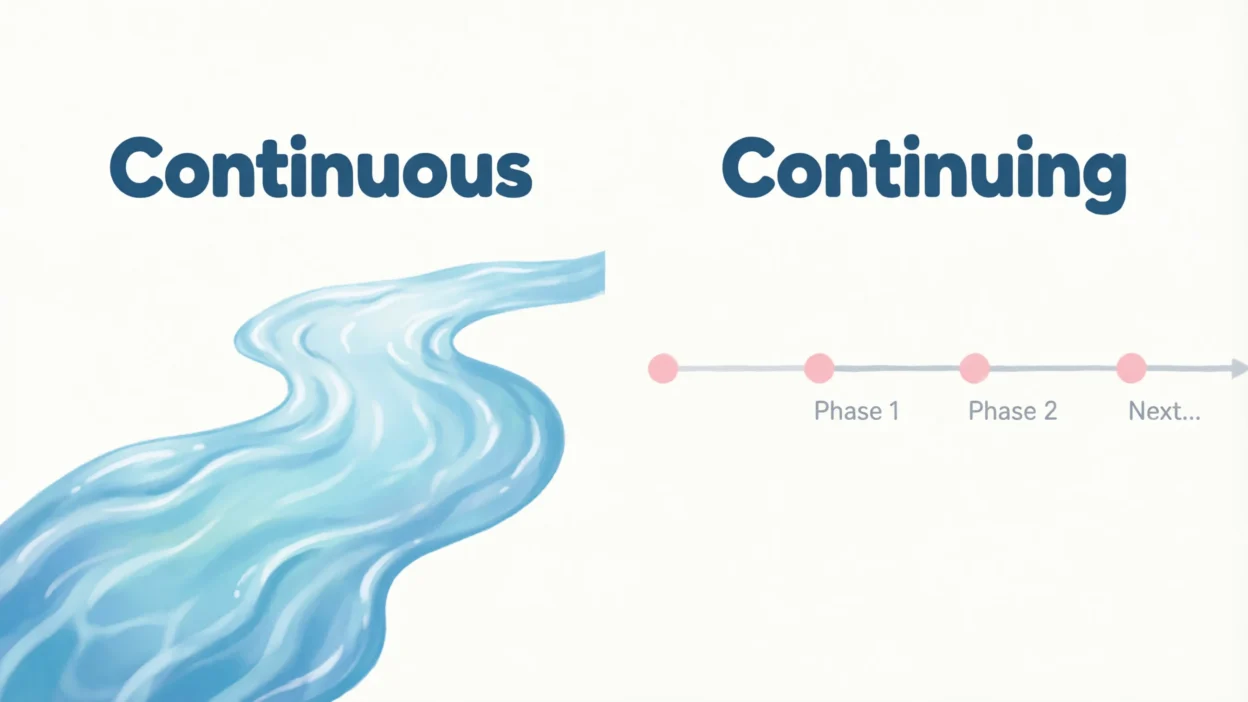
Many English learners confuse “continuous” and “continuing” because both words describe things that happen over time. Although they are related, they are not used in exactly the same way.
The key idea: continuous means nonstop, while continuing means still ongoing.
Understanding this difference will help you improve your grammar, vocabulary, speaking, and writing skills.
Quick Answer
- ✅ Continuous – Happening without interruption or stopping
- ✅ Continuing – Still happening, ongoing, or carrying on over time
- ✏️ Remember: Continuous = nonstop, Continuing = ongoing
Clear Explanation
What Does “Continuous” Mean?
Continuous is an adjective.
👉 It means:
- uninterrupted
- constant
- happening without pauses or breaks
Examples:
- The machine made a continuous noise.
- We experienced continuous rain all day.
- The alarm produced a continuous sound.
- Continuous pressure damaged the pipe.
- She worked in continuous silence.
👉 “Continuous” focuses on:
- no interruption
- no stopping
- constant activity
Common Uses of “Continuous”
1. Continuous Sound
- continuous buzzing
- continuous music
- continuous noise
Example:
- The fan made a continuous humming sound.
2. Continuous Motion
- continuous movement
- continuous operation
Example:
- The factory runs on continuous production.
3. Continuous Pressure or Stress
- continuous pressure
- continuous stress
Example:
- Continuous heat weakened the material.
What Does “Continuing” Mean?
Continuing is usually an adjective or the present participle form of the verb continue.
👉 It means:
- still happening
- ongoing
- carrying on over time
Examples:
- The company faces continuing challenges.
- We appreciate your continuing support.
- Continuing education helps professionals improve.
- The discussion is continuing online.
- There is continuing interest in the topic.
👉 “Continuing” focuses on:
- something not finished yet
- something that keeps happening over time
Common Uses of “Continuing”
1. Continuing Support
- continuing assistance
- continuing cooperation
Example:
- Thank you for your continuing help.
2. Continuing Education
- continuing studies
- continuing training
Example:
- Doctors often complete continuing education courses.
3. Continuing Problems or Efforts
- continuing investigation
- continuing issues
Example:
- The city faces continuing traffic problems.
Key Difference
| Feature | Continuous | Continuing |
|---|---|---|
| Meaning | Without stopping | Still ongoing |
| Focus | No interruptions | Ongoing over time |
| Type | Adjective | Adjective/verb form |
| Example | Continuous rain | Continuing discussion |
Which One to Use and When
Use “Continuous” When:
- Something happens nonstop
- There are no breaks or interruptions
Examples:
- Continuous noise
- Continuous operation
- Continuous movement
- Continuous rain
- Continuous pressure
Example Sentences:
- The road experienced continuous traffic.
- Continuous vibration damaged the machine.
- We heard continuous thunder all night.
Use “Continuing” When:
- Something keeps happening over time
- The action or situation is still active
Examples:
- Continuing support
- Continuing education
- Continuing discussion
- Continuing problems
- Continuing efforts
Example Sentences:
- The investigation is continuing.
- She thanked everyone for their continuing support.
- Continuing improvements increased sales.
Common Mistakes People Make
1. Using “Continuous” for General Ongoing Situations
❌ Continuous support from customers
✅ Continuing support from customers
👉 Support happens over time, not nonstop every second.
2. Using “Continuing” for Nonstop Action
❌ Continuing noise all night without stopping
✅ Continuous noise all night without stopping
👉 The sound had no interruption.
3. Ignoring the “No Pause” Meaning
“Continuous” strongly suggests:
- no breaks
- no interruptions
4. Confusing Adjective and Verb Forms
“Continuing” may act as:
- adjective
- verb form
Example:
- The meeting is continuing.
5. Mixing Formal and Informal Usage
Business and academic English often use:
- continuing education
- continuing support
- continuing operations
Continuous vs Continual
People also confuse:
- continuous
- continual
Difference:
- Continuous = nonstop
- Continual = repeated frequently with pauses
Examples:
- Continuous rain = rain never stopped
- Continual rain = rain stopped and started repeatedly
Easy Memory Trick
👉 Continuous = constant/no breaks
👉 Continuing = still happening
Think:
- continuous sound = nonstop
- continuing project = ongoing
Real-Life Examples
Correct Use of “Continuous”
- The patient required continuous monitoring.
- The machine stayed in continuous operation.
- Continuous snowfall covered the roads.
Correct Use of “Continuing”
- The school offers continuing education programs.
- We appreciate your continuing patience.
- The talks are continuing this week.
Practice Exercise
Fill in the blanks:
- The speaker heard ______ applause without stopping.
- The company faces ______ challenges.
- There was ______ traffic noise all night.
- We appreciate your ______ support.
Answers:
- continuous
- continuing
- continuous
- continuing
Quick Quiz
- Which word means “without interruption”?
a) Continuing
b) Continuous - Which word means “still ongoing”?
a) Continuous
b) Continuing - Which phrase sounds correct?
a) Continuous support
b) Continuing support
Correct Answers:
- b) Continuous
- b) Continuing
- b) Continuing support
Why This Confusion Happens
The confusion happens because:
- both words come from “continue”
- both involve time and duration
- both describe ongoing situations
However:
- continuous focuses on no interruption
- continuing focuses on something still happening
Helpful Tip for Better Writing
If you mean:
- nonstop → use continuous
- ongoing over time → use continuing
Conclusion
The difference between “continuous” and “continuing” is mainly about interruption and duration. Continuous describes something nonstop and uninterrupted, while continuing describes something that is still ongoing over time.
👉 Continuous = nonstop
👉 Continuing = ongoing

Michael Anderson is a professional editor and senior contributor with a background in long-form content and strategic writing. He focuses on quality, structure, and credibility across all publications. Michael brings years of experience in content development and ensures high editorial standards for every project.