Many learners search for “elude vs allude” because the words look and sound similar. However, they have very different meanings.
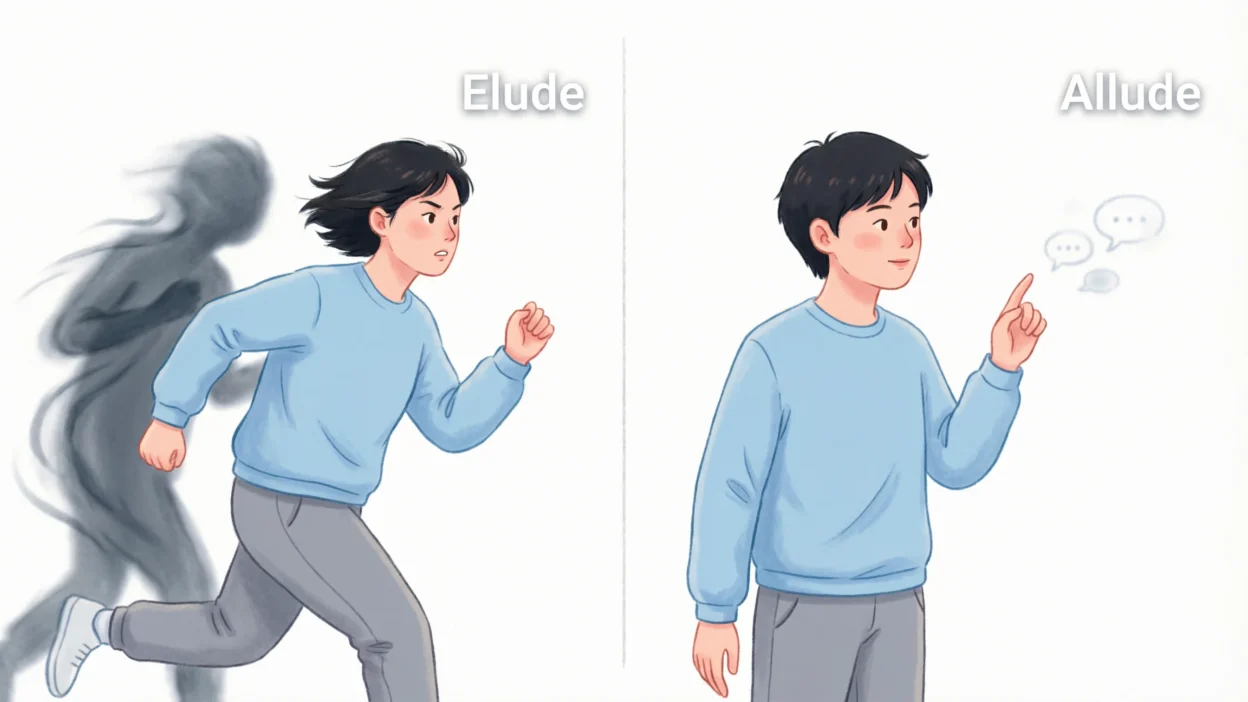
The key idea: one is about escaping, the other is about hinting.
Quick Answer
- ✅ Elude – To escape or avoid something
- ✅ Allude – To refer to something indirectly
- ✏️ Remember: Elude = escape, Allude = hint
Clear Explanation of the Difference
What Does “Elude” Mean?
Elude means to escape from or avoid something, often cleverly.
👉 It can be used for:
- avoiding capture
- escaping understanding
Examples:
- The thief eluded the police.
- The answer eluded me.
- He managed to elude capture.
- The solution keeps eluding her.
- She eluded all questions.
What Does “Allude” Mean?
Allude means to refer to something indirectly.
👉 It is used when:
- you hint at something
- you mention something without saying it directly
Examples:
- He alluded to his past.
- She alluded to a problem.
- The speaker alluded to history.
- He didn’t say it, but he alluded to it.
- The book alludes to real events.
Comparison Table
| Feature | Elude | Allude |
|---|---|---|
| Meaning | Escape / avoid | Hint / refer indirectly |
| Usage | Avoiding something | Mentioning indirectly |
| Context | Action or difficulty | Communication |
| Example | Elude capture | Allude to a topic |
Which One to Use and When
Use “Elude” When:
- Talking about escaping or avoiding
- Something is hard to catch or understand
Examples:
- He eluded the guards.
- The idea eluded me.
- They eluded capture.
- The answer keeps eluding him.
- She eluded the question.
Use “Allude” When:
- Talking about hinting or indirect reference
- Mentioning something without saying it clearly
Examples:
- He alluded to a secret.
- She alluded to her past.
- The writer alludes to history.
- He alluded to the issue.
- They alluded to a solution.
Common Mistakes People Make
1. Mixing the Two Words
They look similar but mean different things.
2. Using “Elude” for Talking
❌ He eluded to the problem
✅ He alluded to the problem
3. Using “Allude” for Escaping
❌ He alluded the police
✅ He eluded the police
4. Not Knowing Context
Meaning depends on usage.
5. Ignoring Verb Patterns
“Allude” is often followed by to.
Everyday Real-Life Examples
Escape Situations
- “He eluded the police.”
- “The answer eluded me.”
Communication
- “She alluded to a problem.”
- “He alluded to the past.”
Conversations
- “The meaning eluded me.”
- “He alluded to something important.”
School
- “The student alluded to history.”
- “The concept eluded many students.”
Daily Life
- “Sleep eluded me.”
- “She alluded to her feelings.”
Short Learning Section for Students and Beginners
Easy Rule to Remember
- Elude = escape
- Allude = hint
Memory Tip
“A for allude = address (mention)”
“E for elude = escape”
Practice Exercise
Fill in the blanks:
- The thief ______ the police.
- He ______ to a secret.
- The answer ______ me.
Answers:
- eluded
- alluded
- eluded
Quick Quiz
Choose the correct option:
- He ______ to the problem.
a) Eluded
b) Alluded - The answer ______ me.
a) Alluded
b) Eluded
Correct Answers:
- b) Alluded
- b) Eluded
Frequently Asked Questions (FAQs)
1. What does “elude” mean?
It means to escape or avoid.
2. What does “allude” mean?
It means to hint or refer indirectly.
3. Can they be used the same way?
No, they have different meanings.
4. Is this a common mistake?
Yes, very common.
5. Which one is used with “to”?
Allude (allude to something).
6. Which one means escape?
Elude.
7. How can I remember it?
E = escape, A = address (hint).
8. Is context important?
Yes, very important.
Conclusion
The difference between “elude” and “allude” is simple. Elude means to escape or avoid, while allude means to refer to something indirectly.
To avoid mistakes, remember:
👉 Elude = escape
👉 Allude = hint
This will help you use both words correctly and confidently.

Michael Anderson is a professional editor and senior contributor with a background in long-form content and strategic writing. He focuses on quality, structure, and credibility across all publications. Michael brings years of experience in content development and ensures high editorial standards for every project.