Many learners search for “any time vs anytime” because both forms look similar and sound the same. The difference is small but important.
The key idea: one is a phrase, the other is a single-word adverb.
Quick Answer
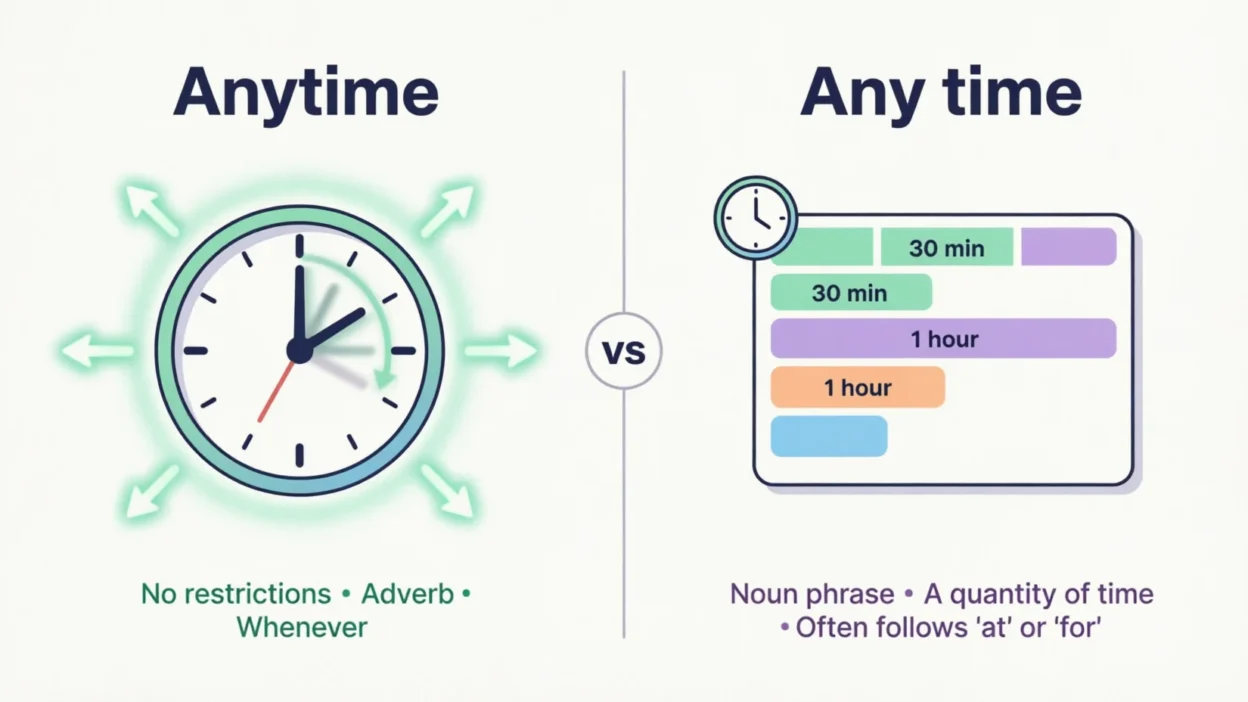
- ✅ Any time – Two words (noun phrase; refers to a specific amount of time)
- ✅ Anytime – One word (adverb; means “whenever”)
- ✏️ Remember: Anytime = whenever, Any time = amount of time
Clear Explanation of the Difference
What Does “Any Time” Mean?
Any time (two words) is a noun phrase.
👉 It means:
- an amount of time
- used when referring to time as a thing
Often used after prepositions like at, in, or for.
Examples:
- Do you have any time to talk?
- I don’t have any time today.
- You can call me at any time.
- She didn’t spend any time studying.
- We don’t have any time left.
What Does “Anytime” Mean?
Anytime (one word) is an adverb.
👉 It means:
- whenever
- at any moment
It does not need a preposition.
Examples:
- You can call me anytime.
- Come anytime you want.
- I’m available anytime.
- Visit us anytime.
- You can start anytime.
Comparison Table
| Feature | Any time | Anytime |
|---|---|---|
| Type | Noun phrase | Adverb |
| Meaning | Amount of time | Whenever |
| Needs preposition | Often yes | No |
| Example | At any time | Come anytime |
Which One to Use and When
Use “Any Time” When:
- Referring to time as a noun
- Using prepositions like at, in, for
Examples:
- I don’t have any time.
- Call me at any time.
- She didn’t spend any time here.
- We need more time.
- He doesn’t have any time left.
Use “Anytime” When:
- You mean whenever
- No preposition is used
Examples:
- Call me anytime.
- Come anytime you like.
- I’m free anytime.
- Visit anytime.
- Start anytime.
Quick Trick to Test
👉 Add a preposition:
- If the sentence needs “at” → use any time
- If not → use anytime
Example:
- Call me at any time ✔
- Call me anytime ✔
Common Mistakes People Make
1. Using “Anytime” After Prepositions
❌ At anytime
✅ At any time
2. Using “Any Time” Without Need
❌ Come any time (less natural)
✔ Come anytime
3. Mixing Forms
They follow different grammar rules.
4. Ignoring Word Type
Adverb vs noun confusion.
5. Writing Based on Sound
They sound identical.
Everyday Real-Life Examples
Conversations
- “Call me anytime.”
- “Call me at any time.”
Daily Life
- “I don’t have any time.”
- “I’m free anytime.”
Work
- “Reach out at any time.”
- “Contact me anytime.”
School
- “You can ask anytime.”
- “Do you have any time?”
Social Situations
- “Visit anytime.”
- “Visit at any time.”
Short Learning Section for Students and Beginners
Easy Rule to Remember
- Anytime = whenever
- Any time = amount of time
Memory Tip
“One word = quick (anytime), two words = time (any time)”
Practice Exercise
Fill in the blanks:
- Call me ______.
- I don’t have ______ today.
- You can come ______.
Answers:
- anytime
- any time
- anytime
Quick Quiz
Choose the correct option:
- You can call me ______.
a) Any time
b) Anytime - I don’t have ______ to help.
a) Anytime
b) Any time
Correct Answers:
- b) Anytime
- b) Any time
Frequently Asked Questions (FAQs)
1. Is “anytime” one word?
Yes, when used as an adverb.
2. Is “any time” two words?
Yes, when referring to time as a noun.
3. Can they be used the same way?
No, they follow different rules.
4. Which is more common?
Both are common in different contexts.
5. Is this a common mistake?
Yes, very common.
6. Can I say “at anytime”?
No, it should be “at any time.”
7. Which is easier to remember?
“Anytime = whenever.”
8. How can I remember it?
Remember: one word = whenever.
Conclusion
The difference between “any time” and “anytime” is simple once you know the rule. Anytime is an adverb meaning “whenever,” while any time is a noun phrase referring to an amount of time.
To avoid mistakes, remember:
👉 Anytime = whenever
👉 Any time = time
This will help you use both forms correctly and confidently.

Michael Anderson is a professional editor and senior contributor with a background in long-form content and strategic writing. He focuses on quality, structure, and credibility across all publications. Michael brings years of experience in content development and ensures high editorial standards for every project.