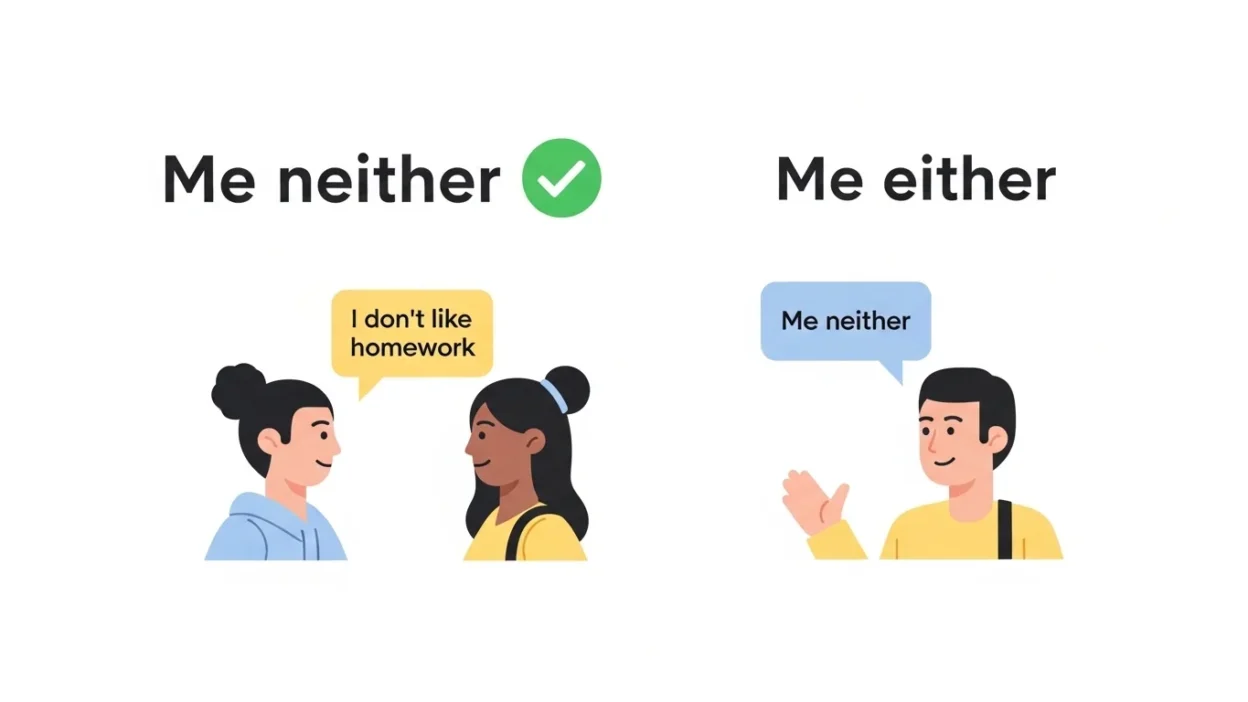
Many learners search for “me either vs me neither” because both are used to agree with negative statements. The confusion comes from informal vs formal usage.
The key idea: both can be correct, but not in the same way.
Quick Answer
- ✅ Me neither – Standard and grammatically correct
- ⚠️ Me either – Informal but very common in speech
- ✏️ Remember: Neither = proper negative agreement
Clear Explanation of the Difference
What Does “Me Neither” Mean?
Me neither is the standard, grammatically correct response to a negative statement.
👉 It means:
- “I also do not”
- agreeing with a negative sentence
Examples:
- “I don’t like coffee.” → “Me neither.”
- “I can’t swim.” → “Me neither.”
- “I’m not ready.” → “Me neither.”
- “I don’t understand.” → “Me neither.”
- “I don’t want it.” → “Me neither.”
What Does “Me Either” Mean?
Me either is informal, but widely used in spoken English.
👉 It also means:
- “I don’t either”
Examples:
- “I don’t like tea.” → “Me either.”
- “I can’t go.” → “Me either.”
- “I don’t want it.” → “Me either.”
👉 In formal writing, it’s better to use “me neither.”
Comparison Table
| Feature | Me neither | Me either |
|---|---|---|
| Correctness | Standard | Informal |
| Usage | Formal + informal | Mostly spoken |
| Meaning | I also don’t | I also don’t |
| Example | Me neither. | Me either. |
Which One to Use and When
Use “Me Neither” When:
- Writing formally
- Speaking correctly in exams or professional settings
Examples:
- “I don’t like it.” → “Me neither.”
- “I can’t help.” → “Me neither.”
- “I’m not going.” → “Me neither.”
- “I don’t know.” → “Me neither.”
- “I didn’t see it.” → “Me neither.”
Use “Me Either” When:
- Speaking casually
- In informal conversations
Examples:
- “I don’t like it.” → “Me either.”
- “I can’t go.” → “Me either.”
- “I don’t want that.” → “Me either.”
Better (Full) Forms
For clearer grammar, use full sentences:
- Neither do I ✔
- I don’t either ✔
Examples:
- “I don’t like it.” → “Neither do I.”
- “I can’t swim.” → “I can’t either.”
Common Mistakes People Make
1. Using “Me Either” in Formal Writing
❌ Me either (formal writing)
✅ Me neither
2. Mixing Positive and Negative
❌ I like it → Me neither
✅ I like it → Me too
3. Not Understanding Context
These only respond to negative statements.
4. Overusing Informal Forms
Better to use correct structure in writing.
5. Ignoring Grammar Rules
“Neither” fits negative agreement better.
Everyday Real-Life Examples
Conversations
- “I don’t like it.” → “Me neither.”
- “I don’t like it.” → “Me either.”
Friends Talking
- “I can’t go.” → “Me either.”
- “I can’t go.” → “Me neither.”
School
- “I don’t understand.” → “Me neither.”
Work
- “I don’t agree.” → “Me neither.”
Casual Speech
- “I don’t want it.” → “Me either.”
Short Learning Section for Students and Beginners
Easy Rule to Remember
- Me neither = correct
- Me either = informal
Memory Tip
“Negative = neither.”
Practice Exercise
Fill in the blanks:
- “I don’t like it.” → “Me ______.”
- “I can’t go.” → “Me ______.”
- “I don’t understand.” → “Me ______.”
Answers:
- neither (preferred)
- neither / either (informal)
- neither
Quick Quiz
Choose the correct option:
- “I don’t like coffee.” → ______
a) Me either
b) Me neither - Which is better for formal writing?
a) Me either
b) Me neither
Correct Answers:
- b) Me neither
- b) Me neither
Frequently Asked Questions (FAQs)
1. Is “me either” correct?
It is informal but commonly used.
2. Is “me neither” correct?
Yes, it is standard English.
3. Which should I use in writing?
Use me neither.
4. Do they mean the same thing?
Yes, in casual speech.
5. Is this a common confusion?
Yes, very common.
6. Can I use both in speaking?
Yes, but “me neither” is safer.
7. What is the best formal alternative?
“Neither do I.”
8. How can I remember it?
Remember: Negative = neither.
Conclusion
The difference between “me either” and “me neither” is mainly about formality. Me neither is grammatically correct and preferred, while me either is informal but widely used in conversation.
To avoid mistakes, remember:
👉 Use “me neither” for correct English
👉 Use “me either” only in casual speech
This will help you communicate clearly and confidently.

Michael Anderson is a professional editor and senior contributor with a background in long-form content and strategic writing. He focuses on quality, structure, and credibility across all publications. Michael brings years of experience in content development and ensures high editorial standards for every project.