Many learners search for “farther vs further” because both words relate to distance and are sometimes used interchangeably. However, there is a useful distinction that helps you choose correctly.
The key idea: physical distance vs figurative distance.
Quick Answer
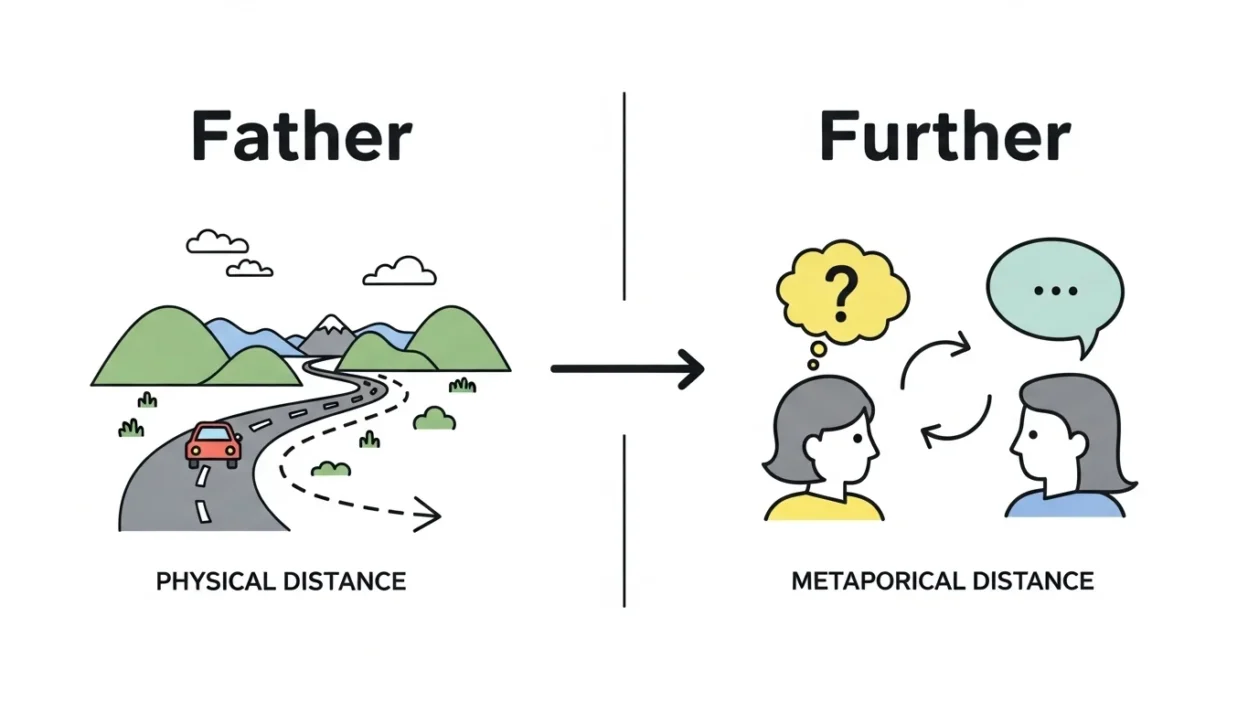
- ✅ Farther – Physical distance (measurable)
- ✅ Further – Figurative distance, degree, or more discussion
- ✏️ Remember: Far = farther, Figure = further
Clear Explanation of the Difference
What Does “Farther” Mean?
Farther is used for physical distance you can measure.
👉 Think: miles, meters, steps
Examples:
- He ran farther than me.
- The school is farther away.
- We walked farther down the road.
- She threw the ball farther.
- The store is farther than I thought.
What Does “Further” Mean?
Further is used for non-physical distance.
👉 It means:
- more or additional
- deeper level
- continuation
Examples:
- Let’s discuss this further.
- I need further information.
- She wants to study further.
- We will go further into the topic.
- No further questions.
Comparison Table
| Feature | Farther | Further |
|---|---|---|
| Meaning | Physical distance | Figurative / abstract |
| Usage | Measurable space | Ideas, time, degree |
| Example | Walk farther | Discuss further |
Which One to Use and When
Use “Farther” When:
- Talking about real, physical distance
- You can measure it
Examples:
- He ran farther than before.
- The park is farther away.
- We traveled farther this time.
- She moved farther down the street.
- The ball went farther.
Use “Further” When:
- Talking about ideas, time, or degree
- Meaning “more” or “additional”
Examples:
- We need further details.
- Let’s talk further.
- She studied further.
- I have no further questions.
- He explained it further.
Important Note
In modern English, “further” is often used for both meanings, especially in casual usage.
✔ But for accuracy:
- Use farther for physical distance
- Use further for everything else
Common Mistakes People Make
1. Using “Further” for Distance
✔ Acceptable in casual use
✔ But “farther” is more precise
2. Not Knowing the Rule
Many learners don’t learn the distinction.
3. Mixing Both in Writing
Consistency is important.
4. Ignoring Context
Meaning depends on situation.
5. Overthinking It
Simple rule works in most cases.
Everyday Real-Life Examples
Travel
- “We walked farther.”
- “The destination is farther.”
Study and Work
- “We need further research.”
- “Let’s go further.”
Conversations
- “Explain further.”
- “Can you walk farther?”
School
- “Further information is needed.”
- “The school is farther away.”
Daily Life
- “Drive farther.”
- “Think further.”
Short Learning Section for Students and Beginners
Easy Rule to Remember
- Farther = distance
- Further = more/extra
Memory Tip
“Far = farther, Figure = further.”
Practice Exercise
Fill in the blanks:
- He ran ______ than me.
- We need ______ details.
- The shop is ______ away.
Answers:
- farther
- further
- farther
Quick Quiz
Choose the correct option:
- The house is ______ away.
a) Further
b) Farther - I need ______ explanation.
a) Farther
b) Further
Correct Answers:
- b) Farther
- b) Further
Frequently Asked Questions (FAQs)
1. What does “farther” mean?
It means physical distance.
2. What does “further” mean?
It means more or additional.
3. Can they be used the same way?
Sometimes, but not always.
4. Which is more common?
Further is more commonly used.
5. Is this a common mistake?
Yes, very common.
6. Can I use “further” for distance?
Yes, but “farther” is more precise.
7. How can I remember it?
Remember: Far = farther.
8. Should I worry too much about it?
No, just follow the basic rule.
Conclusion
The difference between “farther” and “further” is simple when you follow the rule. Farther is used for physical distance, while further is used for abstract ideas or additional information.
To avoid mistakes, remember:
👉 Farther = distance
👉 Further = more
This will help you write clearly and confidently.

Michael Anderson is a professional editor and senior contributor with a background in long-form content and strategic writing. He focuses on quality, structure, and credibility across all publications. Michael brings years of experience in content development and ensures high editorial standards for every project.