
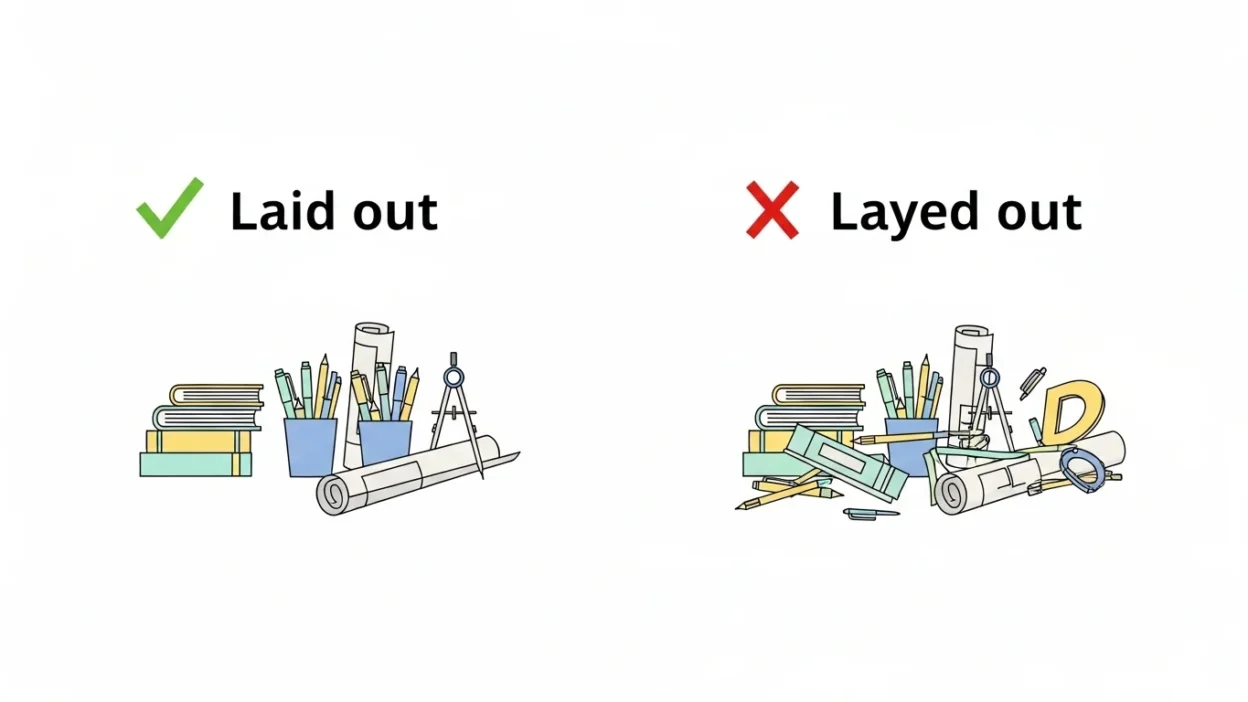
Many learners search for “laid out vs layed out” because of confusion with the verb “lay.” Since many verbs take “-ed” in the past tense, people often assume “layed” is correct—but it’s not.
The key idea: “lay” is irregular.
Quick Answer
- ✅ Laid out – Correct past tense of lay out
- ❌ Layed out – Incorrect spelling
- ✏️ Remember: Lay → Laid (never layed)
Clear Explanation of the Difference
What Does “Laid Out” Mean?
Laid out is the correct past form of the phrasal verb “lay out.”
👉 It means:
- to arrange something
- to spread something out
- to explain something clearly
Examples:
- She laid out the clothes.
- He laid out the plan.
- They laid out the tools.
- The teacher laid out the rules.
- I laid everything out on the table.
What About “Layed Out”?
❌ Layed out is not correct in standard English.
👉 It is a common spelling mistake caused by adding “-ed” incorrectly.
Why Is It “Laid,” Not “Layed”?
The verb lay is irregular:
- Present: lay
- Past: laid
- Past participle: laid
There is no form “layed.”
Comparison Table
| Feature | Laid out | Layed out |
|---|---|---|
| Spelling | Correct | Incorrect |
| Meaning | Arranged / spread | No meaning |
| Usage | Standard English | Error |
| Example | She laid out the plan. | ❌ She layed out the plan. |
Which One to Use and When
Use “Laid Out” When:
- Talking about arranging or organizing
- Referring to past actions
Examples:
- She laid out the documents.
- He laid out the plan clearly.
- They laid out the tools.
- I laid out my clothes.
- The teacher laid out the instructions.
Avoid “Layed Out”
Never use layed out—it is always incorrect.
Common Mistakes People Make
1. Adding “-ed” to “Lay”
❌ Layed
✅ Laid
2. Confusing Regular and Irregular Verbs
“Lay” does not follow normal patterns.
3. Writing Based on Sound
Pronunciation leads to spelling errors.
4. Mixing with “Played”
Not all verbs behave the same.
5. Lack of Practice
Repetition helps avoid mistakes.
Everyday Real-Life Examples
Daily Life
- “She laid out her clothes.”
- “I laid out everything.”
Work
- “He laid out the plan.”
- “They laid out the strategy.”
School
- “The teacher laid out the rules.”
- “Instructions were laid out clearly.”
Conversations
- “I laid it out for you.”
- “She laid out all the options.”
Short Learning Section for Students and Beginners
Easy Rule to Remember
Lay → Laid (never layed)
Memory Tip
“Paid, said, laid → same pattern.”
Practice Exercise
Fill in the blanks:
- She ______ out the clothes.
- He ______ out the plan.
- They ______ out the tools.
Answers:
- laid
- laid
- laid
Quick Quiz
Choose the correct option:
- She ______ out the documents.
a) Layed
b) Laid - He ______ out the strategy.
a) Laid
b) Layed
Correct Answers:
- b) Laid
- a) Laid
Frequently Asked Questions (FAQs)
1. Is “layed out” correct?
No, it is incorrect.
2. What is the correct phrase?
The correct phrase is laid out.
3. What does “laid out” mean?
It means arranged or explained.
4. Why do people write “layed”?
Because they think all verbs take “-ed.”
5. Is “lay” irregular?
Yes, it becomes laid.
6. Is this a common mistake?
Yes, very common.
7. Can I use “layed” anywhere?
No, not in standard English.
8. How can I remember it?
Remember: Lay → Laid.
Conclusion
The difference between “laid out” and “layed out” is simple. Laid out is the correct past form of lay out, while layed out is incorrect and should never be used.
To stay accurate, remember:
👉 Lay → Laid (not layed)
This will help you write clearly and correctly every time.

Daniel Brooks is a technology and business writer with experience covering innovation, startups, and digital tools. His work emphasizes clarity, accuracy, and real-world application. Daniel aims to help readers understand emerging technologies and make informed decisions in a fast-changing digital landscape.