Many learners search for “laid off vs layed off” because the verb “lay” has irregular forms. This makes it easy to spell the past tense incorrectly.
The key idea: only one spelling is correct.
Quick Answer
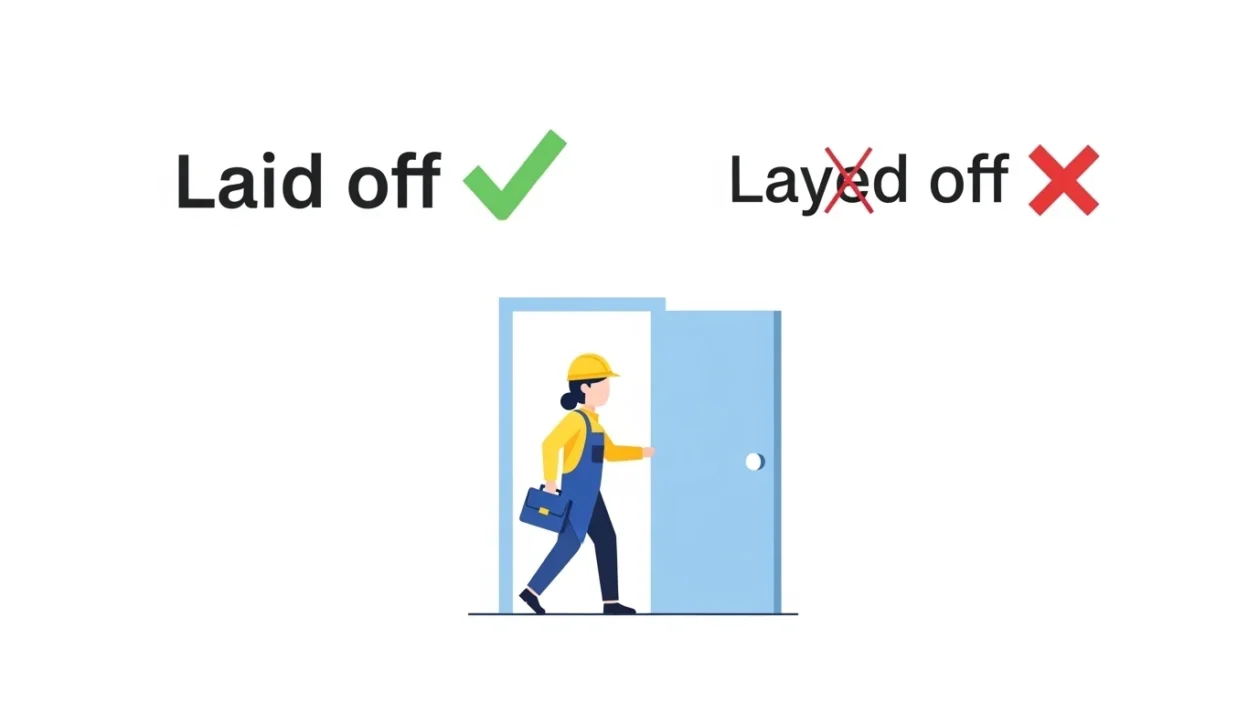
- ✅ Laid off – Correct phrase; past tense of lay off
- ❌ Layed off – Incorrect spelling
- ✏️ Remember: Lay → Laid (not layed)
Clear Explanation of the Difference
What Does “Laid Off” Mean?
Laid off is the correct past form of the phrasal verb “lay off.”
👉 It means:
- to lose a job (usually temporarily or due to business reasons)
Examples:
- He was laid off last month.
- Many workers were laid off.
- She got laid off from her job.
- The company laid off employees.
- They were laid off due to budget cuts.
What About “Layed Off”?
Layed off is not correct English.
❌ Layed off
✅ Laid off
👉 The correct past tense of lay is laid, not layed.
Why Is It “Laid,” Not “Layed”?
The verb lay is irregular:
- Present: lay
- Past: laid
- Past participle: laid
There is no form “layed.”
Comparison Table
| Feature | Laid off | Layed off |
|---|---|---|
| Spelling | Correct | Incorrect |
| Meaning | Lost job | No meaning |
| Verb form | Past tense | Invalid form |
| Example | He was laid off. | ❌ He was layed off. |
Which One to Use and When
Use “Laid Off” When:
- Talking about losing a job
- Using past tense of lay off
Examples:
- She was laid off yesterday.
- He got laid off from work.
- They were laid off last year.
- The company laid off staff.
- Many people were laid off.
Avoid “Layed Off”
Never use layed off, as it is always incorrect.
Common Mistakes People Make
1. Adding “-ed” to “Lay”
❌ Layed
✅ Laid
2. Confusing with “Played”
People assume similar patterns.
3. Not Knowing Irregular Verbs
“Lay” is irregular.
4. Writing Based on Sound
Pronunciation leads to wrong spelling.
5. Typing Too Quickly
Spelling errors happen fast.
Everyday Real-Life Examples
Work and Jobs
- “He was laid off.”
- “They were laid off last year.”
News
- “Workers were laid off.”
- “The company laid off staff.”
Conversations
- “I got laid off.”
- “She was laid off recently.”
Business
- “The firm laid off employees.”
- “Many were laid off due to cuts.”
Short Learning Section for Students and Beginners
Easy Rule to Remember
Lay → Laid (never layed)
Memory Tip
“Paid, said, laid → same pattern.”
Practice Exercise
Fill in the blanks:
- He was ______ off last month.
- The company ______ off workers.
- She got ______ off.
Answers:
- laid
- laid
- laid
Quick Quiz
Choose the correct option:
- He was ______ off.
a) Layed
b) Laid - They were ______ off last year.
a) Laid
b) Layed
Correct Answers:
- b) Laid
- a) Laid
Frequently Asked Questions (FAQs)
1. Is “layed off” correct?
No, it is incorrect.
2. What is the correct phrase?
The correct phrase is laid off.
3. What does “laid off” mean?
It means losing a job.
4. Why do people write “layed”?
Because they think all verbs take “-ed.”
5. Is “lay” irregular?
Yes, it becomes laid.
6. Is this a common mistake?
Yes, very common.
7. Can I use “layed” anywhere?
No, it is not standard English.
8. How can I remember it?
Remember: Lay → Laid.
Conclusion
The difference between “laid off” and “layed off” is simple. Laid off is the correct past form of lay off, while layed off is incorrect and should never be used.
To stay accurate, remember:
👉 Lay → Laid (not layed)
This will help you write clearly and correctly every time.

Michael Anderson is a professional editor and senior contributor with a background in long-form content and strategic writing. He focuses on quality, structure, and credibility across all publications. Michael brings years of experience in content development and ensures high editorial standards for every project.