Many learners search for “payed vs paid” because both look possible as past forms of pay. However, only one is correct in most everyday situations.
The confusion comes from irregular verb rules.
Quick Answer
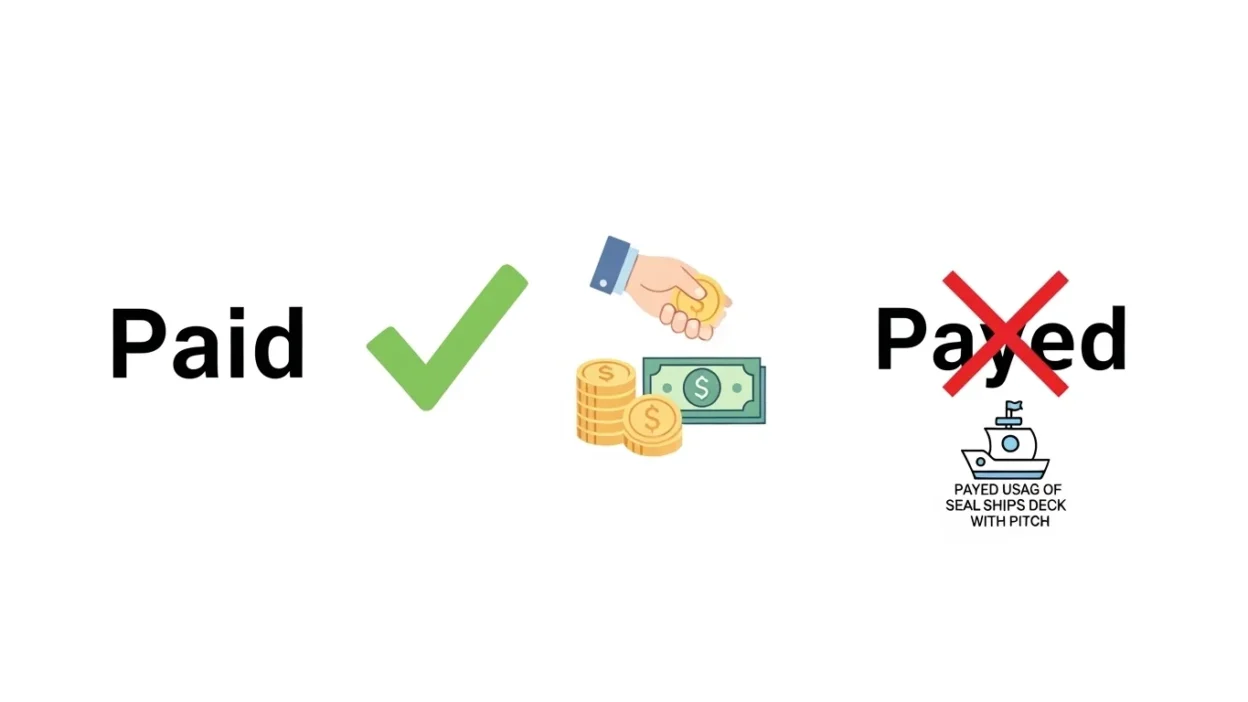
- ✅ Paid – Correct past tense of pay (money, cost, effort)
- ⚠️ Payed – Rare, used only in nautical contexts
- ❌ Do not use “payed” for money
- ✏️ Remember: Pay → Paid
Clear Explanation of the Difference
What Does “Paid” Mean?
Paid is the correct past tense and past participle of pay.
👉 It is used for:
- money
- bills
- effort or attention
Examples:
- I paid the bill.
- She paid for dinner.
- He paid a lot of money.
- They paid attention.
- We paid the price.
What Does “Payed” Mean?
Payed is a real word, but very rare.
👉 It is used in nautical (sailing) contexts, meaning:
- to seal or coat something (like a ship)
- to let out rope or cable
Examples (rare):
- The crew payed the deck with tar.
- They payed out the rope.
👉 These uses are uncommon for most learners.
Comparison Table
| Feature | Paid | Payed |
|---|---|---|
| Usage | Money, general use | Nautical only |
| Correctness | Standard English | Rare usage |
| Frequency | Very common | Very rare |
| Example | I paid the bill. | They payed the rope. |
Which One to Use and When
Use “Paid” When:
- Talking about money
- Referring to bills or costs
- Describing effort or attention
Examples:
- I paid my fees.
- She paid for the meal.
- He paid attention in class.
- They paid the rent.
- We paid the price.
Use “Payed” Only When:
- Talking about ships or ropes (very rare)
👉 Most people will never need this word.
Common Mistakes People Make
1. Using “Payed” for Money
❌ I payed the bill
✅ I paid the bill
2. Adding “-ed” to an Irregular Verb
“Pay” becomes paid, not “payed.”
3. Not Knowing Rare Exceptions
“Payed” exists but is very uncommon.
4. Writing Based on Sound
Both sound the same.
5. Ignoring Context
Context determines correctness.
Everyday Real-Life Examples
Money
- “I paid the bill.”
- “She paid for lunch.”
Work
- “They paid the workers.”
- “He paid his dues.”
School
- “I paid the fees.”
- “She paid attention.”
Conversations
- “Have you paid yet?”
- “I already paid.”
Short Learning Section for Students and Beginners
Easy Rule to Remember
Always use “paid” for money
Memory Tip
“Money = paid, not payed.”
Practice Exercise
Fill in the blanks:
- I ______ the bill.
- She ______ for dinner.
- He ______ attention.
Answers:
- paid
- paid
- paid
Quick Quiz
Choose the correct option:
- I ______ the fees.
a) Payed
b) Paid - She ______ attention.
a) Paid
b) Payed
Correct Answers:
- b) Paid
- a) Paid
Frequently Asked Questions (FAQs)
1. Is “payed” correct?
Only in rare nautical contexts.
2. What is the correct past tense of “pay”?
Paid.
3. Can I use “payed” for money?
No, it is incorrect.
4. Why is “paid” irregular?
English has many irregular verbs.
5. Is this a common mistake?
Yes, very common.
6. Will I ever use “payed”?
Probably not.
7. Which is more common?
Paid is very common.
8. How can I remember it?
Remember: Pay → Paid.
Conclusion
The difference between “payed” and “paid” is simple. Paid is the correct past tense of pay for almost all situations, while payed is a rare word used only in nautical contexts.
To avoid mistakes, remember:
👉 Always use “paid” for money
This will help you write clearly and correctly every time.

Sophia Reynolds is a digital writer and researcher with a focus on modern trends, productivity, and online education. She enjoys exploring new ideas and presenting them in a simple, reader-friendly way. Sophia is committed to creating informative and trustworthy content that helps audiences stay informed and inspired.