Many learners search for “on to vs onto” because both look similar and often appear in similar sentences. The confusion comes from spacing, but that space changes the meaning.
The key idea: movement vs continuation.
Quick Answer
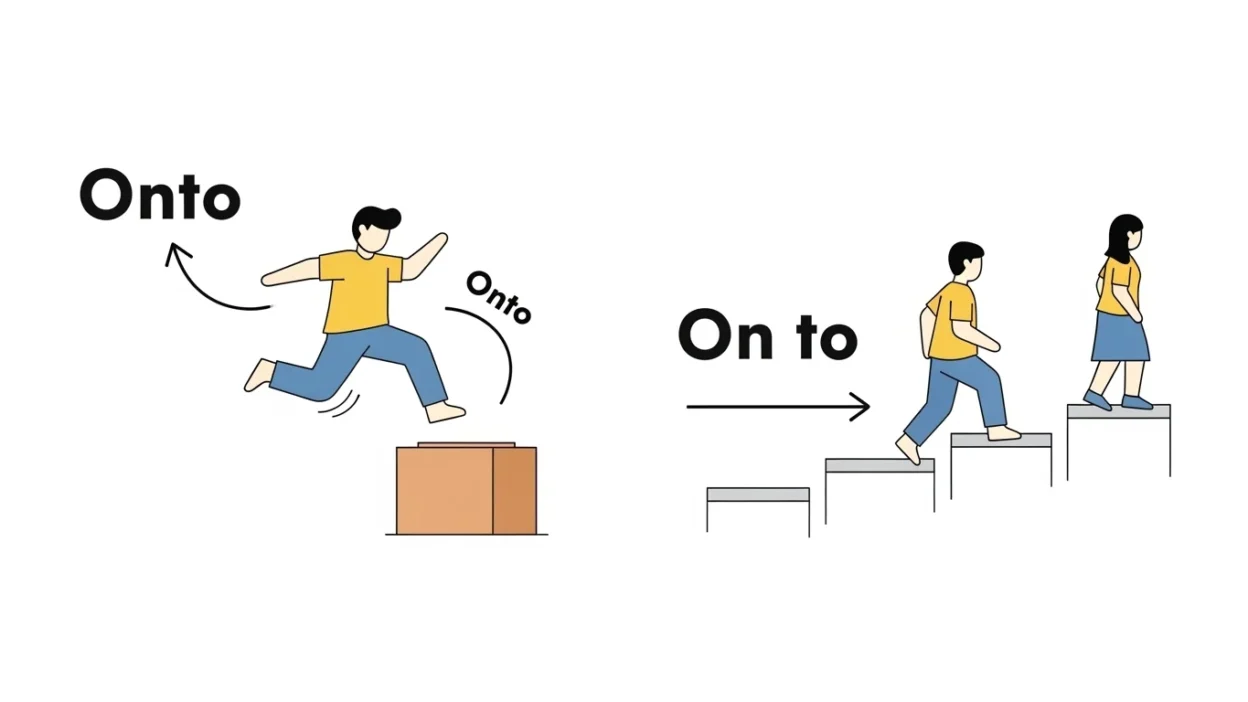
- ✅ Onto – Shows movement toward a surface
- ✅ On to – Means “onward to” or part of a verb phrase
- ❌ They are not always interchangeable
- ✏️ Remember: Onto = motion, On to = separate words
Clear Explanation of the Difference
What Does “Onto” Mean?
Onto is a preposition.
👉 It shows movement toward or on top of something
Examples:
- The cat jumped onto the table.
- He climbed onto the roof.
- She stepped onto the stage.
- The ball rolled onto the road.
- He got onto the bus.
What Does “On to” Mean?
On to is a combination of two words:
👉 It usually means:
- moving forward to the next thing
- part of a verb + preposition
Examples:
- Let’s move on to the next topic.
- She went on to become a doctor.
- We continued on to the next level.
- He held on to the rope.
- They passed it on to others.
Comparison Table
| Feature | Onto | On to |
|---|---|---|
| Type | Preposition | Verb + preposition |
| Meaning | Movement to a surface | Continue or move forward |
| Usage | Physical direction | Abstract or action phrases |
| Example | Jump onto the bed | Move on to the next task |
Which One to Use and When
Use “Onto” When:
- There is physical movement
- Something goes from one place to another surface
Examples:
- She climbed onto the chair.
- The dog jumped onto the couch.
- He stepped onto the platform.
- The book fell onto the floor.
- They moved onto the stage.
Use “On to” When:
- Talking about progress or continuation
- Using a verb phrase
Examples:
- Let’s move on to the next question.
- He went on to win the prize.
- She held on to her bag.
- We passed it on to them.
- They went on to succeed.
Quick Trick to Test
👉 Replace with “onward to”:
- If it works → use on to
- If not → use onto
Example:
- Move on to the next step → “onward to” ✔ → on to
- Jump onto the table → “onward to” ❌ → onto
Common Mistakes People Make
1. Using “Onto” for Abstract Ideas
❌ Move onto the next topic
✅ Move on to the next topic
2. Using “On to” for Movement
❌ Jump on to the table
✅ Jump onto the table
3. Ignoring Context
Meaning depends on movement vs continuation.
4. Not Using the Test Trick
“Onward to” helps identify the correct form.
5. Writing Without Checking
Small spacing errors change meaning.
Everyday Real-Life Examples
Physical Movement
- “He jumped onto the bed.”
- “She stepped onto the stage.”
Learning and Work
- “Let’s move on to the next topic.”
- “We went on to complete the task.”
Conversations
- “Hold on to this.”
- “Climb onto the ladder.”
School
- “Move on to the next question.”
- “Step onto the platform.”
Daily Life
- “Put the book onto the table.”
- “Let’s go on to the next place.”
Short Learning Section for Students and Beginners
Easy Rule to Remember
- Onto = movement
- On to = next step
Memory Tip
“One word = motion, Two words = direction in ideas.”
Practice Exercise
Fill in the blanks:
- He jumped ______ the table.
- Let’s move ______ the next topic.
- She climbed ______ the roof.
Answers:
- onto
- on to
- onto
Quick Quiz
Choose the correct option:
- Move ______ the next level.
a) Onto
b) On to - The cat jumped ______ the chair.
a) On to
b) Onto
Correct Answers:
- b) On to
- b) Onto
Frequently Asked Questions (FAQs)
1. Is “onto” one word?
Yes, and it shows movement.
2. Is “on to” two words?
Yes, and it shows continuation.
3. Can they be used the same way?
No, they have different meanings.
4. Which is more common?
Both are common in different contexts.
5. Is this a common mistake?
Yes, very common.
6. How can I test which to use?
Use the “onward to” trick.
7. Does “onto” always show movement?
Yes, usually physical movement.
8. How can I remember it?
Remember: Onto = motion.
Conclusion
The difference between “on to” and “onto” is simple once you understand the rule. Onto shows movement to a surface, while on to shows continuation or progression.
To avoid mistakes, remember:
👉 Onto = movement
👉 On to = next step
This will help you write clearly and correctly every time.