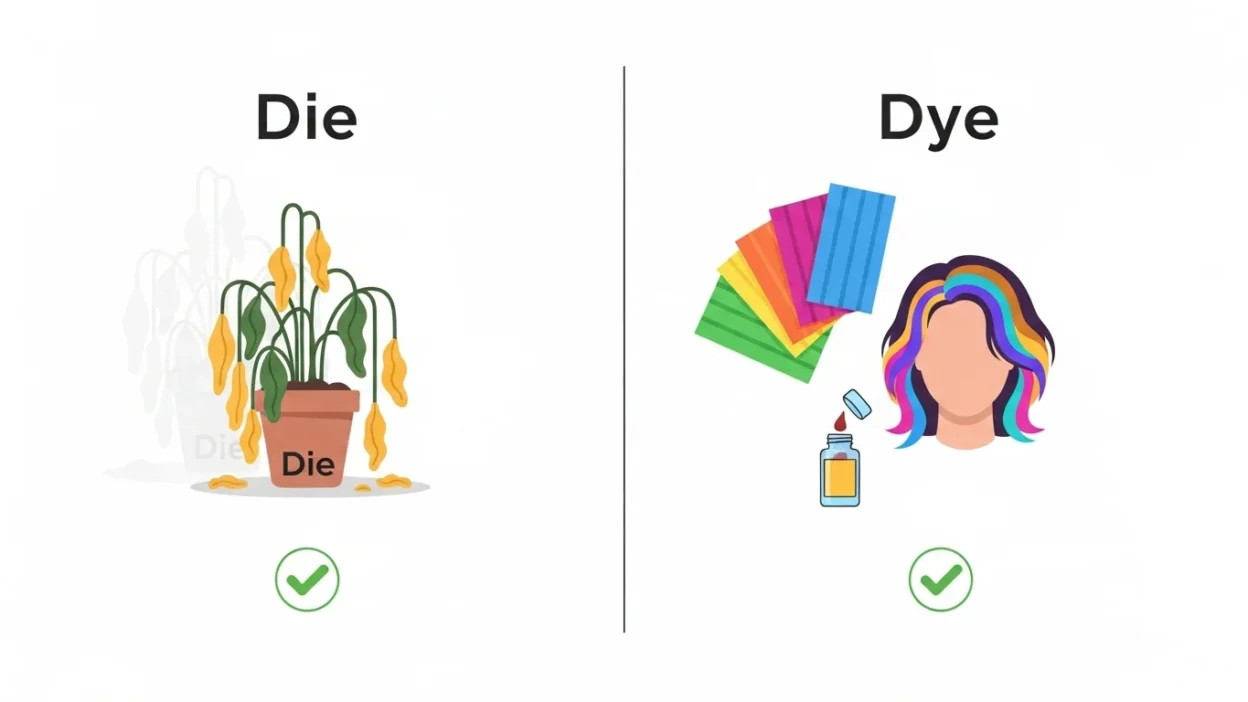
Many learners search for “die vs dye” because the words sound exactly the same. However, they have completely different meanings and uses.
The key idea: one relates to death, the other to color.
Quick Answer
- ✅ Die – To stop living / a metal tool for shaping
- ✅ Dye – A substance used to color something
- ❌ They are not interchangeable
- ✏️ Remember: Die = death, Dye = color
Clear Explanation of the Difference
What Does “Die” Mean?
1. As a Verb
👉 To stop living
Examples:
- Plants die without water.
- He didn’t want the character to die.
- Many insects die in winter.
2. As a Noun
👉 A tool used in machines to cut or shape material
Examples:
- The metal was shaped with a die.
- The factory uses a die for cutting.
What Does “Dye” Mean?
Dye is usually a noun or verb.
👉 It means:
- a substance used to change color
- the action of coloring something
Examples:
- She used dye for her hair.
- I want to dye my shirt blue.
- The fabric absorbed the dye.
- He dyed his hair black.
- They used natural dye.
Comparison Table
| Feature | Die | Dye |
|---|---|---|
| Meaning | Death / tool | Coloring substance |
| Type | Verb / Noun | Noun / Verb |
| Usage | Life, machines | Colors, fabric, hair |
| Example | Plants die quickly. | She used dye. |
Which One to Use and When
Use “Die” When:
- Talking about life or death
- Referring to a machine tool
Examples:
- Animals die.
- The character will die.
- The plant may die.
- The metal was cut with a die.
- Some insects die quickly.
Use “Dye” When:
- Talking about coloring
- Referring to hair, clothes, or fabric
Examples:
- I will dye my hair.
- She used red dye.
- The shirt was dyed blue.
- They dye fabric.
- The dye is natural.
Common Mistakes People Make
1. Mixing Similar Sounds
They sound the same but mean different things.
2. Using “Die” for Coloring
❌ I will die my hair
✅ I will dye my hair
3. Using “Dye” for Death
❌ The plant will dye
✅ The plant will die
4. Spelling Confusion
Small spelling change, big meaning difference.
5. Not Checking Context
Context decides the correct word.
Everyday Real-Life Examples
Life and Nature
- “Plants die without water.”
- “Animals die naturally.”
Fashion and Beauty
- “She dyed her hair.”
- “This dye is strong.”
Work and Industry
- “The machine uses a die.”
- “The metal is shaped with a die.”
Conversations
- “Don’t let it die.”
- “I want to dye my shirt.”
School
- “Learn correct spelling.”
- “Understand meaning from context.”
Short Learning Section for Students and Beginners
Easy Rule to Remember
- Die = death
- Dye = color
Memory Tip
“Dye has ‘y’ for color.”
Practice Exercise
Fill in the blanks:
- Plants will ______ without water.
- I want to ______ my hair.
- She used a red ______.
Answers:
- die
- dye
- dye
Quick Quiz
Choose the correct option:
- I will ______ my shirt blue.
a) Die
b) Dye - The plant may ______.
a) Dye
b) Die
Correct Answers:
- b) Dye
- b) Die
Frequently Asked Questions (FAQs)
1. What does “die” mean?
It means to stop living or a tool.
2. What does “dye” mean?
It means to color something.
3. Are they interchangeable?
No, they have different meanings.
4. Why are they confusing?
Because they sound the same.
5. Which one is used for hair?
Dye is used for hair.
6. Which one relates to death?
Die relates to death.
7. Is this a common mistake?
Yes, very common.
8. How can I remember it?
Remember: Dye = color.
Conclusion
The difference between “die” and “dye” is simple but important. Die relates to death or tools, while dye is used for coloring.
To avoid mistakes, remember:
👉 Die = death
👉 Dye = color
This will help you write clearly and correctly every time.

Emily Carter is a content writer and editor based in the United States, specializing in lifestyle, wellness, and personal development topics. With a passion for clear and engaging storytelling, she creates content that connects with readers and delivers practical value. Emily focuses on making complex ideas easy to understand and relatable.