Many learners search for “awhile vs a while” because both forms look almost the same. The only difference is a space but that space changes how the word works in a sentence.
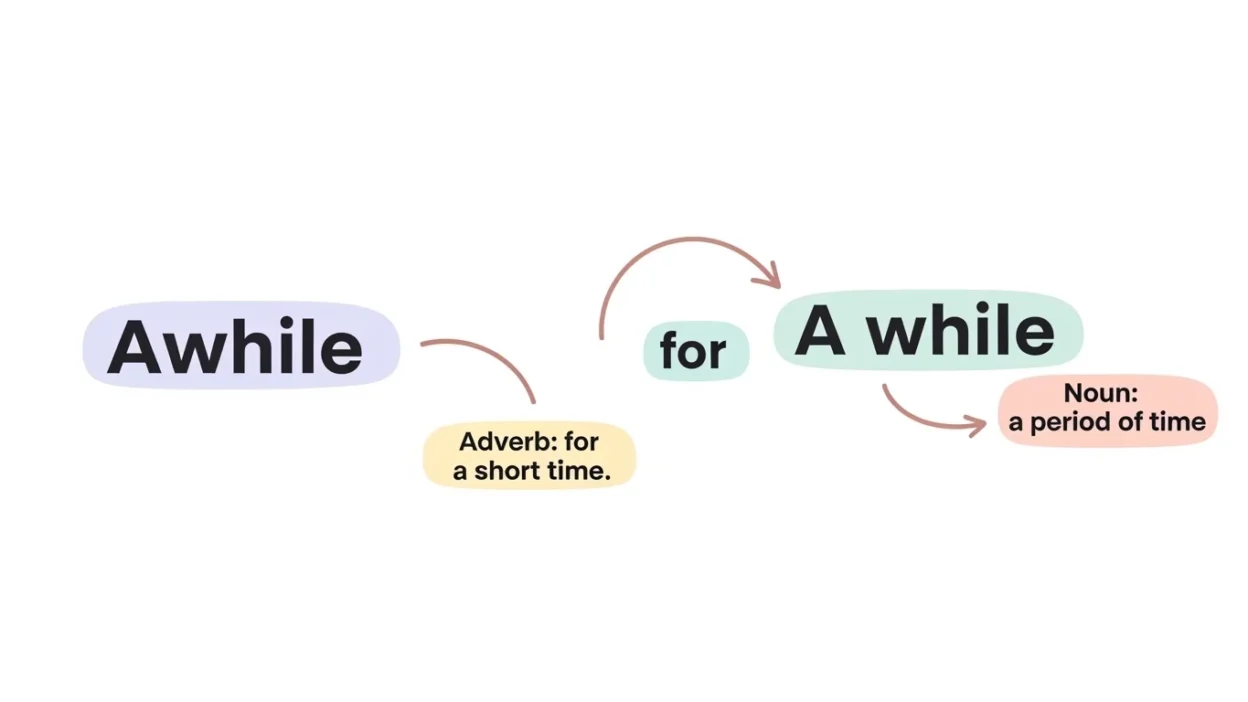
The key idea: one is an adverb, the other is a noun phrase.
Quick Answer
- ✅ Awhile – Adverb (means “for a short time”)
- ✅ A while – Noun phrase (needs a preposition like for)
- ❌ They are not interchangeable
- ✏️ Remember: Awhile = alone, A while = needs “for”
Clear Explanation of the Difference
What Does “Awhile” Mean?
Awhile is an adverb.
👉 It means:
- for a short time
It does not need a preposition.
Examples:
- Sit awhile.
- Stay awhile.
- Rest awhile.
- Wait awhile.
- Come and talk awhile.
What Does “A While” Mean?
A while is a noun phrase.
👉 It means:
- a short period of time
It usually needs a preposition, such as for.
Examples:
- Sit for a while.
- I stayed for a while.
- We talked for a while.
- Wait for a while.
- He rested for a while.
Comparison Table
| Feature | Awhile | A while |
|---|---|---|
| Type | Adverb | Noun phrase |
| Meaning | For a short time | A short period |
| Needs “for”? | No | Yes (usually) |
| Example | Stay awhile. | Stay for a while. |
Which One to Use and When
Use “Awhile” When:
- No preposition is needed
- It directly modifies the verb
Examples:
- Sit awhile.
- Stay awhile.
- Wait awhile.
- Rest awhile.
- Talk awhile.
Use “A While” When:
- You use a preposition like for
- You are referring to a period of time
Examples:
- Sit for a while.
- Stay for a while.
- Wait for a while.
- Rest for a while.
- Talk for a while.
Quick Trick to Test
👉 Add “for”:
- If the sentence needs “for” → use a while
- If not → use awhile
Example:
- Stay awhile ✔ (no “for”)
- Stay for a while ✔
Common Mistakes People Make
1. Using Both Together
❌ Stay for awhile
✅ Stay for a while
2. Forgetting “For”
❌ Stay a while (sometimes incorrect in strict grammar)
✔ Better: Stay awhile OR Stay for a while
3. Not Knowing Word Type
Adverb vs noun confusion.
4. Mixing Rules
Each form has its own usage.
5. Ignoring Structure
Sentence structure matters.
Everyday Real-Life Examples
Conversations
- “Stay awhile.”
- “Stay for a while.”
Daily Life
- “Rest awhile.”
- “Rest for a while.”
Social Situations
- “Sit awhile.”
- “Sit for a while.”
Work
- “Wait awhile.”
- “Wait for a while.”
School
- “Talk awhile.”
- “Talk for a while.”
Short Learning Section for Students and Beginners
Easy Rule to Remember
- Awhile = no “for”
- A while = use “for”
Memory Tip
“Two words need support (for), one word stands alone.”
Practice Exercise
Fill in the blanks:
- Sit ______.
- Sit for ______.
- Wait ______.
Answers:
- awhile
- a while
- awhile
Quick Quiz
Choose the correct option:
- Stay ______.
a) Awhile
b) A while - Stay for ______.
a) Awhile
b) A while
Correct Answers:
- a) Awhile
- b) A while
Frequently Asked Questions (FAQs)
1. Is “awhile” one word?
Yes, and it is an adverb.
2. Is “a while” two words?
Yes, and it is a noun phrase.
3. Can I use them the same way?
No, they follow different rules.
4. Do I always need “for” with “a while”?
Usually, yes.
5. Is this a common mistake?
Yes, very common.
6. Can I say “stay a while”?
It is used informally, but “stay awhile” is more precise.
7. Which is easier to remember?
“Awhile = no for.”
8. How can I remember it?
Remember: One word = alone.
Conclusion
The difference between “awhile” and “a while” is simple once you understand the rule. Awhile is an adverb used without “for,” while a while is a noun phrase that usually needs “for.”
To avoid mistakes, remember:
👉 Awhile = no “for”
👉 A while = use “for”
This will help you write clearly and correctly every time.

Emily Carter is a content writer and editor based in the United States, specializing in lifestyle, wellness, and personal development topics. With a passion for clear and engaging storytelling, she creates content that connects with readers and delivers practical value. Emily focuses on making complex ideas easy to understand and relatable.