Many learners search for “scarry vs scary” because the words sound the same. When speaking, we don’t hear the difference between one “r” and two “r”s, so people often guess the spelling and write “scarry.”
This confusion is very common for students, ESL learners, and beginners. The good news is simple: only one spelling is correct.
Quick Answer
Here is the clear and simple answer:
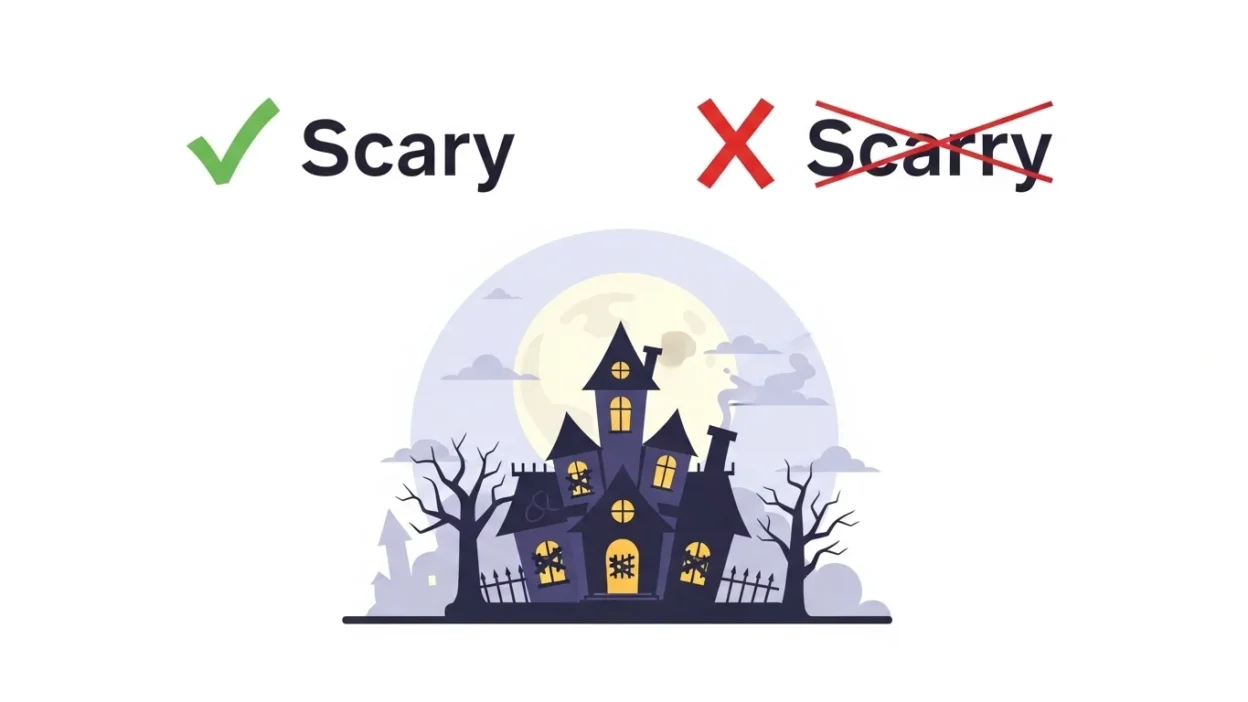
- ✅ Scary – Correct spelling; means something that causes fear
- ❌ Scarry – Incorrect spelling; not a real English word
- 📚 Always use scary in writing
- ✏️ Remember: Only one “r” → scary
Origin and Background
The word scary comes from the verb scare, which means to frighten someone.
- Scare → Scary
When we add “-y” to form an adjective, we do not double the “r.”
Examples:
- Care → Careful (not carrful)
- Dare → Daring (not darring)
- Scare → Scary (not scarry)
Clear Explanation of the Difference
What Does “Scary” Mean?
Scary is an adjective. It describes something that makes you feel afraid.
Common Meanings
- Frightening
- That movie was scary.
- Causing Fear
- The loud noise was scary.
- Unpleasant or Dangerous
- It was a scary situation.
What About “Scarry”?
Scarry is not a correct English word. It is a spelling mistake caused by adding an extra “r.”
❌ Scarry
✅ Scary
You should never use scarry in correct writing.
Comparison Table
| Feature | Scary | Scarry |
|---|---|---|
| Spelling | Correct | Incorrect |
| Meaning | Causing fear | No meaning in English |
| Part of Speech | Adjective | Not a valid word |
| Rule | No double “r” | Incorrect doubling |
| Usage | Formal and informal English | Considered a spelling error |
| Example | The story is scary. | ❌ The story is scarry. |
Which One to Use and When
Use “Scary” When:
- Describing something frightening
- Talking about movies, stories, or situations
- Writing essays, messages, or conversations
Examples:
- That movie is scary.
- The night was dark and scary.
- It was a scary experience.
- The dog looked scary.
- This story is very scary.
Avoid “Scarry”
Never use scarry, as it is always incorrect.
Common Mistakes People Make
1. Adding an Extra “R”
People think the “r” should be doubled.
❌ Scarry
✅ Scary
2. Spelling Based on Sound
Both forms sound the same.
3. Not Knowing the Base Word
Understanding scare helps avoid mistakes.
4. Typing Too Quickly
Fast typing can add extra letters.
5. Lack of Proofreading
Mistakes remain without checking.
Everyday Real-Life Examples
Emails
- “That situation was scary.”
- “It was a scary moment.”
School and Education
- “Students read a scary story.”
- “The book is scary.”
Social Media
- “That movie was so scary!”
- “This game is scary.”
Entertainment
- “I watched a scary film.”
- “It’s a scary scene.”
Daily Conversations
- “That was scary!”
- “The noise was scary.”
Short Learning Section for Students and Beginners
Easy Rule to Remember
Scare → Scary (no extra “r”)
Memory Tip
“One scare, one r → scary.”
Pronunciation Guide
- Scary: SKAIR-ee
Practice Exercise
Fill in the blanks with the correct word:
- The movie was ______.
- It was a ______ night.
- That sound is ______.
Answers:
- scary
- scary
- scary
Quick Quiz
Choose the correct option:
- That story is ______.
a) Scarry
b) Scary - It was a ______ moment.
a) Scary
b) Scarry
Correct Answers:
- b) Scary
- a) Scary
Frequently Asked Questions (FAQs)
1. Is “scarry” correct?
No, it is incorrect.
2. What is the correct spelling?
The correct spelling is scary.
3. What does “scary” mean?
It means something that causes fear.
4. Why do people write “scarry”?
Because of pronunciation confusion.
5. Is “scary” used in formal writing?
Yes, it is used in both formal and informal contexts.
6. How do you pronounce “scary”?
It is pronounced SKAIR-ee.
7. Can “scary” be used daily?
Yes, it is very common in everyday English.
8. How can I remember it?
Remember: Scare → Scary (one “r”).
Conclusion
The difference between “scarry” and “scary” is very simple. Scary is the correct spelling and means something that causes fear. Scarry is incorrect and should never be used.
To avoid mistakes, remember this easy rule:
👉 Scare → Scary (no extra “r”).
Using the correct spelling will help you write clearly, confidently, and correctly in all situations.

Sophia Reynolds is a digital writer and researcher with a focus on modern trends, productivity, and online education. She enjoys exploring new ideas and presenting them in a simple, reader-friendly way. Sophia is committed to creating informative and trustworthy content that helps audiences stay informed and inspired.