Many learners search for “tieing vs tying” because the spelling looks unusual. When we add “-ing” to most verbs, we simply add it to the base word. So people think “tie + ing = tieing.”
But English has some special rules, and this word is one of them. That’s why confusion happens.
Quick Answer
Here is the clear and simple answer:
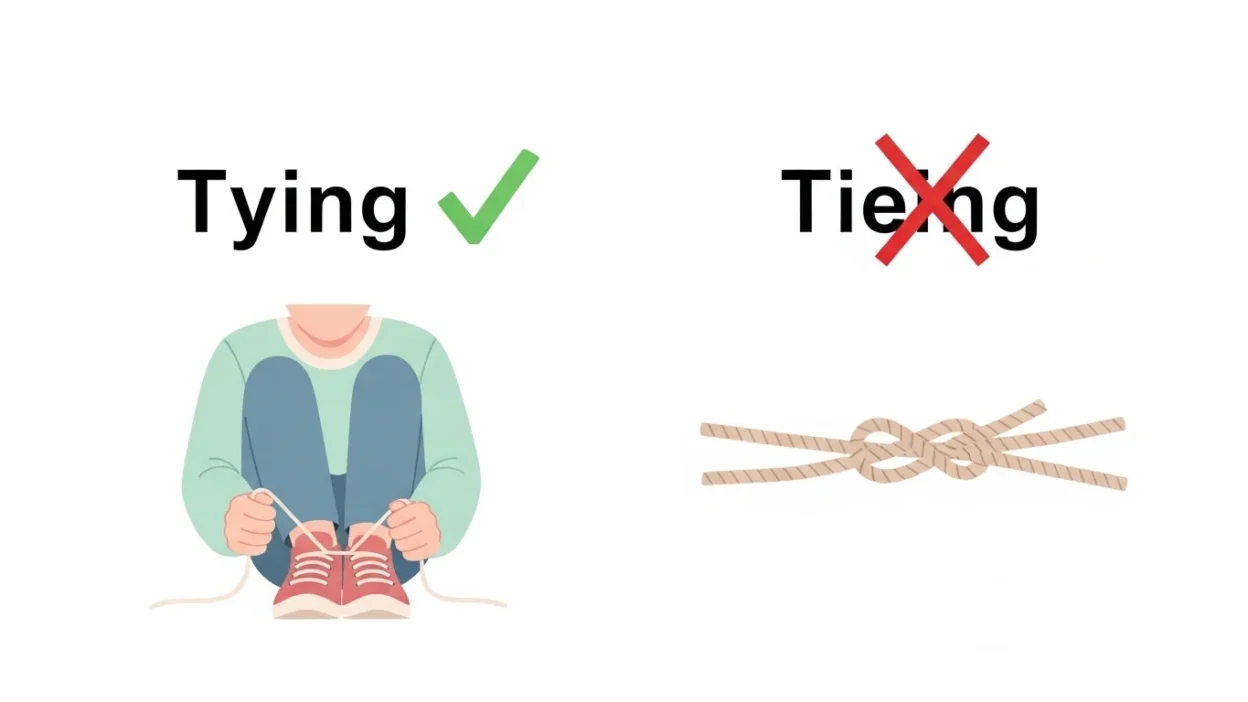
- ✅ Tying – Correct spelling; means fastening or making a knot
- ❌ Tieing – Incorrect spelling
- 📚 Always use tying in writing
- ✏️ Remember: Drop the “e” → tie → tying
Origin and Background
The word tie means to fasten something with a knot or string.
When we add “-ing,” we usually:
- Drop the silent “e”
- Then add “-ing”
Examples:
- Make → Making
- Take → Taking
- Write → Writing
But tie is a little different. It changes slightly:
- Tie → Tying (not tieing)
Clear Explanation of the Difference
What Does “Tying” Mean?
Tying is the present participle (or “-ing” form) of the verb tie. It means fastening or making a knot.
Common Uses
- Making a Knot
- She is tying her shoes.
- Fastening Something
- He is tying the rope.
- Connecting or Securing
- They are tying the package.
What About “Tieing”?
Tieing is not correct in standard English. It is a common spelling mistake.
❌ Tieing
✅ Tying
You should never use tieing in proper writing.
Comparison Table
| Feature | Tying | Tieing |
|---|---|---|
| Spelling | Correct | Incorrect |
| Meaning | Fastening or making a knot | No meaning in standard English |
| Part of Speech | Verb (present participle) | Not valid |
| Rule | Drop “e” and adjust spelling | Incorrect rule use |
| Usage | Formal and informal English | Considered a spelling error |
| Example | She is tying her shoes. | ❌ She is tieing her shoes. |
Which One to Use and When
Use “Tying” When:
- Talking about fastening or knots
- Writing or speaking about actions
- Describing present actions
Examples:
- She is tying her shoes.
- He is tying the rope.
- I am tying a knot.
- They are tying the package.
- He kept tying and untying the string.
Avoid “Tieing”
Never use tieing, as it is always incorrect.
Common Mistakes People Make
1. Adding “-ing” Directly
People think: tie + ing = tieing
❌ Tieing
✅ Tying
2. Not Dropping the “E”
Forgetting the rule causes errors.
3. Spelling Based on Logic
It looks logical but is wrong.
4. Typing Too Quickly
Fast typing leads to mistakes.
5. Lack of Practice
Less exposure leads to confusion.
Everyday Real-Life Examples
Daily Activities
- “I am tying my shoes.”
- “He is tying a knot.”
School and Learning
- “Students are tying ropes in class.”
- “She is tying the project materials.”
Work and Tasks
- “He is tying the package.”
- “They are tying cables together.”
Outdoor Activities
- “He is tying the tent.”
- “She is tying the boat.”
Conversations
- “Wait, I am tying my shoes.”
- “He is tying the rope tightly.”
Short Learning Section for Students and Beginners
Easy Rule to Remember
Tie → Tying (not tieing)
Memory Tip
“Drop the e → tying.”
Pronunciation Guide
- Tying: TY-ing
Practice Exercise
Fill in the blanks with the correct word:
- She is ______ her shoes.
- He is ______ the rope.
- I am ______ a knot.
Answers:
- tying
- tying
- tying
Quick Quiz
Choose the correct option:
- He is ______ the string.
a) Tieing
b) Tying - She is ______ her hair.
a) Tying
b) Tieing
Correct Answers:
- b) Tying
- a) Tying
Frequently Asked Questions (FAQs)
1. Is “tieing” correct?
No, it is incorrect.
2. What is the correct spelling?
The correct spelling is tying.
3. Why is it “tying” and not “tieing”?
Because we drop the “e” and adjust the spelling.
4. What does “tying” mean?
It means fastening or making a knot.
5. Is “tying” used in daily life?
Yes, it is very common.
6. How do you pronounce “tying”?
It is pronounced TY-ing.
7. Is this an exception?
Yes, it is a special spelling case.
8. How can I remember it?
Remember: Tie → Tying (drop the e).
Conclusion
The difference between “tieing” and “tying” is simple but important. Tying is the correct spelling and means fastening or making a knot. Tieing is incorrect and should never be used.
To avoid mistakes, remember this easy rule:
👉 Tie → Tying (drop the “e”).
Using the correct spelling will help you write clearly, confidently, and correctly in all situations.

Michael Anderson is a professional editor and senior contributor with a background in long-form content and strategic writing. He focuses on quality, structure, and credibility across all publications. Michael brings years of experience in content development and ensures high editorial standards for every project.