English spelling often confuses learners, especially when words look similar and sound alike. One common mistake is mixing up “possess” and “posses.” Many students, ESL learners, and beginners struggle with this pair because of the double letters and unfamiliar spelling patterns.
This confusion usually happens when people rely on pronunciation instead of correct spelling. Since both words appear similar at first glance, it’s easy to assume they mean the same thing. However, only one of them is correct in standard English. This guide will explain the difference in very simple language so you can understand and remember it easily.
Quick Answer
Here is the clear and simple answer:
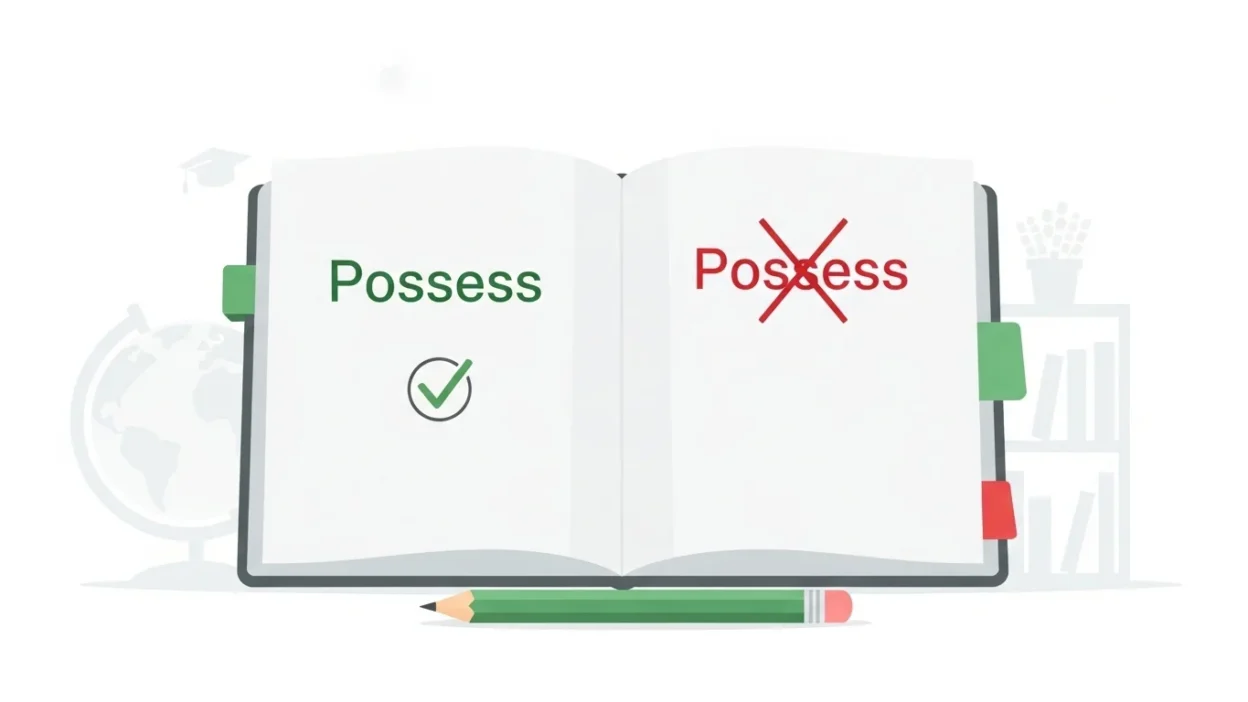
- ✅ Possess – Correct spelling; means to own or have something.
- ❌ Posses – Incorrect spelling; not a standard English word.
- 📚 Always use possess in writing and speech.
- ✏️ If you see “posses,” it is a spelling mistake.
Origin and Background
The word possess comes from the Latin word possidere, which means “to own,” “to occupy,” or “to control.” Over time, it passed into Old French and then into English, keeping its original meaning.
The spelling includes double “s” in the middle and at the end, which often causes confusion. Many learners accidentally drop one “s,” leading to the incorrect form “posses.”
Related Word Forms
| Word | Meaning |
|---|---|
| Possess | To own or have |
| Possession | Something that is owned |
| Possessive | Showing ownership |
| Possessor | The owner of something |
Understanding these related words makes it easier to remember the correct spelling.
Clear Explanation of the Difference
What Does “Possess” Mean?
Possess is a verb that means to own, control, or have something. It is used in both literal and figurative contexts.
1. To Own Something
- She possesses a beautiful house.
- He possesses great wealth.
- They possess valuable skills.
2. To Have a Quality or Ability
- She possesses strong leadership skills.
- He possesses a kind heart.
- The student possesses excellent writing abilities.
3. To Control or Influence (Figurative Use)
- Fear possessed him during the storm.
- She was possessed by determination.
What About “Posses”?
Posses is not a correct word in standard English. It is simply a misspelling of possess.
❌ Posses
✅ Possess
If you accidentally write “posses,” it should always be corrected to “possess.”
Comparison Table
| Feature | Possess | Posses |
|---|---|---|
| Spelling | Correct | Incorrect |
| Meaning | To own, have, or control | No meaning in standard English |
| Part of Speech | Verb | Not a valid word |
| Dictionary Recognition | Yes | No |
| Usage | Formal and informal English | Considered a spelling mistake |
| Example Sentence | She possesses great talent. | ❌ She posses great talent. |
Which One to Use and When
Use “Possess” When:
- Talking about ownership or control
- Describing skills, qualities, or abilities
- Writing essays, emails, and reports
- Communicating in academic or professional settings
- Expressing emotions or figurative meanings
Examples:
- She possesses a rare talent for music.
- They possess the rights to the property.
- He possesses deep knowledge of science.
- The team possesses great determination.
- This artifact possesses historical value.
Avoid “Posses”
Never use posses, as it is always incorrect in standard English.
Common Mistakes People Make
1. Dropping One “S”
Many learners forget that “possess” contains four “s” letters in total.
❌ Posses
✅ Possess
2. Spelling by Sound
Since the extra “s” is not strongly pronounced, people often omit it when writing.
3. Confusion with Similar Words
Learners sometimes compare it with simpler words like:
- Pass
- Dress
- Mess
However, possess has a unique spelling pattern.
4. Typing Errors
Fast typing or lack of proofreading can result in incorrect spelling.
5. Misunderstanding Word Forms
Some people confuse “possess” with its related forms such as “possession” and “possessive,” leading to mistakes.
Everyday Real-Life Examples
Emails
- “She possesses the necessary skills for this role.”
- “Our company possesses valuable experience in this field.”
School and Education
- “The student possesses excellent problem-solving abilities.”
- “Great leaders possess confidence and honesty.”
Workplace Communication
- “He possesses strong communication skills.”
- “This team possesses the potential to succeed.”
News and Media
- “The country possesses vast natural resources.”
- “Scientists discovered a plant that possesses healing properties.”
Social Media
- “She possesses a creative mind.”
- “He possesses a unique sense of style.”
Daily Conversations
- “Do you possess a driver’s license?”
- “She possesses incredible patience.”
Short Learning Section for Students and Beginners
Easy Trick to Remember
Think of the word possession. If you can spell possession, you can spell possess.
Possess → Possession
Memory Tip
“To possess is to have success.”
Both words end with double “s.”
Another Simple Rule
Remember this pattern:
- Possess has four ‘S’ letters.
Pronunciation Guide
- Possess: puh-ZESS
Practice Exercise
Fill in the blanks with the correct word:
- She ______ great talent.
- They ______ valuable land.
- He ______ strong leadership skills.
Answers:
- possesses
- possess
- possesses
Quick Quiz
Choose the correct option:
- The museum ______ rare artifacts.
a) Posses
b) Possess - She ______ a beautiful voice.
a) Possess
b) Possesses
Correct Answers:
- b) Possess
- b) Possesses
Frequently Asked Questions (FAQs)
1. Is “posses” a real English word?
No, “posses” is not a correct word. It is a misspelling of “possess.”
2. What is the correct spelling?
The correct spelling is possess.
3. What does “possess” mean?
It means to own, have, control, or display a quality or ability.
4. How do you pronounce “possess”?
It is pronounced as puh-ZESS.
5. What is the noun form of “possess”?
The noun form is possession.
6. What is the adjective form of “possess”?
The adjective form is possessive.
7. How can I remember the correct spelling?
Remember this rule: Possess has four “S” letters.
8. Can “possess” be used figuratively?
Yes. For example, “Fear possessed him during the storm.”
Conclusion
The difference between “possess” and “posses” is simple yet important. Possess is the correct spelling and means to own, have, or control something. On the other hand, posses is an incorrect spelling and should never be used in proper English.
By learning its origin, understanding its meaning, and practicing with real-life examples, you can avoid this mistake with confidence. Just remember the easy rule: Possess contains four ‘S’ letters. Mastering this spelling will improve your writing and help you communicate clearly and accurately.

Emily Carter is a content writer and editor based in the United States, specializing in lifestyle, wellness, and personal development topics. With a passion for clear and engaging storytelling, she creates content that connects with readers and delivers practical value. Emily focuses on making complex ideas easy to understand and relatable.