English spelling can be confusing, especially when words sound the same but are spelled differently. One common mistake is between “proceed” and “procede.” Many students, ESL learners, and beginners mix them up because both sound alike when spoken.
This confusion usually happens because English pronunciation does not always match spelling. As a result, learners often guess the spelling based on sound. This guide will clearly explain the difference in very simple English so you can understand it easily on your first read.
Quick Answer
Here is the clear and simple answer:
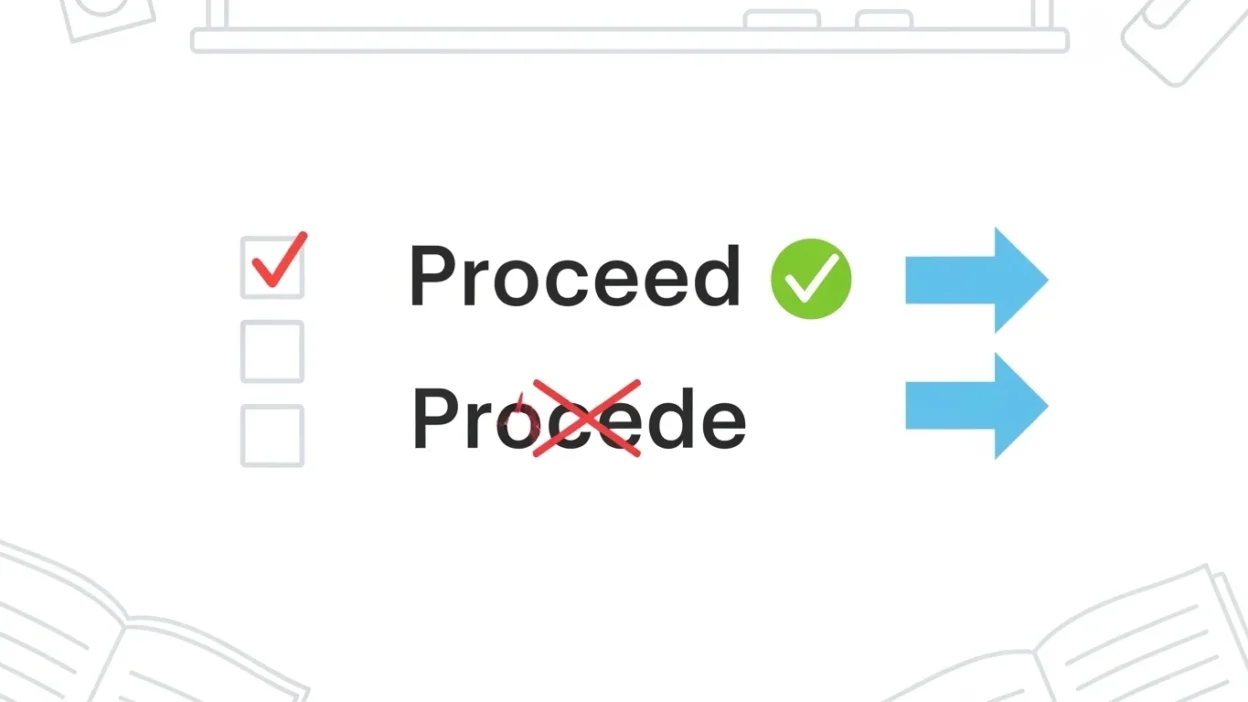
- ✅ Proceed – Correct spelling; means to continue or move forward.
- ❌ Procede – Incorrect spelling; not a real English word.
- 📚 Always use proceed in writing and speech.
- ✏️ If you see “procede,” it is a spelling mistake that should be corrected.
Origin and Background
The word proceed comes from the Latin word procedere, which means “to go forward.” It entered English through Old French and has kept its meaning over time.
The spelling includes a double “e” in the middle, which often causes confusion. Some learners mistakenly remove one “e,” resulting in the incorrect spelling “procede.”
Related Words
| Word | Meaning |
|---|---|
| Proceed | To move forward or continue |
| Procedure | A set of steps or actions |
| Process | A series of actions or changes |
| Proceeds | Money received from a sale or event |
Understanding these related words makes it easier to remember the correct spelling.
Clear Explanation of the Difference
What Does “Proceed” Mean?
Proceed is a verb that means to continue, move forward, or begin the next step in an action or process.
1. To Continue an Action
- Please proceed with the meeting.
- The teacher asked the students to proceed with their assignments.
2. To Move Forward
- The cars were allowed to proceed after the traffic light turned green.
- Passengers may proceed to the boarding gate.
3. To Begin the Next Step
- After registration, you may proceed to the examination hall.
- The judge allowed the case to proceed.
4. To Originate From
- The strange sound seemed to proceed from the next room.
- The river proceeds from the mountains.
5. As a Noun (Proceeds)
- The proceeds from the charity event were donated to a hospital.
What About “Procede”?
Procede is not a correct English word. It is simply a misspelling of proceed.
❌ Procede
✅ Proceed
You should never use “procede” in formal or informal writing.
Comparison Table
| Feature | Proceed | Procede |
|---|---|---|
| Spelling | Correct | Incorrect |
| Meaning | To continue or move forward | No meaning in standard English |
| Part of Speech | Verb | Not a valid word |
| Dictionary Recognition | Yes | No |
| Usage | Formal and informal writing | Considered a spelling mistake |
| Example Sentence | Please proceed to the next step. | ❌ Please procede to the next step. |
Which One to Use and When
Use “Proceed” When:
- Continuing an activity or process
- Giving instructions or directions
- Writing emails, essays, and reports
- Making announcements
- Communicating in academic or professional settings
Examples:
- Please proceed with the payment.
- Students may proceed to the classroom.
- The meeting will proceed as planned.
- You may proceed when you are ready.
- After approval, we will proceed with the project.
Avoid “Procede”
Never use procedе, as it is always incorrect in standard English.
Common Mistakes People Make
1. Dropping One “E”
Many learners remove one “e” from the correct spelling.
❌ Procede
✅ Proceed
2. Spelling by Sound
Since both spellings sound the same, people rely on pronunciation instead of spelling rules.
3. Confusion with Similar Words
Words such as procedure and process may lead to confusion, but they have different spellings.
4. Typing Errors
Fast typing and lack of proofreading often cause mistakes.
5. Misuse of Autocorrect
Sometimes autocorrect fails to fix the incorrect spelling.
Everyday Real-Life Examples
Emails
- “Please proceed with the application.”
- “You may proceed with the payment.”
School and Education
- “Students may proceed to the examination hall.”
- “After completing the first section, proceed to the next.”
Workplace Communication
- “The manager approved the team to proceed.”
- “We will proceed with the project next week.”
Travel and Public Announcements
- “Passengers may now proceed to Gate 12.”
- “Please proceed to the nearest exit calmly.”
News and Media
- “The investigation will proceed as planned.”
- “The court allowed the trial to proceed.”
Daily Conversations
- “You can proceed when you are ready.”
- “Shall we proceed with dinner?”
Short Learning Section for Students and Beginners
Easy Trick to Remember
Think of the phrase:
“Proceed to succeed.”
Both words contain double “e.”
Memory Tip
Pro + ceed = Proceed
Remember: It has two e’s in the middle.
Pronunciation Guide
- Proceed: pro-SEED
Practice Exercise
Fill in the blanks with the correct word:
- Please ______ to the next step.
- The meeting will ______ as planned.
- Passengers may now ______ to the boarding gate.
Answers:
- proceed
- proceed
- proceed
Quick Quiz
Choose the correct option:
- The teacher asked us to ______.
a) Procede
b) Proceed - After approval, we will ______ with the project.
a) Proceed
b) Procede
Correct Answers:
- b) Proceed
- a) Proceed
Frequently Asked Questions (FAQs)
1. Is “procede” a real English word?
No, “procede” is not a correct English word. It is a spelling mistake.
2. What is the correct spelling?
The correct spelling is proceed.
3. What does “proceed” mean?
It means to continue, move forward, or begin the next step.
4. How do you pronounce “proceed”?
It is pronounced as pro-SEED.
5. What is the noun form of “proceed”?
The noun form is proceeds, which refers to money earned from a sale or event.
6. Is “proceed” used in formal writing?
Yes, it is commonly used in both formal and informal communication.
7. How can I remember the correct spelling?
Remember the phrase: “Proceed to succeed.”
8. Can “proceed” be used in announcements?
Yes. For example, “Passengers may proceed to the boarding gate.”
Conclusion
The difference between “proceed” and “procede” is simple but important. Proceed is the correct spelling and means to continue or move forward, while procede is an incorrect form that should never be used.
By learning its meaning, understanding its origin, and practicing with real-life examples, you can avoid this common mistake. Just remember the simple rule: Proceed has double “e.” Mastering this spelling will help you write clearly, confidently, and correctly.

Daniel Brooks is a technology and business writer with experience covering innovation, startups, and digital tools. His work emphasizes clarity, accuracy, and real-world application. Daniel aims to help readers understand emerging technologies and make informed decisions in a fast-changing digital landscape.