
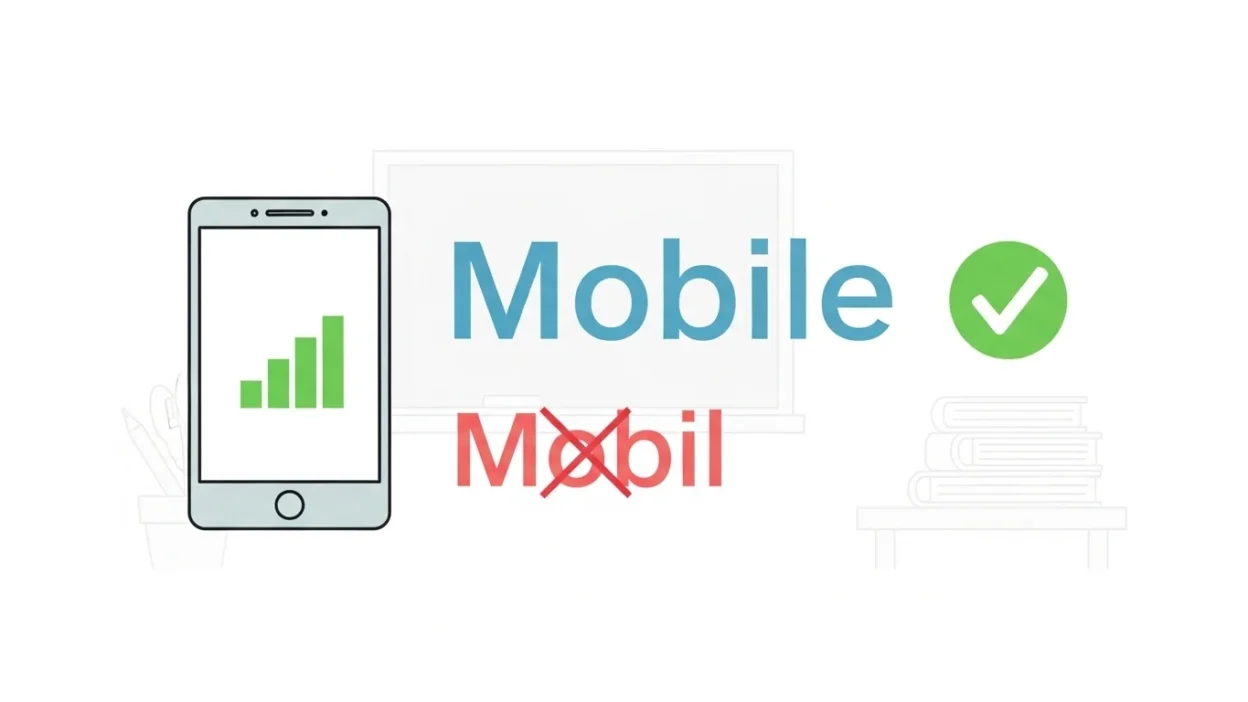
Many English learners and beginners feel confused when choosing between “mobil” and “mobile.” These words look very similar and sound almost the same, which makes spelling tricky. The confusion often happens because English pronunciation does not always match spelling. Additionally, learners may shorten words when typing quickly or assume simpler spellings are correct.
Understanding the correct form is important for school assignments, emails, social media posts, and professional communication. This guide explains the difference in very simple English so that anyone can understand it easily on the first read.
Quick Answer
Here is the clear and simple answer:
- ✅ Mobile – Correct spelling; refers to something that can move or a mobile phone.
- ❌ Mobil – Incorrect spelling in standard English; mainly a brand name or a spelling variant in some languages.
- 📱 Always use mobile in everyday English.
- ✏️ Use Mobil only when referring to the well-known fuel brand or specific proper names.
Origin and Background
The word mobile comes from the Latin word mobilis, which means “movable” or “capable of motion.” It entered English through French and has been widely used for centuries.
Over time, mobile developed several meanings, including objects that can move, decorative art pieces, and modern devices like mobile phones.
The spelling “Mobil” is not used as a standard English word. However, it appears as a proper noun—most famously in the name of a global oil company. In other languages, such as German or French, “mobil” can also mean “mobile,” but in English, mobile is the correct form.
Clear Explanation of the Difference
What Does “Mobile” Mean?
Mobile is a commonly used English word. It can function as both an adjective and a noun.
1. As an Adjective: Able to Move
It describes something that can move or be easily transported.
Examples:
- The clinic provides mobile medical services.
- The army uses mobile units.
- The device is lightweight and mobile.
2. As a Noun: A Mobile Phone
In modern English, “mobile” often refers to a mobile phone.
Examples:
- I forgot my mobile at home.
- Please call me on my mobile.
- She bought a new mobile yesterday.
3. As a Decorative Art Form
A mobile can also be a hanging artwork that moves with air.
Examples:
- The baby smiled at the colorful mobile.
- The artist designed a beautiful ceiling mobile.
What Does “Mobil” Mean?
Mobil is not a standard English spelling of the word “mobile.” However, it is used in specific contexts:
- As a Brand Name
It appears in the name of a major global petroleum company. Example:- He stopped at a Mobil gas station.
- As a Foreign Language Variant
In some languages, such as German and French, “mobil” means “mobile.” However, this spelling is not correct in standard English writing.
❌ Mobil (general English usage)
✅ Mobile (correct English spelling)
Comparison Table
| Feature | Mobile | Mobil |
|---|---|---|
| Spelling | Correct in English | Incorrect in standard English |
| Meaning | Able to move; a mobile phone; a hanging decoration | Proper noun or foreign-language variant |
| Part of Speech | Noun and adjective | Proper noun (brand name) |
| Dictionary Recognition | Yes | Only as a brand name |
| Common Usage | Everyday English | Limited and specific contexts |
| Example Sentence | She bought a new mobile. | He stopped at a Mobil station. |
Which One to Use and When
Use “Mobile” When:
- Referring to a mobile phone
- Describing something that can move
- Writing essays, emails, or reports
- Communicating in academic or professional settings
- Discussing technology or transportation
Examples:
- My mobile battery is low.
- The company launched a mobile application.
- The hospital uses mobile units.
- She works in mobile development.
- He forgot his mobile at school.
Use “Mobil” Only When:
- Referring to the well-known fuel brand
- Writing a proper name or trademark
Example:
- The car stopped at a Mobil fuel station.
Common Mistakes People Make
1. Dropping the Final “E”
Learners often shorten “mobile” to “mobil,” which is incorrect.
❌ Mobil
✅ Mobile
2. Spelling by Sound
Because the final “e” is silent, many people omit it.
3. Confusing Brand Names with Regular Words
Some people mistakenly use “Mobil” instead of “mobile.”
4. Typing Errors
Fast typing on phones or computers can lead to spelling mistakes.
5. Influence of Other Languages
Speakers of German or French may write “mobil” instead of “mobile.”
Everyday Real-Life Examples
Emails
- “Please contact me on my mobile.”
- “Our team specializes in mobile applications.”
School and Education
- “Students are not allowed to use mobile phones in class.”
- “The project focuses on mobile technology.”
Workplace Communication
- “The company launched a new mobile app.”
- “Ensure the system is mobile-friendly.”
News and Media
- “Mobile usage has increased worldwide.”
- “The firm introduced advanced mobile services.”
Social Media
- “I upgraded my mobile today.”
- “This game runs smoothly on mobile devices.”
Daily Conversations
- “Where is my mobile?”
- “Can you call me on my mobile?”
Short Learning Section for Students and Beginners
Easy Trick to Remember
Mobile ends with a silent “e.”
Memory Tip
“Your mobile needs the final ‘e’ for energy.”
Pronunciation Guide
- Mobile: MOH-byle (British English)
- Mobile: MOH-buhl (American English)
Practice Exercise
Fill in the blanks:
- I bought a new ______ phone.
- The company launched a ______ application.
- He stopped at a ______ fuel station.
Answers:
- mobile
- mobile
- Mobil
Quick Quiz
Choose the correct option:
- She forgot her ______ at home.
a) Mobil
b) Mobile - He refueled his car at a ______ station.
a) Mobile
b) Mobil
Correct Answers:
- b) Mobile
- b) Mobil
Frequently Asked Questions (FAQs)
1. Is “mobil” a correct English word?
No, it is not correct in standard English. It is mainly used as a brand name or in other languages.
2. What is the correct spelling for a phone?
The correct spelling is mobile.
3. Can “mobile” be used as both a noun and an adjective?
Yes. It refers to a phone and also describes something that can move.
4. Why do people write “mobil” instead of “mobile”?
Because the final “e” is silent, learners often omit it.
5. Is “mobile” used worldwide?
Yes, especially in British English to refer to a mobile phone.
6. What is the American English equivalent of “mobile”?
In American English, people often say cell phone.
7. How do you pronounce “mobile”?
It is pronounced as MOH-byle (British) and MOH-buhl (American).
8. Can “Mobil” ever be correct?
Yes, but only when referring to the fuel brand or a proper noun.
Conclusion
The difference between “mobil” and “mobile” is simple yet important. Mobile is the correct spelling in standard English and refers to something that can move, a mobile phone, or a decorative hanging structure. On the other hand, Mobil is not a general English word and is mainly used as a brand name or in other languages.
To avoid confusion, remember this easy rule: If you are talking about a phone or something movable, always use “mobile.” This knowledge will help you write clearly, correctly, and confidently.

Michael Anderson is a professional editor and senior contributor with a background in long-form content and strategic writing. He focuses on quality, structure, and credibility across all publications. Michael brings years of experience in content development and ensures high editorial standards for every project.