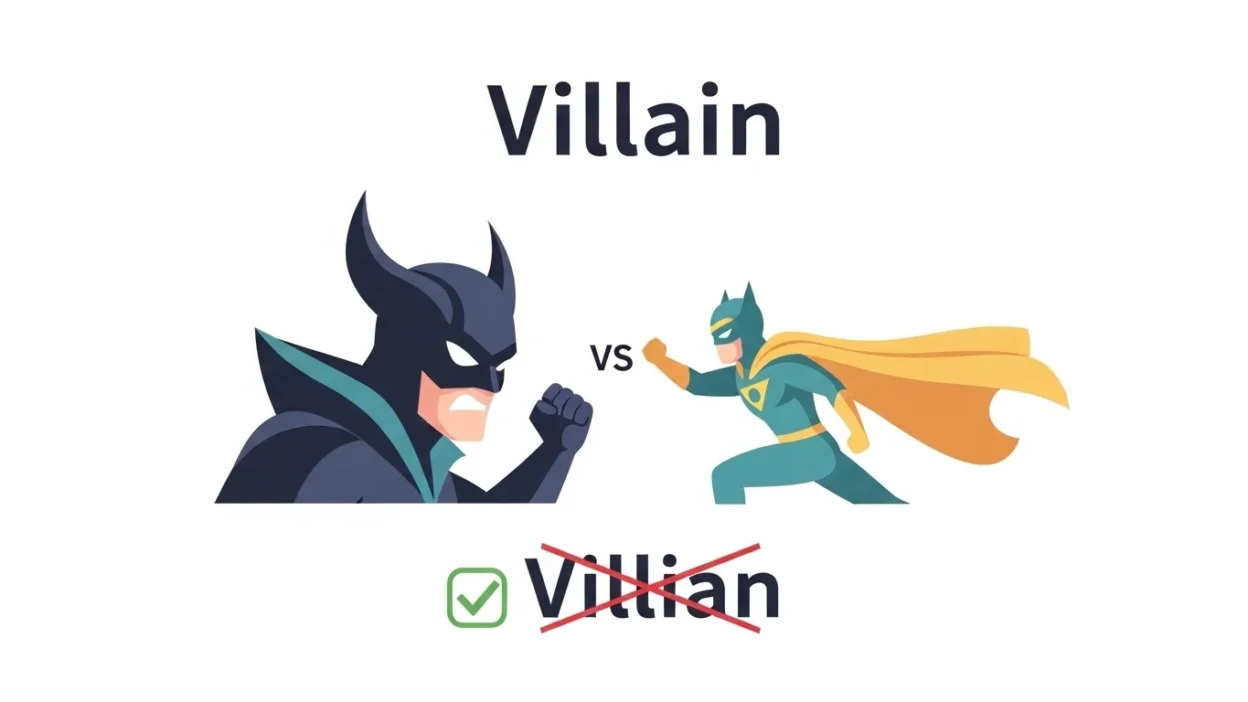
English spelling can be tricky, especially when similar letter combinations are involved. A common mistake is confusing “villain” with “villian.” Since both look almost the same, many students, ESL learners, and beginners mix them up while writing.
This confusion often happens because the placement of the letters “a” and “i” can be hard to remember. In this guide, you will learn the correct spelling, its meaning, and how to use it properly in very simple English.
Quick Answer
Here is the clear and simple answer:
- ✅ Villain – Correct spelling; refers to an evil or bad character.
- ❌ Villian – Incorrect spelling; not a real English word.
- 📚 Always use villain in writing and speech.
- ✏️ Remember: the correct order is “ai,” not “ia.”
Origin and Background
The word villain comes from the Old French word vilain, which originally meant a farm worker or villager. It was derived from the Latin word villanus, meaning “a person who lived on a farm or estate.”
Over time, the meaning changed. In medieval stories, villagers were often portrayed as rough or dishonest. Gradually, the word evolved to mean a wicked or evil person. Today, villain refers to a bad character in stories, movies, and real-life descriptions.
Related Word Forms
| Word | Meaning |
|---|---|
| Villain | A bad or evil character |
| Villainous | Wicked or evil |
| Villainy | Evil actions or behavior |
| Antihero | A main character with flawed morals |
Clear Explanation of the Difference
What Does “Villain” Mean?
Villain is a noun used to describe a person who does bad or harmful things. It is commonly used in literature, movies, and everyday speech.
1. In Stories and Films
- The villain tried to take over the kingdom.
- The hero defeated the villain in the final battle.
2. In Everyday Language
- The thief was seen as the villain of the story.
- He played the villain in the school drama.
3. Figurative Use
- Pollution is the biggest villain affecting our planet.
- Greed is often portrayed as the villain in moral tales.
What About “Villian”?
Villian is a misspelling of villain. It is not recognized in standard English dictionaries and should always be corrected.
❌ Villian
✅ Villain
This mistake occurs because writers accidentally reverse the letters “a” and “i.”
Comparison Table
| Feature | Villain | Villian |
|---|---|---|
| Spelling | Correct | Incorrect |
| Meaning | A wicked or evil person | No meaning in standard English |
| Part of Speech | Noun | Not a valid word |
| Dictionary Recognition | Yes | No |
| Usage | Literature, films, and everyday language | Considered a spelling error |
| Example Sentence | The villain was defeated by the hero. | ❌ The villian was defeated by the hero. |
Which One to Use and When
Use “Villain” When:
- Writing stories, essays, or scripts
- Describing a bad character in movies or books
- Discussing morality or conflicts
- Referring to harmful actions or forces metaphorically
Examples:
- The villain plotted to destroy the city.
- Every superhero has a powerful villain.
- He played the villain in the play.
- The villain laughed menacingly.
- Corruption is often called the villain of society.
Avoid “Villian”
Never use villian, as it is always incorrect in standard English.
Common Mistakes People Make
1. Reversing the Letters “A” and “I”
Many learners write “villian” instead of “villain.”
❌ Villian
✅ Villain
2. Spelling Based on Sound
Both spellings sound the same, leading to confusion.
3. Typing Errors
Fast typing can result in incorrect letter placement.
4. Ignoring Proofreading
Failing to review written work allows mistakes to slip through.
5. Lack of Familiarity
Learners unfamiliar with literary vocabulary may spell the word incorrectly.
Everyday Real-Life Examples
Literature and Movies
- The villain captured the hero.
- The audience booed the villain.
School and Education
- Students analyzed the villain’s motives.
- She wrote an essay about the story’s villain.
Social Media
- “Who is your favorite movie villain?”
- Fans debated the best villain of all time.
Workplace and News
- The documentary portrayed corruption as the villain.
- In the debate, greed was called the main villain.
Daily Conversations
- He dressed as a villain for Halloween.
- Every story needs a hero and a villain.
Short Learning Section for Students and Beginners
Easy Trick to Remember
Villain follows the pattern: “ai” as in “rain.”
Memory Tip
“The villain causes pain—both share ‘ai.’”
Pronunciation Guide
- Villain: VIL-uhn
Practice Exercise
Fill in the blanks with the correct word:
- The hero defeated the ______.
- The movie’s main ______ was unforgettable.
- Greed is often seen as the ______ of society.
Answers:
- villain
- villain
- villain
Quick Quiz
Choose the correct option:
- The ______ laughed evilly.
a) Villian
b) Villain - Every superhero needs a ______.
a) Villain
b) Villian
Correct Answers:
- b) Villain
- a) Villain
Frequently Asked Questions (FAQs)
1. Is “villian” a correct spelling?
No, it is incorrect and not recognized in standard English.
2. What is the correct spelling?
The correct spelling is villain.
3. What does “villain” mean?
It refers to a wicked or evil character, especially in stories and films.
4. Why do people write “villian”?
They mistakenly reverse the letters “a” and “i.”
5. How do you pronounce “villain”?
It is pronounced as VIL-uhn.
6. What is the adjective form of “villain”?
The adjective form is villainous.
7. Can “villain” be used figuratively?
Yes. It can describe harmful forces, such as greed or pollution.
8. Is “villain” commonly used in modern English?
Yes, it is widely used in literature, movies, and everyday language.
Conclusion
The difference between “villain” and “villian” is simple but important. Villain is the correct spelling and refers to a wicked or evil person, while villian is a common misspelling that should never be used.
To avoid mistakes, remember this easy rule: The villain causes pain both contain “ai.” By mastering this spelling, you can write clearly, confidently, and accurately in any context.