English spelling can be confusing, especially when words sound alike. One common mistake is between “insue” and “ensue.” Since both words are pronounced similarly, many learners assume they are interchangeable. However, only one is correct in standard English.
This confusion often happens because English pronunciation does not always match spelling. As a result, students, ESL learners, and beginners may write the wrong form. This guide explains the difference in very simple English so you can understand it easily on your first read.
Quick Answer
Here is the clear and simple answer:
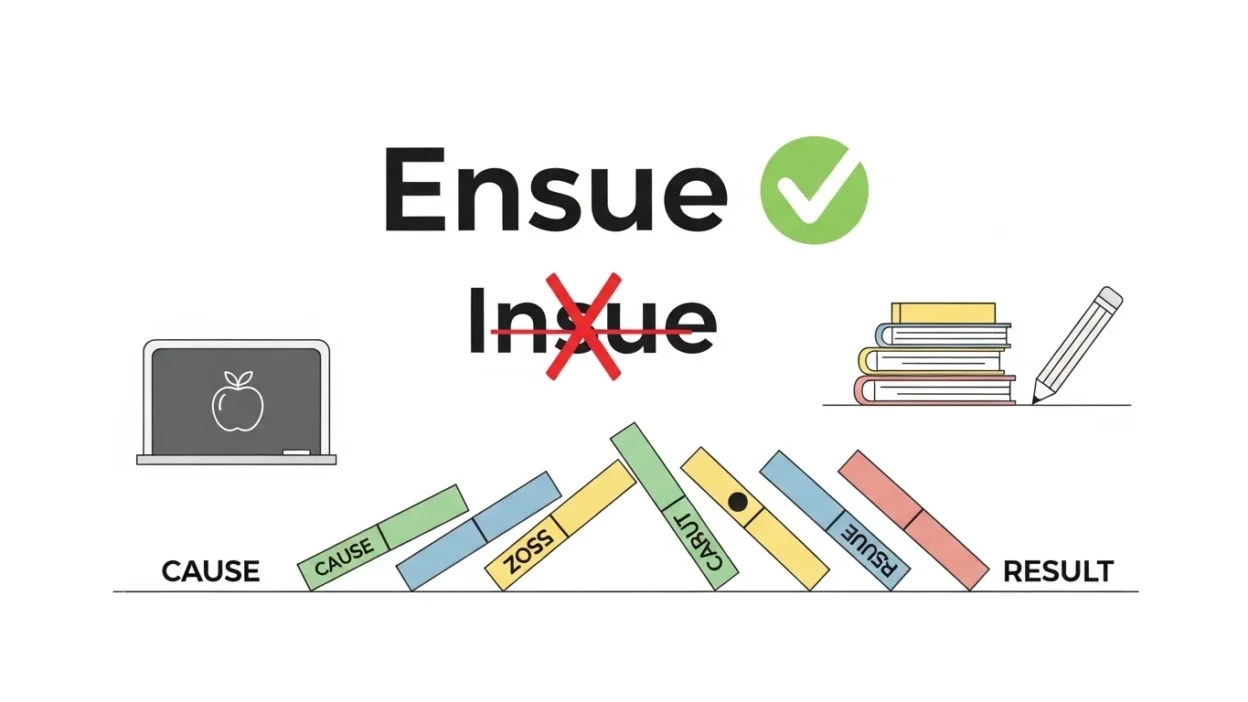
- ✅ Ensue – Correct spelling; means to happen afterward or as a result.
- ❌ Insue – Incorrect spelling; not a real English word.
- 📚 Always use ensue in writing and speech.
- ✏️ Replace “insue” with ensue to avoid errors.
Origin and Background
The word ensue comes from the Latin word insequi, which means “to follow.” It entered English through Old French and has kept its meaning over time.
The prefix “en-” suggests something that follows or results from an action. Because of its pronunciation, learners sometimes mistakenly replace “en-” with “in-,” leading to the incorrect spelling “insue.”
Related Words
| Word | Meaning |
|---|---|
| Ensue | To happen as a result |
| Ensure | To make certain |
| Insure | To provide insurance |
| Pursue | To follow or chase |
Understanding these related words helps prevent confusion.
Clear Explanation of the Difference
What Does “Ensue” Mean?
Ensue is a verb that means to happen after something else or as a result of it. It is commonly used in formal and descriptive writing.
1. To Happen Next
- Silence ensued after the announcement.
- A heated debate ensued during the meeting.
2. To Occur as a Result
- Chaos ensued when the alarm sounded.
- Confusion ensued due to unclear instructions.
3. To Follow an Event
- Applause ensued after the performance.
- Laughter ensued when he told the joke.
What About “Insue”?
Insue is not a correct English word. It is simply a misspelling of ensue.
❌ Insue
✅ Ensue
You should never use “insue” in formal or informal writing.
Comparison Table
| Feature | Ensue | Insue |
|---|---|---|
| Spelling | Correct | Incorrect |
| Meaning | To happen afterward or as a result | No meaning in standard English |
| Part of Speech | Verb | Not a valid word |
| Dictionary Recognition | Yes | No |
| Usage | Formal and informal writing | Considered a mistake |
| Example Sentence | A discussion ensued after the lecture. | ❌ A discussion insued after the lecture. |
Which One to Use and When
Use “Ensue” When:
- Describing events that happen afterward
- Explaining cause-and-effect situations
- Writing essays, reports, or stories
- Communicating in academic or professional contexts
Examples:
- Panic ensued after the loud explosion.
- A misunderstanding ensued during the conversation.
- Legal action may ensue if the rules are ignored.
- A celebration ensued after the victory.
- Silence ensued in the room.
Avoid “Insue”
Never use insue, as it is always incorrect in standard English.
Common Mistakes People Make
1. Spelling Based on Sound
Since “ensue” is pronounced similarly to “in-soo,” learners often write “insue.”
2. Confusing Prefixes
People mistakenly replace “en-” with “in-.”
3. Mixing It with Similar Words
Words like ensure and insure add to the confusion.
4. Typing Errors
Fast typing without proofreading can result in mistakes.
5. Lack of Familiarity
Limited exposure to formal vocabulary leads to incorrect spellings.
Everyday Real-Life Examples
Emails
- “Further discussion will ensue after the presentation.”
- “If the issue continues, consequences may ensue.”
School and Education
- “A class debate ensued after the teacher’s question.”
- “Confusion ensued when instructions were unclear.”
Workplace Communication
- “A meeting ensued to resolve the problem.”
- “Delays may ensue if approval is not granted.”
News and Media
- “Protests ensued following the announcement.”
- “Chaos ensued after the power outage.”
Social Media
- “A heated argument ensued in the comments.”
- “Laughter ensued after the funny video.”
Daily Conversations
- “An awkward silence ensued.”
- “A celebration ensued after the good news.”
Short Learning Section for Students and Beginners
Easy Trick to Remember
Ensue starts with “en,” meaning something that follows.
Memory Tip
“Events ensue.”
Pronunciation Guide
- Ensue: en-SOO
Practice Exercise
Fill in the blanks with the correct word:
- A loud argument ______ after the misunderstanding.
- Applause ______ after the performance.
- Confusion ______ due to unclear directions.
Answers:
- ensued
- ensued
- ensued
Quick Quiz
Choose the correct option:
- Silence ______ after the announcement.
a) Insued
b) Ensued - A discussion will ______.
a) Ensue
b) Insue
Correct Answers:
- b) Ensued
- a) Ensue
Frequently Asked Questions (FAQs)
1. Is “insue” a real English word?
No, “insue” is incorrect and not recognized in standard English.
2. What is the correct spelling?
The correct spelling is ensue.
3. What does “ensue” mean?
It means to happen afterward or as a result of something.
4. How do you pronounce “ensue”?
It is pronounced as en-SOO.
5. Is “ensue” used in formal writing?
Yes, it is commonly used in academic, professional, and literary contexts.
6. What is the past tense of “ensue”?
The past tense is ensued.
7. How is “ensue” different from “ensure”?
Ensue means “to follow,” while ensure means “to make certain.”
8. Can “ensue” be used in everyday conversations?
Yes, especially when describing what happens next.
Conclusion
The difference between “insue” and “ensue” is simple but important. Ensue is the correct spelling and means to happen afterward or as a result. In contrast, insue is an incorrect form that should never be used in standard English.
To avoid confusion, remember this simple rule: When something follows, it ensues. Mastering this spelling will help you write clearly, confidently, and accurately.

Daniel Brooks is a technology and business writer with experience covering innovation, startups, and digital tools. His work emphasizes clarity, accuracy, and real-world application. Daniel aims to help readers understand emerging technologies and make informed decisions in a fast-changing digital landscape.