English spelling can be challenging, especially when similar-looking words differ by just one letter. A common mistake is confusing “annual” with “anual.” Since both look nearly identical and sound alike, many students, ESL learners, and beginners accidentally drop one “n” while writing.
However, only one of these spellings is correct in standard English. This guide explains the difference in very simple language so you can understand it clearly and use the right word with confidence.
Quick Answer
Here is the clear and simple answer:
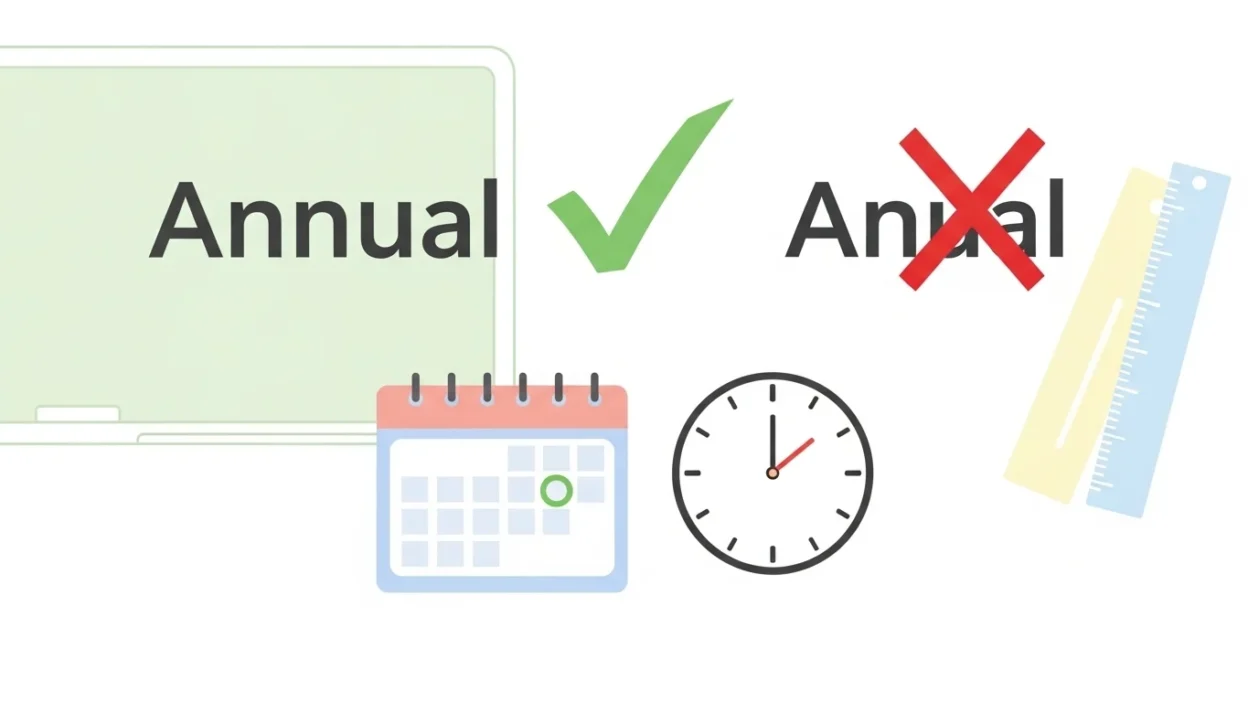
- ✅ Annual – Correct spelling; means happening once every year.
- ❌ Anual – Incorrect spelling; missing one “n.”
- 📚 Always use annual in formal and informal writing.
- ✏️ Remember: Annual has two “n” letters.
Origin and Background
The word annual comes from the Latin word annus, which means “year.” It entered English through Old French and has retained its meaning for centuries.
Because its root relates to the concept of a year, annual is used to describe events, reports, or activities that occur once every year. The incorrect spelling “anual” often results from accidentally omitting one of the two “n” letters.
Related Words
| Word | Meaning |
|---|---|
| Annual | Occurring once every year |
| Annually | Happening every year |
| Anniversary | The yearly celebration of an event |
| Perennial | Lasting for many years |
| Biennial | Occurring every two years |
Clear Explanation of the Difference
What Does “Annual” Mean?
Annual is an adjective that describes something that happens once every year.
Common Uses of “Annual”
- Events
- The school holds an annual sports day.
- They attend the annual cultural festival.
- Reports and Meetings
- The company released its annual report.
- The annual meeting will take place in June.
- Financial and Business Contexts
- She receives an annual bonus.
- The annual budget was approved.
- Nature and Plants
- Annual plants grow and complete their life cycle within one year.
What About “Anual”?
Anual is an incorrect spelling of annual. It is not recognized in standard English dictionaries and should never be used in formal or academic writing.
❌ Anual
✅ Annual
This mistake usually happens due to typing errors or uncertainty about double consonants.
Comparison Table
| Feature | Annual | Anual |
|---|---|---|
| Spelling | Correct | Incorrect |
| Meaning | Occurring once every year | No meaning in standard English |
| Part of Speech | Adjective | Not a valid word |
| Dictionary Recognition | Yes | No |
| Usage | Formal and informal English | Considered a spelling mistake |
| Example Sentence | The annual festival begins tomorrow. | ❌ The anual festival begins tomorrow. |
Which One to Use and When
Use “Annual” When:
- Describing events that happen every year
- Writing reports, essays, or emails
- Discussing finances or business matters
- Referring to yearly celebrations or meetings
- Talking about plants that grow once a year
Examples:
- The annual conference attracts global leaders.
- Our school organizes an annual picnic.
- The company published its annual financial report.
- She goes for an annual health checkup.
- The annual rainfall in the region is high.
Avoid “Anual”
Never use anual, as it is always incorrect in standard English.
Common Mistakes People Make
1. Dropping One “N”
Many learners accidentally write “anual” instead of “annual.”
❌ Anual
✅ Annual
2. Spelling Based on Sound
Since the word sounds smooth, writers may forget that it contains two “n” letters.
3. Typing Errors
Fast typing often leads to missing letters.
4. Confusion with Similar Words
Words like “manual” and “usual” may influence spelling patterns.
5. Lack of Proofreading
Not reviewing written work allows simple errors to go unnoticed.
Everyday Real-Life Examples
Emails
- “Please review the annual report.”
- “The annual meeting is scheduled for Monday.”
School and Education
- “Students participated in the annual sports day.”
- “The school’s annual function was a success.”
Workplace Communication
- “Employees receive an annual performance review.”
- “The annual budget has been approved.”
News and Media
- “The city hosted its annual cultural festival.”
- “The annual rainfall exceeded expectations.”
Healthcare
- “Doctors recommend an annual checkup.”
- “She scheduled her annual medical examination.”
Daily Conversations
- “We attend the annual fair every year.”
- “The annual celebration begins tonight.”
Short Learning Section for Students and Beginners
Easy Rule to Remember
Annual has two “n” letters because it comes from the word “annus,” meaning year.
Memory Tip
“One year, two N’s – Annual.”
Pronunciation Guide
- Annual: AN-yoo-uhl
Practice Exercise
Fill in the blanks with the correct word:
- The company published its ______ report.
- Our school organizes an ______ event.
- She goes for an ______ medical checkup.
Answers:
- annual
- annual
- annual
Quick Quiz
Choose the correct option:
- The ______ festival is held every year.
a) Anual
b) Annual - The company released its ______ statement.
a) Annual
b) Anual
Correct Answers:
- b) Annual
- a) Annual
Frequently Asked Questions (FAQs)
1. Is “anual” a correct spelling?
No, “anual” is incorrect and not recognized in standard English.
2. What is the correct spelling?
The correct spelling is annual.
3. What does “annual” mean?
It means happening once every year.
4. Why does “annual” have two “n” letters?
It comes from the Latin word annus, meaning “year.”
5. Is “annual” used in formal writing?
Yes, it is appropriate for both formal and informal contexts.
6. What is the adverb form of “annual”?
The adverb form is annually.
7. What is the difference between “annual” and “anniversary”?
Annual refers to yearly events, while an anniversary celebrates a specific date each year.
8. How can I remember the correct spelling?
Remember: One year, two N’s – Annual.
Conclusion
The difference between “annual” and “anual” is simple but important. Annual is the correct spelling and means something that happens once every year. In contrast, anual is an incorrect form caused by omitting one “n.”
To avoid mistakes, remember this easy rule: Annual has two “n” letters because it comes from the Latin word for “year.” Mastering this spelling will help you write clearly, confidently, and accurately in both academic and everyday communication.

Daniel Brooks is a technology and business writer with experience covering innovation, startups, and digital tools. His work emphasizes clarity, accuracy, and real-world application. Daniel aims to help readers understand emerging technologies and make informed decisions in a fast-changing digital landscape.