Many learners search for “wisp vs whisp” because both words sound similar and look almost identical. English spelling often includes silent letters, which can cause confusion. Students, ESL learners, and beginners sometimes assume that adding an “h” makes a word more accurate, leading to the incorrect spelling “whisp.”
This guide explains the difference in very simple English so you can understand it clearly and use the correct word with confidence.
Quick Answer
Here is the clear and simple answer:
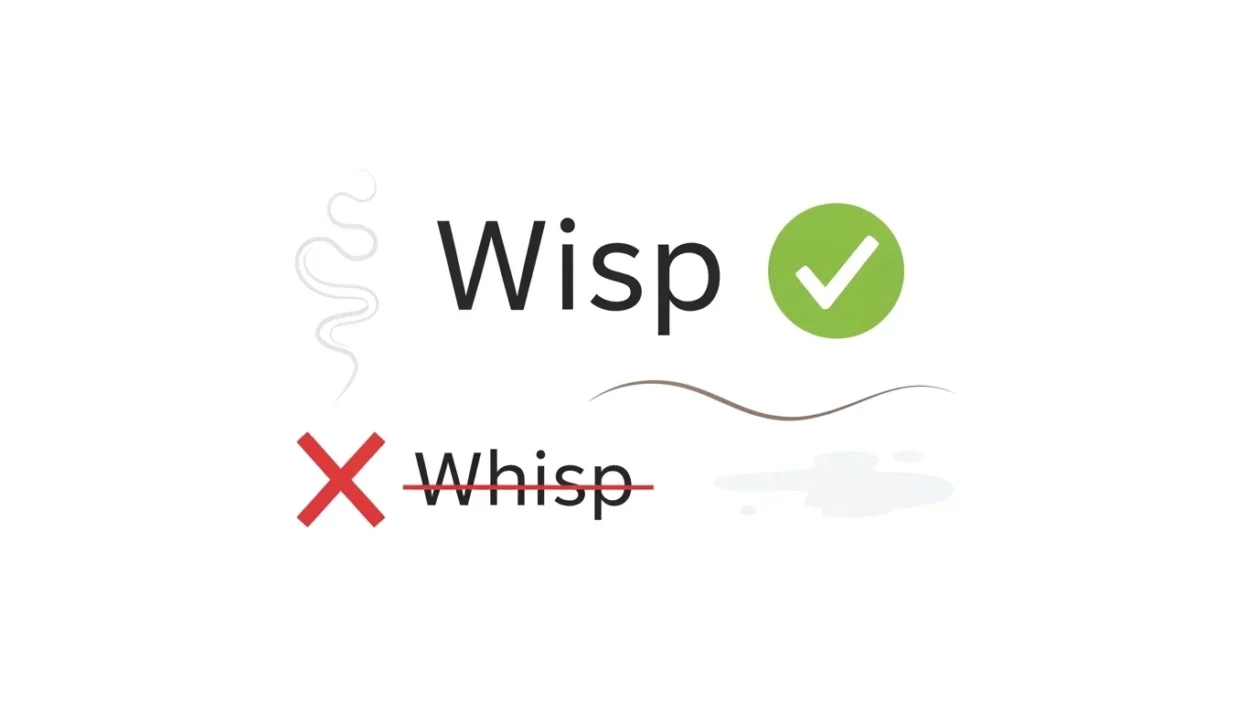
- ✅ Wisp – Correct spelling; means a small, thin, or delicate amount of something.
- ❌ Whisp – Incorrect spelling; not a real English word.
- 📚 Always use wisp in writing and speech.
- ✏️ Remember: Wisp has no “h.”
Origin and Background
The word wisp comes from Middle English wispe, which originally referred to a small bundle of straw or hay used for lighting fires or tying objects. Over time, its meaning expanded to describe anything thin, light, or delicate.
The incorrect spelling “whisp” likely developed because many English words begin with “wh,” such as whisper, white, while, and what. This similarity causes learners to mistakenly insert an “h” into the word wisp.
Clear Explanation of the Difference
What Does “Wisp” Mean?
Wisp is a noun that refers to a small, thin, or delicate amount of something. It is often used to describe things that are light and fragile.
Common Meanings
- A Thin Curl of Smoke or Mist
- A wisp of smoke rose into the air.
- The morning fog appeared as wisps of mist.
- A Small Lock of Hair
- A wisp of hair fell across her face.
- The child had soft wisps of curly hair.
- A Slight Trace or Hint
- There was a wisp of a smile on his lips.
- She felt a wisp of hope.
- A Delicate or Slender Person
- She was a wisp of a girl, light and graceful.
What About “Whisp”?
Whisp is not a standard English word. It is a misspelling of wisp and should never be used in formal or informal writing.
❌ Whisp
✅ Wisp
The confusion usually arises due to similarity with words like whisper.
Comparison Table
| Feature | Wisp | Whisp |
|---|---|---|
| Spelling | Correct | Incorrect |
| Meaning | A small, thin, delicate amount | No meaning in standard English |
| Part of Speech | Noun | Not a valid word |
| Dictionary Recognition | Yes | No |
| Usage | Formal and informal English | Considered a spelling mistake |
| Example Sentence | A wisp of smoke drifted away. | ❌ A whisp of smoke drifted away. |
Which One to Use and When
Use “Wisp” When:
- Describing thin smoke, mist, or vapor
- Referring to a small lock of hair
- Expressing a slight trace of emotion
- Writing stories, essays, or poems
- Communicating in academic or professional contexts
Examples:
- A wisp of smoke curled into the sky.
- She brushed a wisp of hair from her eyes.
- There was a wisp of sadness in his voice.
- The fog appeared in soft wisps.
- A wisp of cloud floated across the horizon.
Avoid “Whisp”
Never use whisp, as it is not recognized in standard English.
Common Mistakes People Make
1. Adding an Unnecessary “H”
Learners often assume the word begins with “wh” because of similar English words.
❌ Whisp
✅ Wisp
2. Confusing It with “Whisper”
The resemblance to whisper leads to incorrect spelling.
3. Spelling Based on Assumption
Some writers believe adding letters makes a word more accurate.
4. Typing Errors
Fast typing can result in accidental mistakes.
5. Lack of Proofreading
Not reviewing written work allows errors to go unnoticed.
Everyday Real-Life Examples
Emails
- “A wisp of smoke was seen near the engine.”
School and Education
- “The poem described a wisp of morning mist.”
Workplace Communication
- “A wisp of steam escaped from the machine.”
News and Media
- “A wisp of cloud hovered over the mountain.”
Literature and Storytelling
- “A wisp of fog drifted through the valley.”
- “She offered a wisp of a smile.”
Daily Conversations
- “A wisp of hair fell across his forehead.”
- “There was a wisp of hope in her voice.”
Short Learning Section for Students and Beginners
Easy Rule to Remember
Wisp begins with “W,” not “WH.”
Memory Tip
“A wisp is small—so it uses fewer letters.”
Pronunciation Guide
- Wisp: WISP
Practice Exercise
Fill in the blanks with the correct word:
- A ______ of smoke rose from the fire.
- She tucked a ______ of hair behind her ear.
- A ______ of mist floated across the field.
Answers:
- wisp
- wisp
- wisp
Quick Quiz
Choose the correct option:
- A ______ of cloud drifted across the sky.
a) Whisp
b) Wisp - He showed a ______ of a smile.
a) Wisp
b) Whisp
Correct Answers:
- b) Wisp
- a) Wisp
Frequently Asked Questions (FAQs)
1. Is “whisp” a real English word?
No, it is an incorrect spelling of wisp.
2. What is the correct spelling?
The correct spelling is wisp.
3. What does “wisp” mean?
It refers to a small, thin, or delicate amount of something.
4. Is “wisp” a noun?
Yes, wisp is a noun.
5. What is the plural form of “wisp”?
The plural form is wisps.
6. How do you pronounce “wisp”?
It is pronounced as WISP.
7. Why do people write “whisp”?
They confuse it with words that begin with “wh,” such as whisper.
8. How can I remember the correct spelling?
Remember: A wisp is small, so the word is short—no “h.”
Conclusion
The difference between “wisp” and “whisp” is simple but important. Wisp is the correct spelling and refers to a small, thin, or delicate amount of something, such as smoke, mist, or hair. In contrast, whisp is an incorrect spelling that should never be used in standard English.
To avoid mistakes, remember this easy rule: Wisp has no “h.” Mastering this word will help you write clearly, confidently, and accurately in everyday and academic communication.

Michael Anderson is a professional editor and senior contributor with a background in long-form content and strategic writing. He focuses on quality, structure, and credibility across all publications. Michael brings years of experience in content development and ensures high editorial standards for every project.