Many people search for “embassador vs ambassador” because both words sound very similar. When we speak quickly, ambassador can sound like “embassador,” which leads to spelling mistakes. This is especially common for students, ESL learners, and beginners who rely on pronunciation.
The good news is that the difference is very simple. Once you learn the correct form, you will never confuse it again.
Quick Answer
Here is the clear and simple answer:
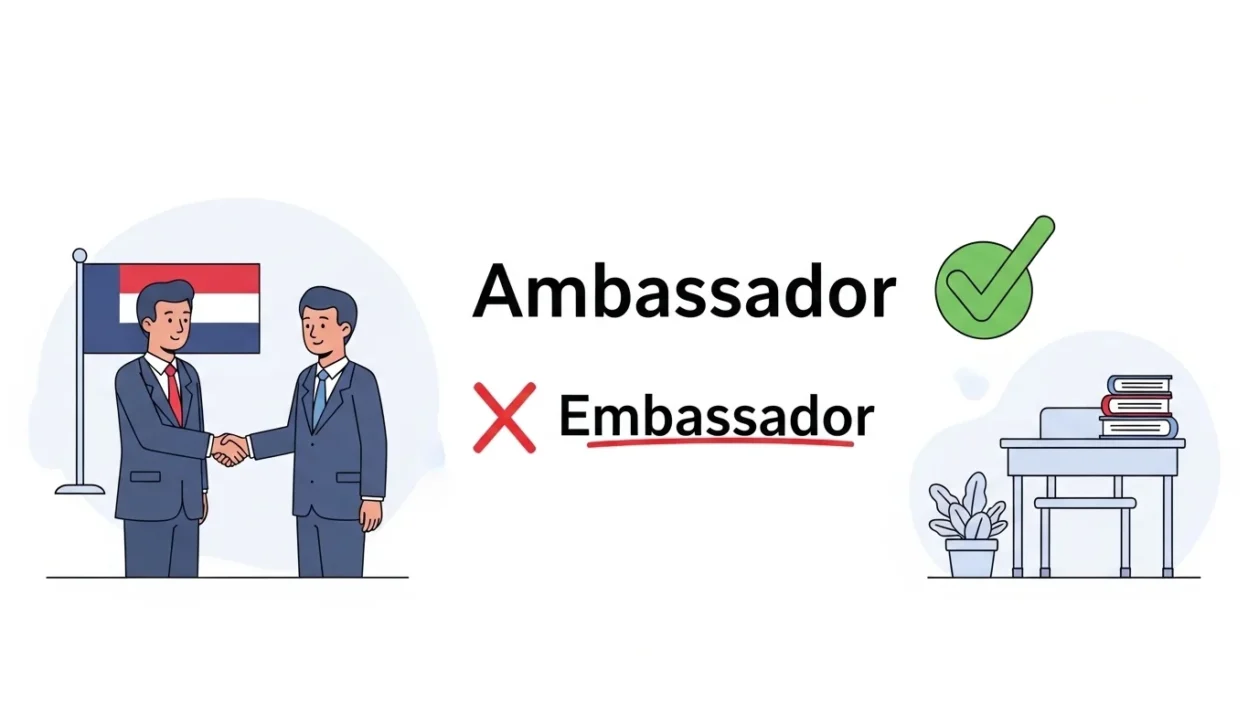
- ✅ Ambassador – Correct spelling; a person who represents a country or group.
- ❌ Embassador – Incorrect spelling; not a real English word.
- 📚 Always use ambassador in writing and speech.
- ✏️ Remember: It starts with “am,” not “em.”
Origin and Background
The word ambassador comes from Latin and Old French roots. It is related to the idea of “sending” someone on a mission.
- Ambassador originally meant a person sent to represent a ruler or country.
- Over time, it became a formal title for diplomats.
The incorrect spelling “embassador” likely appears because of pronunciation. In some accents, the “a” sound may feel like an “e,” causing confusion.
Related Words
| Word | Meaning |
|---|---|
| Ambassador | A person who represents a country |
| Embassy | The official residence or office of an ambassador |
| Diplomat | A person involved in international relations |
| Ambassadorial | Related to an ambassador |
Clear Explanation of the Difference
What Does “Ambassador” Mean?
Ambassador is a noun. It refers to someone who represents a country, organization, or idea.
Common Meanings
- Government Representative
- She is the ambassador to another country.
- Official Diplomat
- The ambassador attended the international meeting.
- Brand or Organization Representative
- He is a brand ambassador for a sports company.
- Symbolic Representative
- She is an ambassador of peace.
What About “Embassador”?
Embassador is not a correct English word. It is simply a misspelling of ambassador.
❌ Embassador
✅ Ambassador
You should never use “embassador” in formal or informal writing.
Comparison Table
| Feature | Ambassador | Embassador |
|---|---|---|
| Spelling | Correct | Incorrect |
| Meaning | A representative of a country or group | No meaning in English |
| Part of Speech | Noun | Not a valid word |
| Dictionary Recognition | Yes | No |
| Usage | Formal and informal English | Considered a spelling error |
| Example Sentence | He is an ambassador of goodwill. | ❌ He is an embassador of goodwill. |
Which One to Use and When
Use “Ambassador” When:
- Talking about international relations
- Referring to diplomats
- Describing brand representatives
- Writing essays, emails, or reports
- Speaking in formal or informal situations
Examples:
- The ambassador met with foreign leaders.
- She serves as an ambassador for education.
- He became a brand ambassador.
- The ambassador gave a speech at the event.
- They appointed her as a peace ambassador.
Avoid “Embassador”
Never use embassador, as it is always incorrect.
Common Mistakes People Make
1. Writing Based on Pronunciation
People hear “em” instead of “am” and spell it incorrectly.
❌ Embassador
✅ Ambassador
2. Confusing Vowel Sounds
The “a” sound may seem like “e” in fast speech.
3. Typing Errors
Quick typing can lead to incorrect spelling.
4. Lack of Proofreading
Mistakes remain when writing is not reviewed.
5. Limited Vocabulary Practice
Not seeing the word often can cause confusion.
Everyday Real-Life Examples
Emails
- “The ambassador will attend the meeting.”
- “She is our brand ambassador.”
School and Education
- “Students learned about the role of an ambassador.”
- “He wrote an essay about a famous ambassador.”
Workplace Communication
- “The company appointed a new ambassador.”
- “She acts as an ambassador for the organization.”
News and Media
- “The ambassador held talks with officials.”
- “A new ambassador was नियुक्तed.”
Social Media
- “She is a fashion brand ambassador.”
- “He promotes products as an ambassador.”
Daily Conversations
- “He wants to become an ambassador.”
- “She represents her country as an ambassador.”
Short Learning Section for Students and Beginners
Easy Rule to Remember
Ambassador starts with “am” like “amazing.”
Memory Tip
“An ambassador is amazing—so it starts with AM.”
Pronunciation Guide
- Ambassador: am-BASS-uh-der
Practice Exercise
Fill in the blanks with the correct word:
- She is an ______ of peace.
- The ______ attended the meeting.
- He became a brand ______.
Answers:
- ambassador
- ambassador
- ambassador
Quick Quiz
Choose the correct option:
- He is an ______ of goodwill.
a) Embassador
b) Ambassador - The ______ spoke at the event.
a) Ambassador
b) Embassador
Correct Answers:
- b) Ambassador
- a) Ambassador
Frequently Asked Questions (FAQs)
1. Is “embassador” a correct spelling?
No, it is incorrect and not used in standard English.
2. What is the correct spelling?
The correct spelling is ambassador.
3. What does “ambassador” mean?
It means a person who represents a country, organization, or idea.
4. Why do people write “embassador”?
Because of pronunciation confusion.
5. Is “ambassador” used in formal writing?
Yes, it is commonly used in formal and informal contexts.
6. What is an embassy?
An embassy is the office or residence of an ambassador.
7. Can “ambassador” be used outside politics?
Yes, it can describe brand or goodwill representatives.
8. How can I remember the correct spelling?
Remember: It starts with “AM,” not “EM.”
Conclusion
The difference between “embassador” and “ambassador” is simple but important. Ambassador is the correct spelling and refers to a person who represents a country or organization. In contrast, embassador is an incorrect form that should never be used.
To avoid mistakes, remember this simple rule: Ambassador starts with “am.” Learning this will help you write clearly, confidently, and correctly in all situations.

Michael Anderson is a professional editor and senior contributor with a background in long-form content and strategic writing. He focuses on quality, structure, and credibility across all publications. Michael brings years of experience in content development and ensures high editorial standards for every project.