
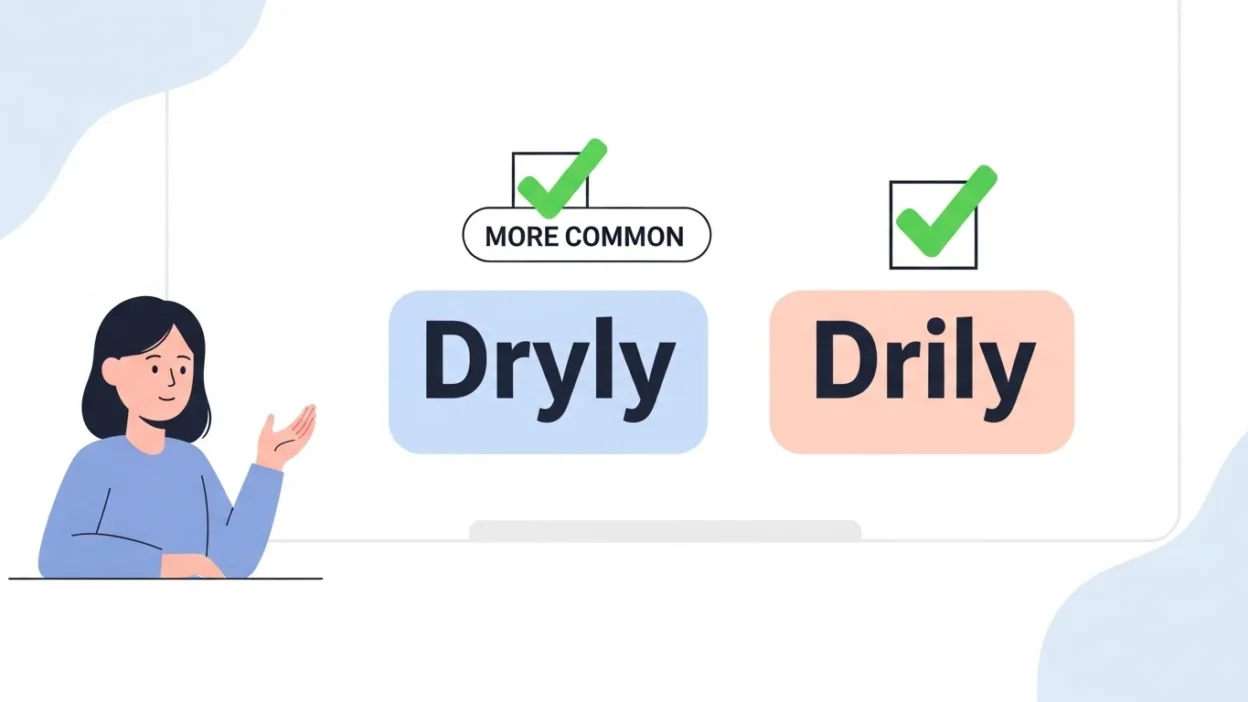
Many learners search for “drily vs dryly” because both spellings look correct. This is one of those rare cases in English where two spellings exist for the same word. The confusion happens because English sometimes changes “y” to “i” before adding endings, but not always.
The good news is simple: both forms are correct, but one is more common. This guide explains everything in very easy English so you can use the right form with confidence.
Quick Answer
Here is the clear and simple answer:
- ✅ Dryly – Correct and more common spelling.
- ✅ Drily – Also correct, but less common.
- 📚 Both words mean the same thing.
- ✏️ Use dryly in most everyday writing.
Origin and Background
The word comes from the adjective dry, which means “not wet” or “lacking emotion.”
When we turn dry into an adverb (to describe how something is said or done), we add -ly.
There are two ways this happens:
- Dry + ly → Dryly
- Dry → Dri + ly → Drily
Both forms developed over time and are accepted in standard English.
Clear Explanation of the Difference
What Do “Dryly” and “Drily” Mean?
Both dryly and drily are adverbs. They describe how something is said or done in a way that is:
- Not emotional
- Slightly sarcastic
- Calm or plain
- Without humor (or with very subtle humor)
Examples of Meaning
- Without Emotion
- He spoke dryly about the situation.
- With Subtle Humor
- She dryly commented on the mistake.
- In a Calm or Plain Way
- The teacher dryly explained the rule.
👉 You can replace dryly with drily in all these examples, and the meaning stays the same.
Comparison Table
| Feature | Dryly | Drily |
|---|---|---|
| Spelling | Correct | Correct |
| Usage | More common | Less common |
| Meaning | Same | Same |
| Style | Modern, preferred | Slightly formal or old-fashioned |
| Dictionary Recognition | Yes | Yes |
| Example | He replied dryly. | He replied drily. |
Which One to Use and When
Use “Dryly” When:
- Writing emails, essays, or reports
- Communicating in modern English
- You want the safest and most common form
- Writing for general readers
Examples:
- He dryly said, “That was expected.”
- She dryly replied to the question.
- The teacher dryly explained the answer.
- He dryly joked about the situation.
- She dryly noted the error.
When to Use “Drily”
You may see drily in:
- Older texts or books
- Formal or literary writing
- British-style writing (in some cases)
Examples:
- He drily remarked on the issue.
- She drily observed the situation.
👉 Still correct—but less common.
Common Mistakes People Make
1. Thinking One Is Wrong
Some learners believe drily is incorrect—but it is actually valid.
2. Overthinking the Rule
People get confused about changing “y” to “i.”
3. Mixing Both Forms
Using dryly and drily in the same document can look inconsistent.
4. Choosing the Less Common Form
Using drily in casual writing may feel unusual to readers.
5. Ignoring Consistency
Switching between spellings can confuse readers.
Everyday Real-Life Examples
Emails
- “He dryly replied to the message.”
- “She dryly pointed out the mistake.”
School and Education
- “The teacher dryly explained the concept.”
- “He dryly answered the question.”
Workplace Communication
- “She dryly commented on the report.”
- “He dryly noted the delay.”
News and Media
- “The speaker dryly criticized the policy.”
- “The article dryly reported the facts.”
Social Media
- “He dryly joked about the situation.”
- “She dryly reacted to the post.”
Daily Conversations
- “He dryly said it was obvious.”
- “She dryly smiled at the comment.”
Short Learning Section for Students and Beginners
Easy Rule to Remember
Both are correct, but “dryly” is more common.
Memory Tip
“Keep the ‘y’—use dryly.”
Pronunciation Guide
- Dryly / Drily: DRY-lee
Practice Exercise
Fill in the blanks with the correct word:
- He ______ replied to the comment.
- She ______ explained the answer.
- The teacher ______ spoke about the topic.
Answers:
- dryly
- dryly
- dryly
(You can also use drily, but dryly is preferred.)
Quick Quiz
Choose the correct option:
- He ______ said, “That’s obvious.”
a) Dryly
b) Drily
c) Both - Which is more common in modern English?
a) Drily
b) Dryly
Correct Answers:
- c) Both
- b) Dryly
Frequently Asked Questions (FAQs)
1. Are “dryly” and “drily” both correct?
Yes, both spellings are correct.
2. Which one should I use?
Use dryly because it is more common.
3. Do they have different meanings?
No, both have exactly the same meaning.
4. Is “drily” old-fashioned?
It can sound slightly more formal or traditional.
5. Is “dryly” used in formal writing?
Yes, it is widely accepted in all contexts.
6. How do you pronounce them?
Both are pronounced DRY-lee.
7. Should I use both in the same text?
No, choose one and stay consistent.
8. What is the easiest way to remember?
Remember: “Dryly is the common choice.”
Conclusion
The difference between “drily” and “dryly” is simple: both are correct and mean the same thing. However, dryly is more common and preferred in modern English, while drily is less common and sometimes feels more formal.
To avoid confusion, follow this easy rule: Use “dryly” in most situations. This will help you write clearly, naturally, and confidently.

Emily Carter is a content writer and editor based in the United States, specializing in lifestyle, wellness, and personal development topics. With a passion for clear and engaging storytelling, she creates content that connects with readers and delivers practical value. Emily focuses on making complex ideas easy to understand and relatable.