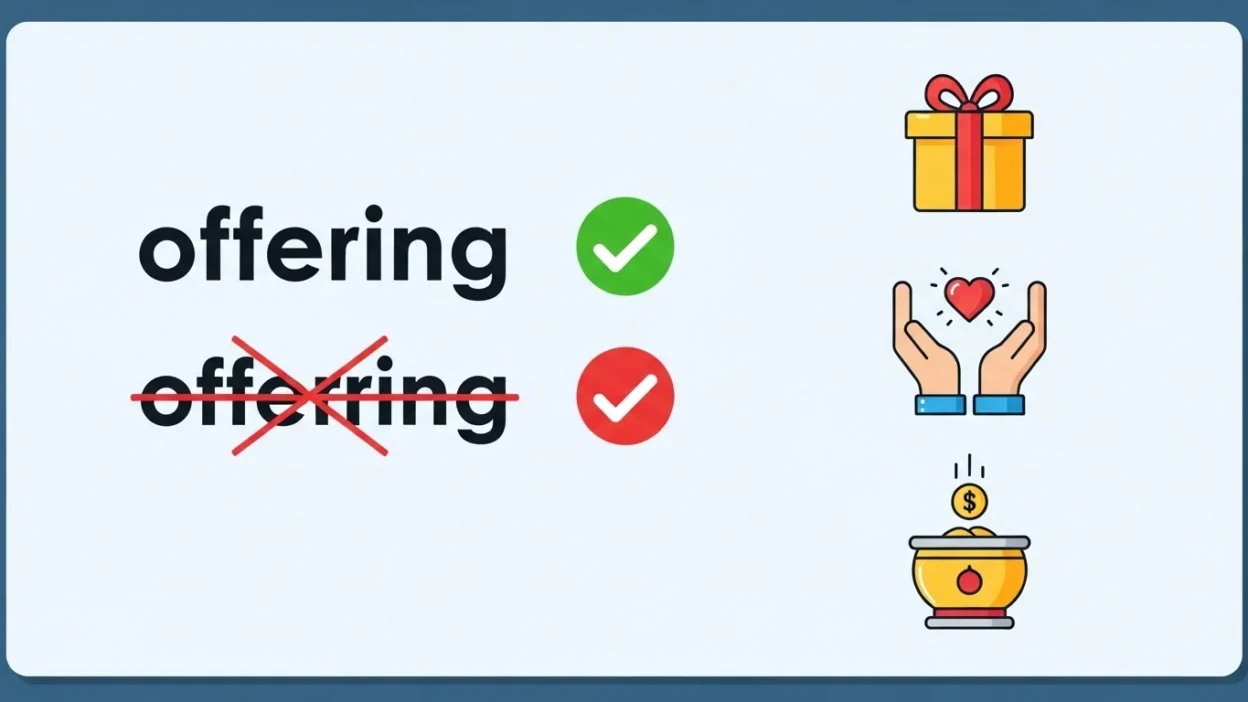
Many learners feel confused between “offerring” and “offering.” These words look almost the same, and the only difference is an extra “r.” Because English has rules about doubling letters, students often wonder which spelling is correct.
This confusion is common among beginners and ESL learners. Some verbs double the last letter before adding -ing, while others do not. Understanding this rule will help you avoid spelling mistakes and write confidently.
The good news is that the answer is simple. This article explains everything in clear and easy English so you can understand it on the first read.
Quick Answer
- Offering = correct spelling (means giving or presenting something)
- Offerring = incorrect spelling
✔ Correct: She is offering help to her friend.
❌ Incorrect: She is offerring help to her friend.
👉 Always use offering
Simple Origin and Background
The Base Word: “Offer”
The word “offer” is a verb. It means:
- To give something
- To present help or a service
- To propose or suggest something
Examples:
- He offered me a seat.
- They offered support.
- She offered her assistance.
The word comes from Latin roots meaning “to present” or “to bring forward.”
How Is “Offering” Formed?
To form offering, we simply add -ing to the base word:
- offer + ing → offering
The spelling stays the same, and no extra letters are added.
Clear Explanation of the Difference
What Does “Offering” Mean?
Offering is the correct spelling. It can be used as:
1. A Verb (Present Continuous Form)
It describes an action happening now.
Examples:
- She is offering help.
- The company is offering discounts.
- They are offering free training.
2. A Noun
It refers to something that is given or presented.
Examples:
- The temple received an offering.
- This product is the company’s newest offering.
- He brought an offering of flowers.
What About “Offerring”?
Offerring is incorrect. It is a spelling mistake caused by misunderstanding the rule of double consonants.
- It is not accepted in standard English.
- It will be marked wrong in exams and formal writing.
- It should never be used.
Comparison Table
| Feature | Offering | Offerring |
|---|---|---|
| Meaning | Giving or presenting something | No meaning |
| Usage | Correct and widely used | Incorrect |
| Spelling | One “r” before “-ing” | Two “r”s (wrong) |
| Grammar | Proper English | Not accepted |
| Use in exams | Correct | Marked wrong |
| Parts of Speech | Noun and verb | Not applicable |
Which One to Use and When
Use “Offering” in All Situations
You should use offering when describing:
- Giving help or support
- Presenting goods or services
- Making religious or symbolic gifts
Examples:
- She is offering advice.
- The store is offering big discounts.
- He made an offering at the shrine.
- This is our latest product offering.
Avoid “Offerring”
Never use offerring in:
- School assignments
- Exams
- Emails and reports
- Social media posts
- Professional communication
It is always incorrect.
Common Mistakes People Make
1. Adding an Extra “R”
Many learners assume that verbs ending in -er double the final letter before adding -ing. This is not true for offer.
Incorrect:
- ❌ offerring
Correct:
- ✔ offering
2. Misunderstanding the Double Consonant Rule
A consonant is doubled only when a word ends in a vowel + consonant with stress on the last syllable, such as:
- run → running
- begin → beginning
But offer has stress on the first syllable (OF-fer), so the “r” is not doubled.
3. Spelling Based on Sound
Since “offer” ends with “er,” learners may assume it needs another “r,” leading to the incorrect form.
4. Typing Too Fast
Quick typing often results in accidental spelling errors like “offerring.”
Everyday Real-Life Examples
In Emails
Correct:
- We are offering a special discount.
- The company is offering new services.
Incorrect:
- We are offerring a special discount.
In Business and Advertising
- The bank is offering low-interest loans.
- This is our newest product offering.
- The company is offering free delivery.
On Social Media
- They are offering amazing deals!
- Thank you for offering your help.
In Daily Conversation
- She is offering me a job.
- He is offering his support.
In Religious or Cultural Contexts
- They made an offering at the temple.
- Flowers were placed as an offering.
Short Learning Section for Students and Beginners
Simple Rule to Remember
👉 Offer + ing = Offering (no extra “r”)
Easy Memory Trick
Think:
👉 “Offer stays simple, so offering has one ‘r’.”
Practice Sentences
Fill in the blanks:
- She is ______ help to her friend.
✔ offering - The company is ______ free training.
✔ offering - He brought an ______ to the temple.
✔ offering
Mini Exercise
Choose the correct word:
- She is offerring/offering assistance.
✔ offering - The store is offerring/offering discounts.
✔ offering - This is the company’s latest offerring/offering.
✔ offering
FAQ Section
1. Is “offerring” a real word?
No, it is a spelling mistake and not accepted in standard English.
2. What does “offering” mean?
It means giving, presenting, or proposing something.
3. Why is the “r” not doubled in “offering”?
Because the stress is on the first syllable of “offer,” so the final consonant is not doubled.
4. Can “offering” be used as both a noun and a verb?
Yes. It can describe an action or refer to something given.
5. Can I use “offerring” in exams?
No. It will be marked incorrect.
6. What is the base form of “offering”?
The base word is offer.
7. Is “offering” commonly used in business English?
Yes, it is widely used to describe products, services, and deals.
8. How can I remember the correct spelling?
Remember:
👉 “Offer has one ‘r,’ so offering also has one ‘r.’”
Conclusion
The difference between offerring and offering is simple:
- Offering is the correct spelling and means giving or presenting something.
- Offerring is incorrect and should never be used.
This mistake happens because learners misunderstand spelling rules about double letters. By remembering the base word offer, you can always spell it correctly.
👉 Final Tip: One “r” in offer means one “r” in offering.
With this knowledge, you can write confidently and avoid common spelling errors.

Emily Carter is a content writer and editor based in the United States, specializing in lifestyle, wellness, and personal development topics. With a passion for clear and engaging storytelling, she creates content that connects with readers and delivers practical value. Emily focuses on making complex ideas easy to understand and relatable.