Many learners feel confused between “natzi” and “nazi.” These words look similar, and the difference is only one letter. Because of this, people often assume both spellings are correct. However, only one of them is accurate and recognized in English.
This confusion usually happens due to typing errors, lack of familiarity with historical terms, or misunderstanding of spelling. Since the correct word has deep historical significance, it is important to use it accurately and respectfully.
This article explains the difference in very simple English so students, beginners, and general readers can understand it clearly on the first read.
Quick Answer
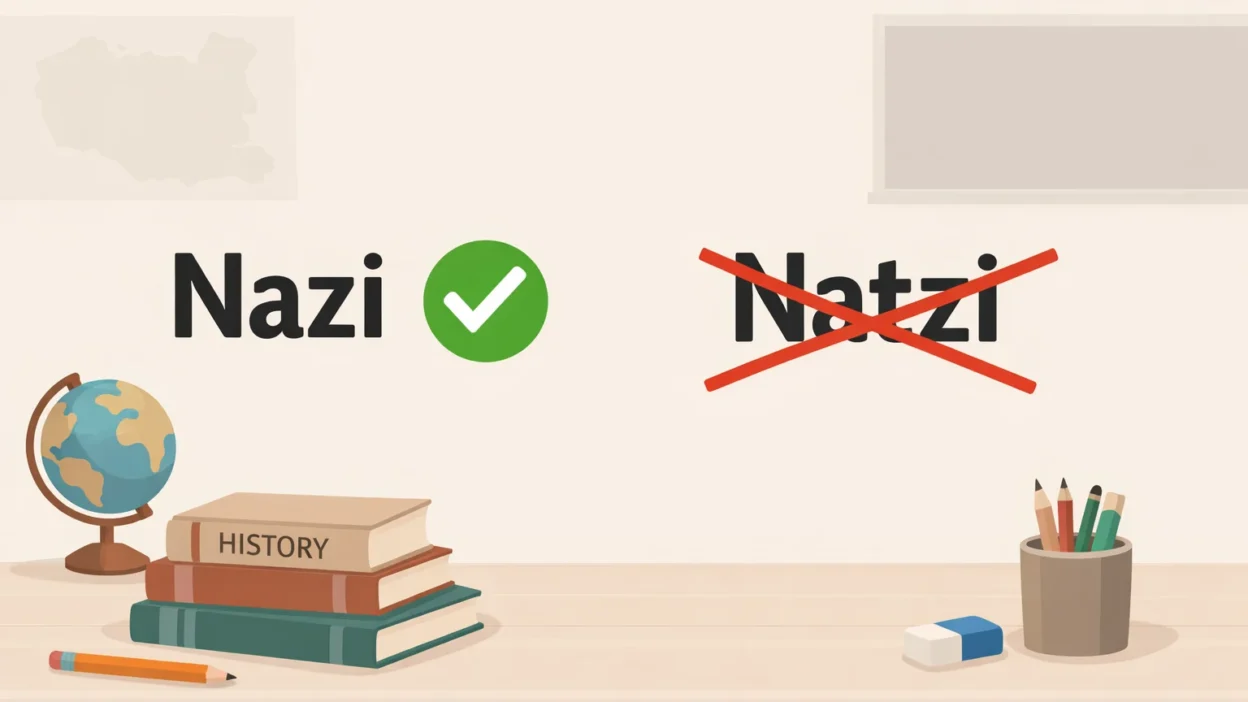
- Nazi = correct spelling (a historical and political term)
- Natzi = incorrect spelling (a common typo)
✔ Correct: The Nazi regime ruled Germany from 1933 to 1945.
❌ Incorrect: The Natzi regime ruled Germany from 1933 to 1945.
👉 Always use Nazi, never natzi.
Simple Origin and Background
What Does “Nazi” Mean?
The word “Nazi” is a short form of the German term “Nationalsozialist,” which means National Socialist. It refers to members of the political movement led by Adolf Hitler in Germany.
This movement controlled Germany from 1933 to 1945 and played a major role in World War II. The period is remembered for its strict dictatorship, aggressive expansion, and terrible human rights violations.
Because of its historical importance, the word “Nazi” is widely used in history books, documentaries, and academic discussions.
Why Does “Natzi” Exist?
The word “natzi” is not a real English word. It appears because:
- People accidentally insert an extra “t” while typing.
- They are unfamiliar with the correct spelling.
- They rely on pronunciation rather than proper spelling.
It is simply a spelling mistake and should never be used in formal or informal writing.
Clear Explanation of the Difference
What Does “Nazi” Mean?
Nazi refers to:
- A member of the National Socialist German Workers’ Party.
- The ideology and government associated with Adolf Hitler.
- Historical events related to World War II.
Examples:
- The Nazi regime influenced European history.
- Students study Nazi Germany in history classes.
- Museums preserve records of the Nazi era.
Because of its sensitive nature, the word should be used only in historical, educational, or factual contexts.
What About “Natzi”?
Natzi:
- Has no meaning in English.
- Is not recognized by dictionaries.
- Is considered a spelling error.
If used in exams or formal writing, it will be marked incorrect.
Comparison Table
| Feature | Nazi | Natzi |
|---|---|---|
| Meaning | Historical and political term | No meaning |
| Usage | Correct | Incorrect |
| Spelling | N-A-Z-I | N-A-T-Z-I (wrong) |
| Recognition | Accepted worldwide | Not recognized |
| Grammar | Proper English | Spelling error |
| Use in exams | Correct | Marked wrong |
Which One to Use and When
Use “Nazi”
Use Nazi when discussing:
- World War II history
- Nazi Germany
- Political or historical studies
- Educational materials and documentaries
Examples:
- The Nazi government controlled Germany during World War II.
- Students learn about the impact of the Nazi regime.
- Books analyze the rise and fall of the Nazi Party.
Always use the term respectfully and in factual contexts.
Never Use “Natzi”
Avoid natzi in all situations, including:
- School assignments
- Exams
- Essays and research papers
- Emails and reports
It is always incorrect and unprofessional.
Common Mistakes People Make
1. Adding an Extra “T”
Many learners mistakenly write:
- ❌ natzi
Instead of: - ✔ nazi
2. Typing Too Quickly
Fast typing often results in accidental spelling errors.
3. Spelling by Sound
Some people assume the spelling based on pronunciation, which leads to mistakes.
4. Lack of Historical Knowledge
Learners unfamiliar with world history may not recognize the correct form.
Everyday Real-Life Examples
In History Books
- The Nazi regime rose to power in 1933.
- Nazi Germany played a central role in World War II.
In Education
- Students study the Nazi era to understand global history.
- Teachers explain the impact of Nazi policies.
In Documentaries and News
- The documentary explores life under Nazi rule.
- Museums preserve artifacts from the Nazi period.
In Academic Writing
- The research focuses on Nazi propaganda.
- The essay analyzes the fall of Nazi Germany.
Short Learning Section for Students and Beginners
Simple Rule to Remember
👉 Nazi is correct; Natzi is wrong.
Easy Memory Trick
Think:
👉 “Nazi has four letters—N-A-Z-I.”
No extra letters are needed.
Practice Sentences
Fill in the blanks:
- The ______ regime ruled Germany during World War II.
✔ Nazi - Students learn about ______ Germany in history class.
✔ Nazi - The museum displays artifacts from the ______ era.
✔ Nazi
Mini Exercise
Choose the correct word:
- The Natzi/Nazi government rose to power in 1933.
✔ Nazi - We studied Natzi/Nazi Germany in class.
✔ Nazi - The Natzi/Nazi period is an important part of history.
✔ Nazi
FAQ Section
1. Is “natzi” a real word?
No, it is a spelling mistake and not recognized in English.
2. What does “Nazi” mean?
It refers to members of the National Socialist movement in Germany during Adolf Hitler’s rule.
3. Why is the word “Nazi” capitalized?
It is a proper noun derived from a German political party name.
4. Can I use “natzi” in exams?
No. It will be marked incorrect.
5. Is “Nazi” used only in history?
It is mainly used in historical and educational contexts.
6. Why is it important to spell “Nazi” correctly?
Because it is a sensitive historical term with significant global importance.
7. How can I remember the correct spelling?
Remember: N-A-Z-I — no extra letters.
8. Is it appropriate to use this word casually?
No. It should be used respectfully and only in factual discussions.
Conclusion
The difference between natzi and nazi is simple but important:
- Nazi is the correct spelling and a historically significant term.
- Natzi is incorrect and should never be used.
Understanding the correct spelling helps ensure clarity, accuracy, and respect when discussing world history. Always remember:
👉 Use “Nazi,” never “natzi.”
This knowledge will help you write confidently and correctly in academic and general contexts.

Sophia Reynolds is a digital writer and researcher with a focus on modern trends, productivity, and online education. She enjoys exploring new ideas and presenting them in a simple, reader-friendly way. Sophia is committed to creating informative and trustworthy content that helps audiences stay informed and inspired.