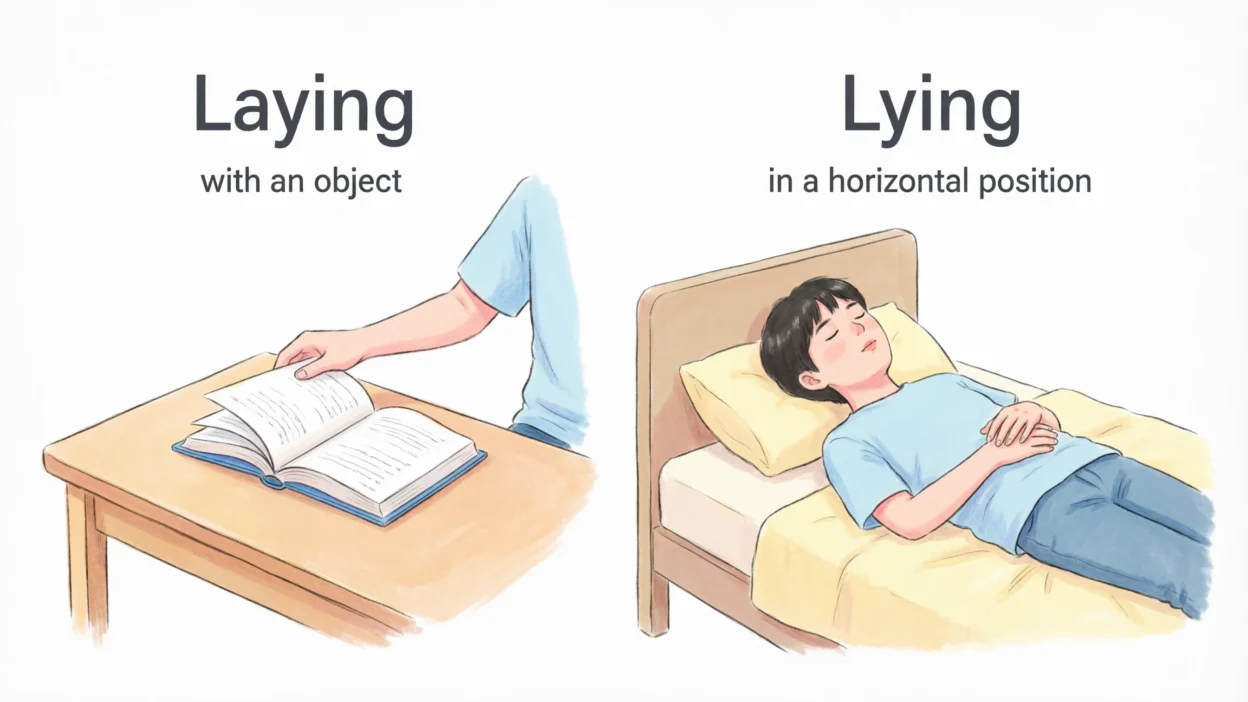
Many learners struggle with “laying vs lying” because both relate to resting or placing something down. The confusion comes from their similar forms, but the grammar is different.
The key idea: object vs no object.
Quick Answer
- ✅ Laying – Putting something down (needs an object)
- ✅ Lying – Resting or being in a position (no object)
- ✏️ Remember: Lay = place something, Lie = rest
Clear Explanation
What Does “Laying” Mean?
Laying comes from the verb lay.
👉 It means:
- to put or place something down
- it always needs an object (something you lay)
Examples:
- She is laying the book on the table.
- He is laying the bricks carefully.
- They are laying the carpet.
- She is laying the baby in bed.
- The worker is laying tiles.
👉 Notice: something is being placed (book, bricks, carpet, baby).
What Does “Lying” Mean?
Lying comes from the verb lie.
👉 It means:
- to rest, recline, or be in a position
- it does not need an object
Examples:
- He is lying on the bed.
- The keys are lying on the table.
- She is lying under the tree.
- The dog is lying on the floor.
- I am lying down.
👉 Nothing is being placed—just resting.
Key Difference
| Feature | Laying | Lying |
|---|---|---|
| Verb | Lay | Lie |
| Meaning | Put something down | Rest / recline |
| Needs object | Yes | No |
| Example | Laying the book | Lying on bed |
Important Forms (Very Useful)
Lay (to place something)
- Present: lay / laying
- Past: laid
- Past participle: laid
👉 Example:
- She laid the book down.
Lie (to rest)
- Present: lie / lying
- Past: lay (confusing!)
- Past participle: lain
👉 Example:
- He lay on the bed yesterday.
- He has lain there for hours.
Common Mistakes People Make
1. Using “Laying” Without an Object
❌ I am laying on the bed
✅ I am lying on the bed
2. Forgetting Object Rule
“Lay” always needs something.
3. Confusing Past Tense
- Lie → past = lay
- Lay → past = laid
4. Mixing Meanings
Placement vs resting confusion.
5. Ignoring Context
Check if something is being placed.
Easy Trick to Remember
👉 Ask yourself:
“Am I putting something somewhere?”
- YES → laying
- NO → lying
Memory Tip
“Lay = place, Lie = relax”
Everyday Real-Life Examples
Daily Life
- “She is laying the table.”
- “He is lying on the sofa.”
Home
- “They are laying tiles.”
- “The cat is lying on the bed.”
Work
- “Workers are laying cables.”
- “The files are lying on the desk.”
Nature
- “The hen is laying eggs.”
- “The dog is lying in the sun.”
Practice Exercise
Fill in the blanks:
- He is ______ on the bed.
- She is ______ the table.
- The keys are ______ there.
Answers:
- lying
- laying
- lying
Quick Quiz
- She is ______ the book on the table.
a) Lying
b) Laying - He is ______ on the couch.
a) Laying
b) Lying
Correct Answers:
- b) Laying
- b) Lying
Frequently Asked Questions (FAQs)
1. What is the main difference?
Laying needs an object; lying does not.
2. Which one means resting?
Lying.
3. Which one means placing something?
Laying.
4. Why is it confusing?
Past tense forms overlap.
5. Is this a common mistake?
Yes, very common.
6. What is the past of “lie”?
Lay.
7. What is the past of “lay”?
Laid.
8. How can I remember it?
“Lay = place, Lie = rest.”
Conclusion
The difference between “laying” and “lying” comes down to one simple rule. Laying means placing something and requires an object, while lying means resting and does not need an object.
To keep it simple:
👉 Laying = putting something down
👉 Lying = resting

Emily Carter is a content writer and editor based in the United States, specializing in lifestyle, wellness, and personal development topics. With a passion for clear and engaging storytelling, she creates content that connects with readers and delivers practical value. Emily focuses on making complex ideas easy to understand and relatable.