
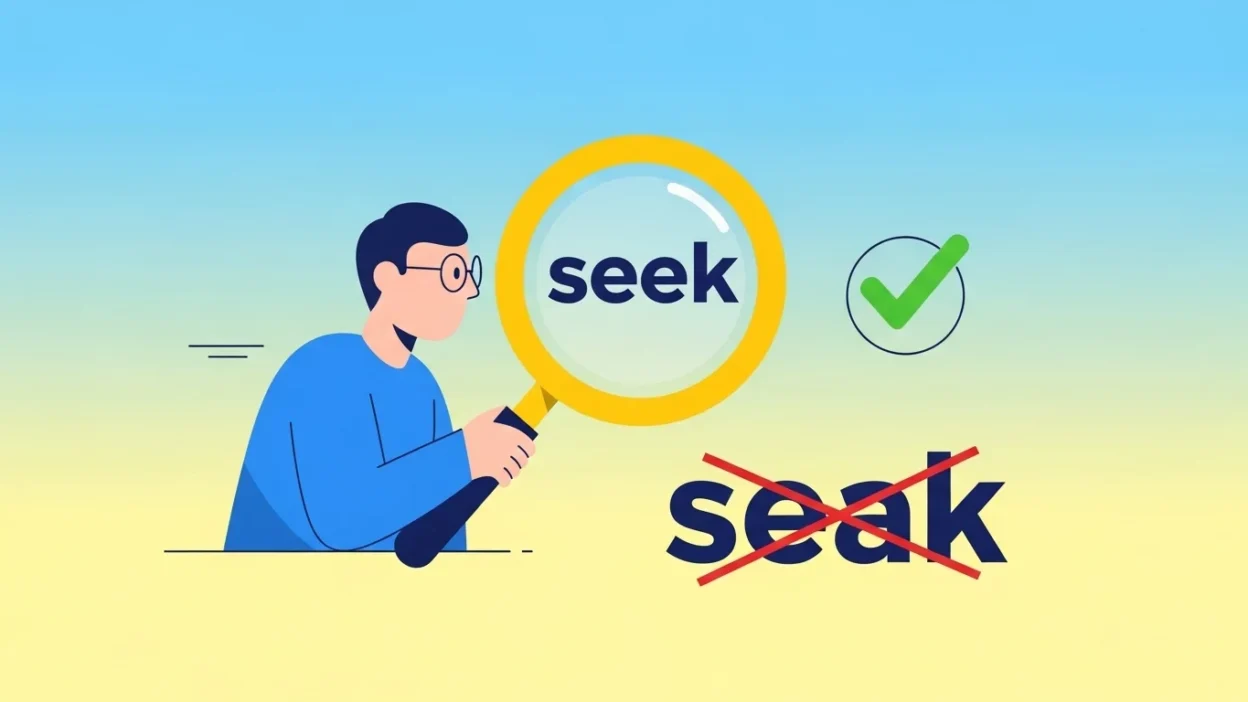
Many learners feel confused between “seak” and “seek.” These words look very similar, and the difference is only one letter: “a” instead of “e.” Because of this small change, people often assume both spellings are correct.
The confusion also happens because English has many words with similar sounds but different spellings. Beginners and ESL learners sometimes rely on pronunciation rather than correct spelling, which leads to mistakes.
The good news is that the answer is simple. Only one of these words is correct in modern English. This article explains everything in clear and easy language so you can understand the difference quickly and confidently.
Quick Answer
- Seek = correct spelling (means to look for or try to find something)
- Seak = incorrect spelling (not a real English word)
✔ Correct: She wants to seek help.
❌ Incorrect: She wants to seak help.
👉 Always use seek
Simple Origin and Background
Where Does “Seek” Come From?
The word “seek” comes from Old English. It has been used for hundreds of years and means:
- To look for something
- To search for something
- To try to obtain something
It is commonly used in both spoken and written English today.
Examples:
- They seek knowledge.
- We seek peace.
Why Does “Seak” Exist?
The word “seak” is not part of standard English. It appears because:
- Learners confuse vowel sounds.
- They guess the spelling based on pronunciation.
- They mix it up with words like “speak” or “steak.”
However, “seak” is always incorrect and should never be used.
Clear Explanation of the Difference
What Does “Seek” Mean?
Seek is a verb (an action word). It means:
- To look for something
- To try to get or achieve something
- To ask for help or advice
Examples:
- She seeks advice from her teacher.
- They seek justice.
- He is seeking a new job.
- We must seek the truth.
It is often used in formal, academic, and professional English.
What About “Seak”?
Seak:
- Is not a correct English word.
- Has no meaning in standard English.
- Is simply a spelling mistake.
If you write “seak” in exams, emails, or essays, it will be marked incorrect.
Comparison Table
| Feature | Seek | Seak |
|---|---|---|
| Meaning | To look for or try to obtain | No meaning |
| Usage | Correct and common | Incorrect |
| Grammar | Proper English | Not accepted |
| Part of Speech | Verb | Not applicable |
| Use in Exams | Correct | Marked wrong |
| Spelling | Uses “ee” | Uses “ea” (wrong) |
Which One to Use and When
Use “Seek”
Use seek when you want to express searching or trying to achieve something.
Examples:
- Students seek knowledge.
- She seeks guidance from her mentor.
- He is seeking medical help.
- The company seeks new opportunities.
Avoid “Seak”
Never use seak in:
- School assignments
- Exams
- Emails
- Professional writing
- Social media posts
It is always incorrect.
Common Mistakes People Make
1. Confusing “Seek” with Similar Words
Learners often mix it with:
- speak
- steak
- sneak
This leads to the incorrect spelling “seak.”
2. Spelling by Sound
English pronunciation can be misleading. Writing based on sound may cause errors.
3. Typing Too Fast
Fast typing often leads to simple spelling mistakes.
4. Assuming Both Are Correct
Some learners think “seak” is an alternative spelling. It is not.
Everyday Real-Life Examples
In Emails
Correct:
- Please seek approval before proceeding.
- I am seeking clarification on this matter.
Incorrect:
- Please seak approval before proceeding.
On Social Media
- Always seek the truth.
- Don’t be afraid to seek help.
In Daily Conversation
- You should seek advice.
- They seek happiness in life.
In School or Homework
- Students seek knowledge.
- The hero seeks justice.
In News and Professional Writing
- The organization seeks volunteers.
- The company is seeking investors.
Short Learning Section for Students and Beginners
Simple Rule to Remember
👉 Seek is correct; seak is wrong.
Easy Memory Trick
Think:
👉 “Seek has double ‘e’ like the eyes you use to look.”
This helps you remember that seek means to search or look for something.
Practice Sentences
Fill in the blanks:
- She wants to ______ help.
✔ seek - They ______ better opportunities.
✔ seek - He is ______ a new job.
✔ seeking
Mini Exercise
Choose the correct word:
- She will seak/seek advice.
✔ seek - They are seaking/seeking success.
✔ seeking - We must seak/seek the truth.
✔ seek
FAQ Section
1. Is “seak” a real word?
No, it is a spelling mistake and not accepted in standard English.
2. What does “seek” mean?
It means to look for, search for, or try to obtain something.
3. What is the past tense of “seek”?
The past tense is sought.
4. Can I use “seak” in exams?
No. It will always be marked incorrect.
5. Is “seek” a formal word?
Yes, it is commonly used in formal and professional English.
6. What is the present participle of “seek”?
The present participle is seeking.
7. What are common phrases with “seek”?
Examples include:
- seek help
- seek advice
- seek permission
- seek justice
8. How can I remember the correct spelling?
Remember:
👉 “Seek has double ‘e’ because you use your eyes to seek.”
Conclusion
The difference between seak and seek is very simple:
- Seek is the correct and meaningful word.
- Seak is incorrect and should never be used.
This mistake happens because of confusion with similar-sounding words, but now you know the correct spelling and usage.
Always remember this rule:
👉 Use “seek,” never “seak.”
With this knowledge, you can write clearly, correctly, and confidently every time.

Sophia Reynolds is a digital writer and researcher with a focus on modern trends, productivity, and online education. She enjoys exploring new ideas and presenting them in a simple, reader-friendly way. Sophia is committed to creating informative and trustworthy content that helps audiences stay informed and inspired.