Many learners search for “rehireable vs rehirable” because both forms look possible. The confusion comes from how English adds endings like “-able.” When we add this ending, sometimes we keep the final “e,” and sometimes we drop it. This can make spelling tricky for students, ESL learners, and beginners.
This guide explains the difference in very simple English so you can choose the correct form with confidence.
Quick Answer
Here is the clear and simple answer:
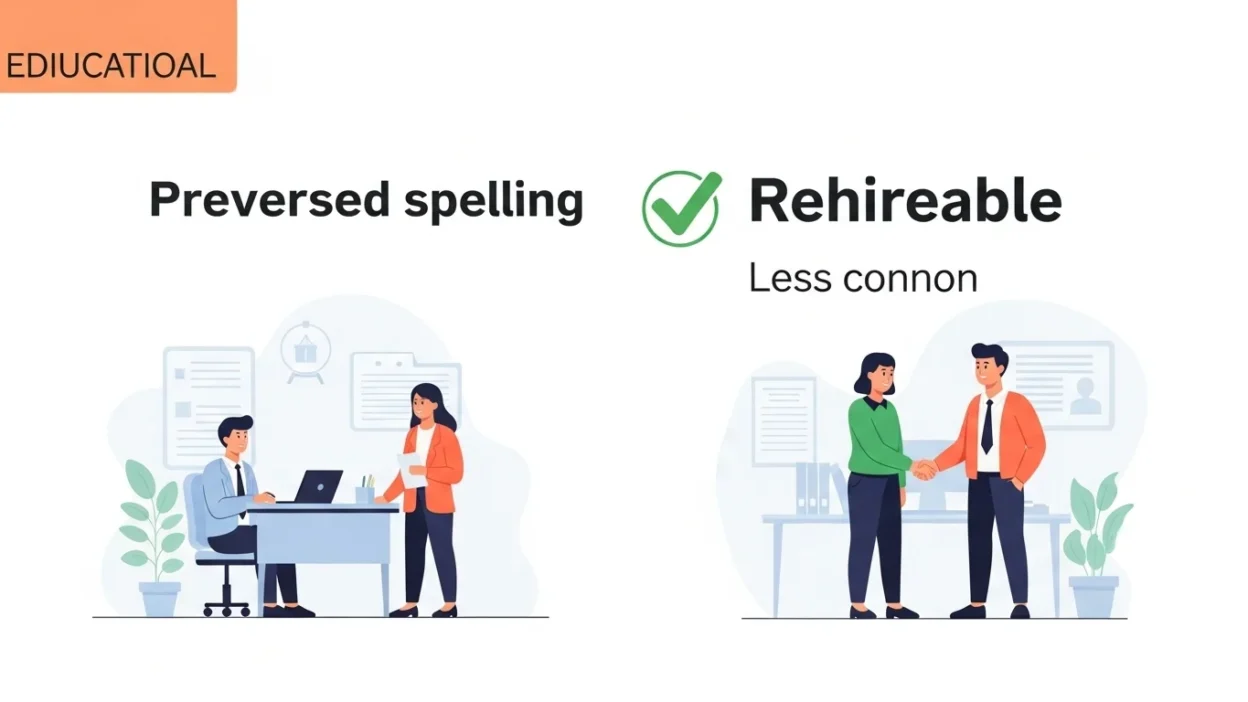
- ✅ Rehirable – Preferred and more standard spelling.
- ⚠️ Rehireable – Less common; sometimes used but not preferred.
- 📚 Use rehirable in most writing, especially formal contexts.
- ✏️ Rule: Drop the silent “e” before adding “-able.”
Origin and Background
The word comes from the verb hire, which means “to employ someone.” When we add the prefix re- (meaning “again”) and the suffix -able (meaning “can be”), we form a new adjective:
- Re + hire + able → rehirable
Spelling Rule
In English, when a word ends with a silent “e,” we usually drop the “e” before adding “-able.”
Examples:
- Hire → Rehirable
- Move → Movable
- Use → Usable
Because of this rule, rehirable is the cleaner and more widely accepted form.
Clear Explanation of the Difference
What Does “Rehirable” Mean?
Rehirable is an adjective. It means that a person can be hired again.
Examples:
- She is rehirable after improving her skills.
- The company considers former employees rehirable.
- His performance made him rehirable.
What Does “Rehireable” Mean?
Rehireable also means “able to be hired again.” However, it keeps the extra “e,” which goes against the usual spelling rule.
Examples:
- The employee is marked as rehireable in the system.
- Some companies use “rehireable” in internal documents.
Although understandable, this form is less common and less preferred.
Comparison Table
| Feature | Rehirable | Rehireable |
|---|---|---|
| Spelling | Preferred | Less common |
| Meaning | Able to be hired again | Same meaning |
| Grammar Rule | Follows spelling rule (drop “e”) | Breaks the usual rule |
| Usage | Formal and professional writing | Informal or internal use |
| Clarity | Clear and standard | Slightly awkward |
| Example | She is rehirable. | She is rehireable. |
Which One to Use and When
Use “Rehirable” When:
- Writing resumes, reports, or emails
- Communicating in professional settings
- Following standard English rules
- Wanting clear and correct spelling
Examples:
- The employee is eligible and rehirable.
- HR marked him as rehirable.
- She remains rehirable after the contract ended.
- The company policy defines who is rehirable.
- He is considered rehirable based on performance.
When Might “Rehireable” Appear?
- In internal company systems
- In informal writing
- In organizations with their own style rules
However, for most purposes, rehirable is the better choice.
Common Mistakes People Make
1. Keeping the Silent “E”
Many learners forget to drop the “e.”
❌ Rehireable
✅ Rehirable
2. Ignoring Spelling Rules
Not applying the “drop the e before -able” rule leads to errors.
3. Following What They See Online
Different spellings online can cause confusion.
4. Typing Without Checking
Fast typing often results in incorrect forms.
5. Lack of Consistency
Using both spellings in the same document creates confusion.
Everyday Real-Life Examples
Emails
- “The employee is marked as rehirable.”
- “Please confirm if she is rehirable.”
Workplace Communication
- “HR confirmed he is rehirable.”
- “Rehirable employees may apply again.”
Job Applications
- “He left on good terms and is rehirable.”
- “The company policy lists rehirable candidates.”
HR Systems
- “Status: Rehirable”
- “Employee marked as rehireable (internal usage).”
Daily Conversations
- “Is she rehirable after leaving?”
- “They consider him rehirable.”
Short Learning Section for Students and Beginners
Easy Rule to Remember
Drop the silent “e” before adding “-able.”
- Hire → Rehirable
- Move → Movable
- Use → Usable
Memory Tip
“Drop the e to keep it simple.”
Pronunciation Guide
- Rehirable: ree-HY-ruh-bul
Practice Exercise
Fill in the blanks with the correct word:
- The employee is ______ after resignation.
- HR confirmed he is ______.
- She remains ______ based on performance.
Answers:
- rehirable
- rehirable
- rehirable
Quick Quiz
Choose the correct option:
- The candidate is ______.
a) Rehireable
b) Rehirable - Company policy states who is ______.
a) Rehirable
b) Rehireable
Correct Answers:
- b) Rehirable
- a) Rehirable
Frequently Asked Questions (FAQs)
1. Are both “rehireable” and “rehirable” correct?
Both are understandable, but rehirable is preferred.
2. Which spelling should I use in formal writing?
Use rehirable.
3. Why is “rehirable” preferred?
Because it follows the rule of dropping the silent “e.”
4. What does “rehirable” mean?
It means able to be hired again.
5. Is “rehireable” wrong?
Not exactly, but it is less standard and less preferred.
6. Where is “rehireable” used?
Sometimes in internal company systems or informal writing.
7. How do you pronounce “rehirable”?
It is pronounced as ree-HY-ruh-bul.
8. How can I remember the correct form?
Remember: Drop the “e” before adding “-able.”
Conclusion
The difference between “rehireable” and “rehirable” is small but important. Both forms mean the same thing, but rehirable is the preferred and more standard spelling because it follows English spelling rules.
To avoid confusion, remember this simple rule: Drop the silent “e” before adding “-able.” Using rehirable will help you write clearly, professionally, and correctly in all situations.

Sophia Reynolds is a digital writer and researcher with a focus on modern trends, productivity, and online education. She enjoys exploring new ideas and presenting them in a simple, reader-friendly way. Sophia is committed to creating informative and trustworthy content that helps audiences stay informed and inspired.