
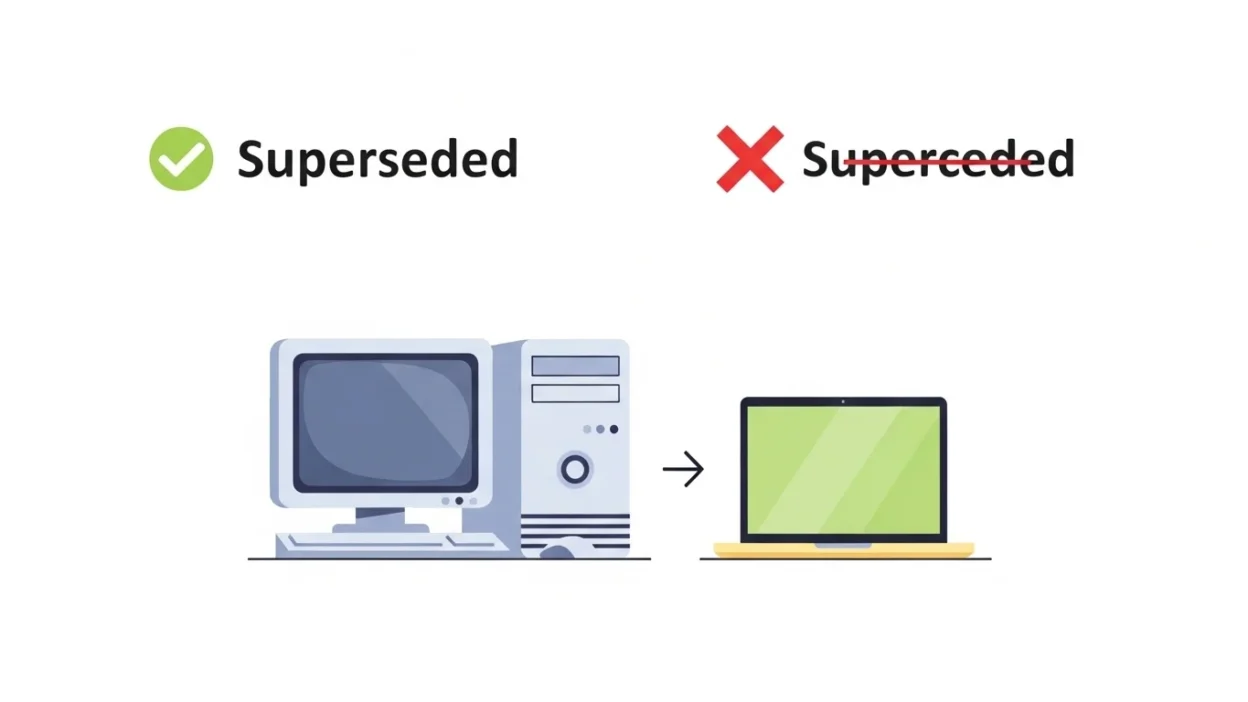
Many learners search for “superseded vs superceded” because the spelling looks unusual. Most English words that sound like “-seed” are spelled with “ceed” (like proceed or exceed). Because of this pattern, people often think “superceded” is correct.
But this word is an exception, and that’s where the confusion begins.
Quick Answer
Here is the clear and simple answer:
- ✅ Superseded – Correct spelling; means replaced or made no longer needed
- ❌ Superceded – Incorrect spelling; very common mistake
- 📚 Always use superseded in writing
- ✏️ Remember: It has “-sede,” not “-cede.”
Origin and Background
The word supersede comes from Latin supersedere, meaning “to sit above” or “to take the place of.”
Unlike many similar-looking words, it uses “-sede” instead of “-cede.” This is why it feels unusual and easy to misspell.
Examples of similar-looking words:
- Proceed
- Exceed
- Succeed
But:
- Supersede (different spelling!)
Clear Explanation of the Difference
What Does “Superseded” Mean?
Superseded is the past form of supersede. It means something has been replaced by something newer or better.
Common Meanings
- Replaced by Something New
- The old rule was superseded by a new one.
- No Longer Used
- This model has been superseded.
- Made Outdated
- New technology has superseded older systems.
What About “Superceded”?
Superceded is not a correct spelling. It is a very common mistake caused by confusion with words ending in “-cede.”
❌ Superceded
✅ Superseded
You should never use superceded in correct writing.
Comparison Table
| Feature | Superseded | Superceded |
|---|---|---|
| Spelling | Correct | Incorrect |
| Meaning | Replaced or outdated | No meaning in standard English |
| Part of Speech | Verb (past form) | Not valid |
| Ending | -sede | Incorrect -cede |
| Usage | Formal and informal English | Considered a spelling error |
| Example | The law was superseded. | ❌ The law was superceded. |
Which One to Use and When
Use “Superseded” When:
- Talking about something replaced
- Writing formal or academic content
- Describing outdated systems or rules
- Communicating in work or daily life
Examples:
- The old system was superseded by a new one.
- This version has been superseded.
- The law was superseded last year.
- New ideas superseded old methods.
- The policy was superseded by updated rules.
Avoid “Superceded”
Never use superceded, as it is always incorrect.
Common Mistakes People Make
1. Following the “-ceed” Pattern
People think it follows words like “proceed.”
❌ Superceded
✅ Superseded
2. Spelling Based on Sound
Both forms sound the same.
3. Not Knowing It’s an Exception
This word does not follow common patterns.
4. Typing Too Quickly
Fast typing can lead to errors.
5. Lack of Practice
Less exposure leads to confusion.
Everyday Real-Life Examples
Emails
- “This version has been superseded.”
- “The old policy was superseded.”
School and Education
- “Old theories were superseded by new ones.”
- “The method was superseded.”
Workplace Communication
- “The system has been superseded.”
- “Guidelines were superseded recently.”
News and Media
- “The law was superseded.”
- “New rules superseded the old ones.”
Daily Conversations
- “That idea was superseded.”
- “The old model is superseded now.”
Short Learning Section for Students and Beginners
Easy Rule to Remember
Supersede uses “-sede,” not “-cede.”
Memory Tip
“Super SEDE (not CEDE).”
Pronunciation Guide
- Superseded: soo-per-SEE-did
Practice Exercise
Fill in the blanks with the correct word:
- The old system was ______.
- This version has been ______.
- The rule was ______ by a new one.
Answers:
- superseded
- superseded
- superseded
Quick Quiz
Choose the correct option:
- The law was ______.
a) Superceded
b) Superseded - The model has been ______.
a) Superseded
b) Superceded
Correct Answers:
- b) Superseded
- a) Superseded
Frequently Asked Questions (FAQs)
1. Is “superceded” correct?
No, it is incorrect.
2. What is the correct spelling?
The correct spelling is superseded.
3. What does “superseded” mean?
It means replaced or made outdated.
4. Why do people write “superceded”?
Because of confusion with “-ceed” words.
5. Is “superseded” used in formal writing?
Yes, it is commonly used in formal contexts.
6. How do you pronounce “superseded”?
It is pronounced soo-per-SEE-did.
7. Is this word an exception?
Yes, it does not follow the usual “-ceed” pattern.
8. How can I remember it?
Remember: Supersede uses “-sede.”
Conclusion
The difference between “superseded” and “superceded” is simple but important. Superseded is the correct spelling and means something has been replaced. Superceded is a common mistake and should never be used.
To avoid errors, remember this easy rule:
👉 Supersede ends with “-sede,” not “-cede.”
Using the correct spelling will help you write clearly, confidently, and correctly in all situations.

Daniel Brooks is a technology and business writer with experience covering innovation, startups, and digital tools. His work emphasizes clarity, accuracy, and real-world application. Daniel aims to help readers understand emerging technologies and make informed decisions in a fast-changing digital landscape.