
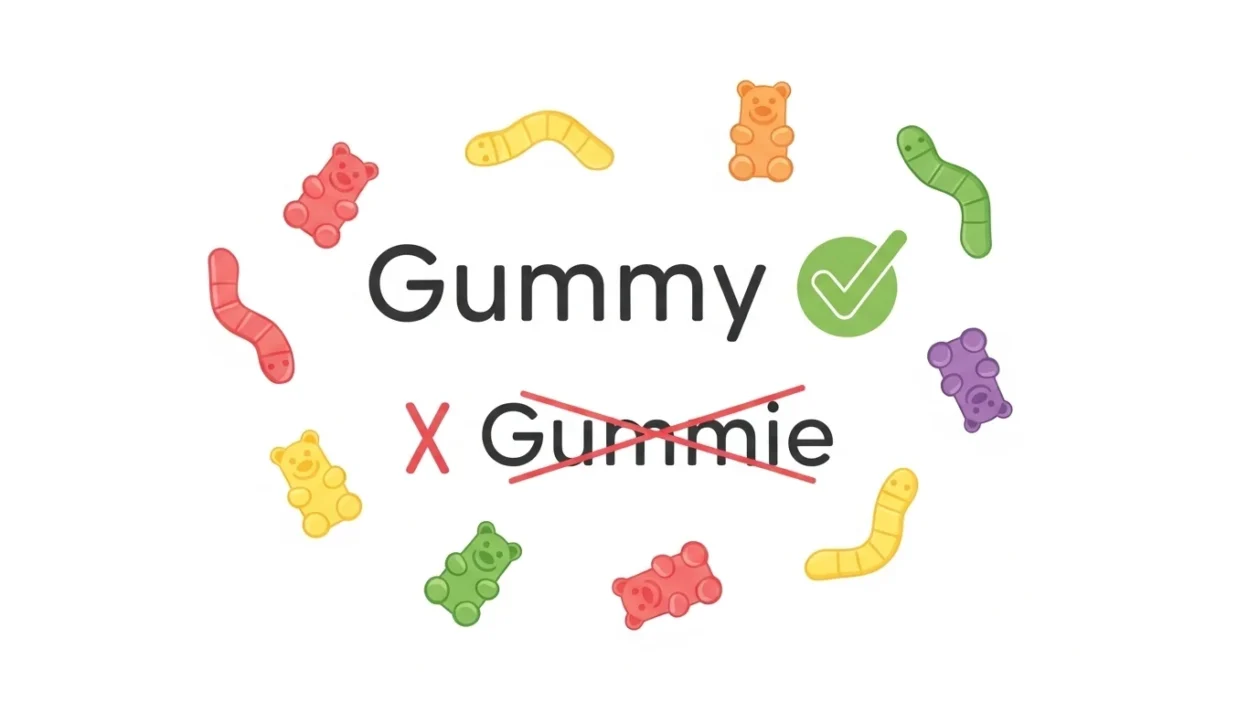
English spelling can be tricky, especially when words sound the same but look slightly different. One common confusion is between “gummy” and “gummie.” These spellings often appear in online searches, candy packaging, and casual writing, leaving many people unsure about which one is correct.
This confusion happens because English sometimes changes the spelling of words when they become plural or take on different forms. For students, ESL learners, and beginners, understanding this difference is important for clear and correct communication. This guide explains everything in very simple English so you can understand it easily on your first read.
Quick Answer
Here is the clear and simple answer:
- ✅ Gummy – Correct spelling; commonly used as an adjective and singular noun.
- ⚠️ Gummie – Rare and nonstandard spelling; usually incorrect in modern English.
- 🍬 Gummies – Correct plural form of “gummy.”
- ✏️ Always use gummy in formal and everyday writing.
Origin and Background
The word “gummy” comes from the noun “gum.” The suffix “-y” is added to describe something that has the qualities of gum—soft, sticky, or chewy.
How the Word Developed
- Gum – A sticky substance or chewy candy.
- Gummy – Soft, chewy, or sticky like gum.
Over time, the word became popular in the food industry, especially for candies such as gummy bears and gummy worms. It is now widely used around the world in both formal and informal English.
The spelling “gummie” occasionally appears due to confusion about plural forms or incorrect spelling habits. However, it is not considered standard in modern English.
Clear Explanation of the Difference
What Does “Gummy” Mean?
Gummy is a real and widely accepted English word. It can function as both an adjective and a noun.
As an Adjective
It describes something soft, sticky, or chewy.
Examples:
- These cookies are too gummy.
- The candy has a sweet, gummy texture.
- The rice turned out sticky and gummy.
As a Noun
It refers to a type of chewy candy.
Examples:
- She ate a strawberry gummy.
- He bought a pack of gummy bears.
- This orange gummy tastes delicious.
What Does “Gummie” Mean?
Gummie is not a standard spelling in modern English. It is usually considered a mistake or a variation used informally. In most dictionaries and professional writing, it does not appear as the preferred form.
Instead of using “gummie,” the correct plural of “gummy” is “gummies.”
❌ Gummie
✅ Gummy (singular)
✅ Gummies (plural)
Comparison Table
| Feature | Gummy | Gummie |
|---|---|---|
| Correct Spelling | Yes | No (nonstandard) |
| Meaning | Soft, sticky, or chewy; a type of candy | No accepted standard meaning |
| Part of Speech | Adjective and noun | Informal or incorrect variant |
| Dictionary Recognition | Yes | Rare or not standard |
| Plural Form | Gummies | Not recommended |
| Usage | Formal and informal English | Avoid in standard writing |
| Example | I love fruity gummy candies. | ❌ I love fruity gummie candies. |
Which One to Use and When
Use “Gummy” When:
- Referring to chewy candies
- Describing sticky or soft textures
- Writing essays, emails, or messages
- Communicating in professional or academic settings
- Posting on social media
Examples:
- My favorite snack is a gummy bear.
- These vitamins come in a gummy form.
- The dessert has a slightly gummy texture.
- She prefers gummy candies over chocolate.
Avoid “Gummie”
You should avoid using “gummie” in formal or everyday writing. If you see it, it is likely a spelling mistake or an informal variation.
Common Mistakes People Make
1. Using “Gummie” as a Singular Form
Some people mistakenly believe “gummie” is the singular form of “gummies.”
❌ I ate a gummie.
✅ I ate a gummy.
2. Incorrect Plural Formation
Learners sometimes replace “-y” with “-ie” instead of “-ies.”
❌ Gummie
✅ Gummies
3. Spelling Errors in Online Searches
Typing quickly or relying on autocorrect can lead to incorrect spellings.
4. Confusion with Other Words
English includes words like:
- Cookie → Cookies
- Candy → Candies
- Puppy → Puppies
Similarly:
- Gummy → Gummies
5. Lack of Proofreading
Not checking your writing can allow small spelling mistakes to go unnoticed.
Everyday Real-Life Examples
Emails
- “Please send me the gummy vitamin samples.”
- “The kids enjoyed the gummy treats.”
Social Media
- “These sour gummy bears are amazing!”
- “I just bought delicious mango gummies.”
News and Advertising
- “The company launched a new line of gummy supplements.”
- “Gummy candies are popular worldwide.”
School and Education
- “She brought gummy snacks for the class party.”
- “The science experiment produced a gummy texture.”
Shopping and Packaging
- “This bottle contains vitamin C gummies.”
- “He bought a pack of strawberry gummy bears.”
Daily Conversations
- “Do you like gummy worms?”
- “These gummies taste great!”
Short Learning Section for Students and Beginners
Easy Rule to Remember
Gum + y = Gummy
Plural Rule
When a word ends in -y, change y to ies to make it plural.
- Gummy → Gummies
- Candy → Candies
- Baby → Babies
Memory Tip
“One gummy, many gummies.”
Pronunciation Guide
- Gummy: GUM-ee
- Gummies: GUM-eez
Practice Exercise
Fill in the blanks:
- I ate a strawberry ______.
- She bought a bag of ______.
- These vitamins are soft and ______.
Answers:
- gummy
- gummies
- gummy
Quick Quiz
Choose the correct option:
- He bought a sour ______.
a) Gummie
b) Gummy - She loves fruit-flavored ______.
a) Gummies
b) Gummie
Correct Answers:
- b) Gummy
- a) Gummies
Frequently Asked Questions (FAQs)
1. Is “gummie” a real word?
No, it is not considered a standard English spelling. It is usually a mistake.
2. What is the correct spelling?
The correct spelling is gummy.
3. What is the plural of “gummy”?
The plural form is gummies.
4. What does “gummy” mean?
It describes something soft, sticky, or chewy, especially candy.
5. Can “gummy” be used as an adjective?
Yes. For example: “The dessert has a gummy texture.”
6. Are gummy vitamins common?
Yes, gummy vitamins are popular because they are easy and pleasant to eat.
7. How do you pronounce “gummy”?
It is pronounced as GUM-ee.
8. Should I ever use “gummie”?
No. It is best to avoid it in both formal and informal writing.
Conclusion
The difference between “gummy” and “gummie” is simple yet important. “Gummy” is the correct and widely accepted spelling used to describe chewy, sticky textures and popular candies. In contrast, “gummie” is a nonstandard spelling that should be avoided in proper English.
By remembering the rule “One gummy, many gummies,” you can avoid confusion and write with confidence. Whether you are a student, an ESL learner, or a beginner, understanding this distinction will help you communicate clearly and accurately in everyday life.

Michael Anderson is a professional editor and senior contributor with a background in long-form content and strategic writing. He focuses on quality, structure, and credibility across all publications. Michael brings years of experience in content development and ensures high editorial standards for every project.