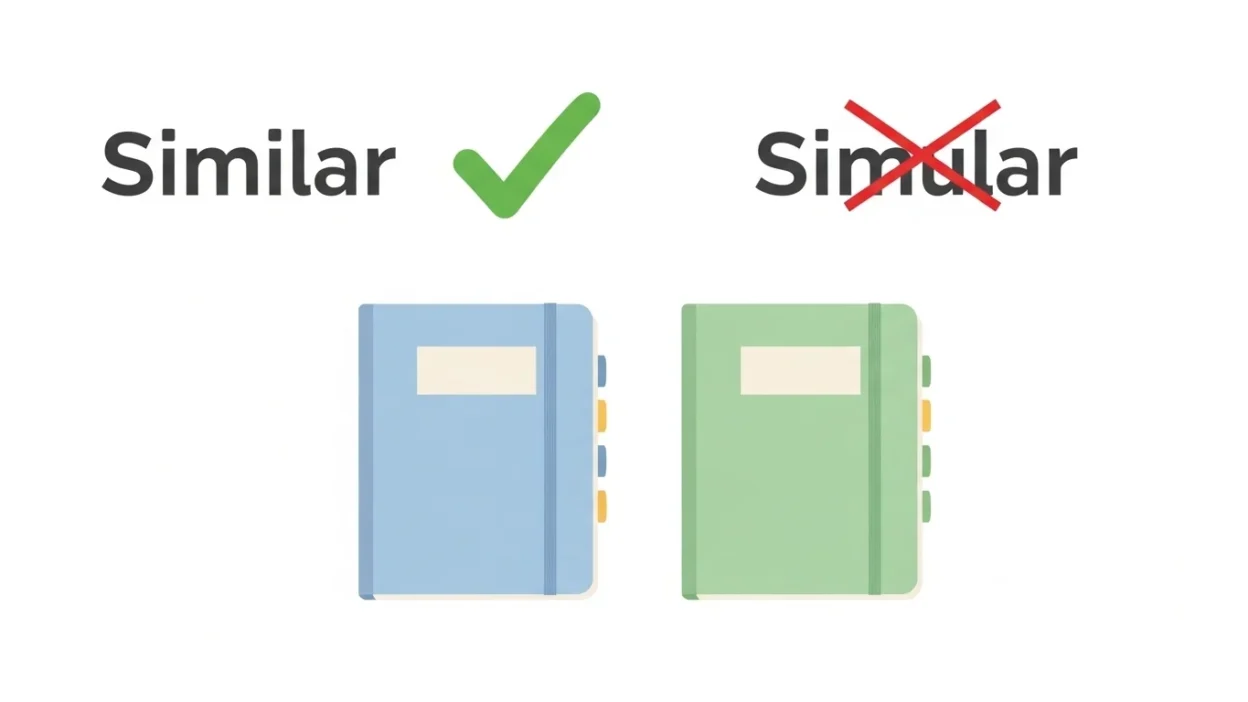
Many people search for “simular vs similar” because they are unsure which spelling is correct. The confusion usually happens due to pronunciation. When spoken quickly, similar may sound like “simular,” leading students, ESL learners, and beginners to spell it incorrectly.
English spelling does not always match pronunciation, which makes such mistakes common. This guide explains the difference in very simple English so you can understand it easily and avoid errors in writing.
Quick Answer
Here is the clear and simple answer:
- ✅ Similar – Correct spelling; means almost the same or alike.
- ❌ Simular – Incorrect spelling; not a real English word.
- 📚 Always use similar in standard English.
- ✏️ Remember: Similar has an “i,” not a “u.”
Origin and Background
The word similar comes from the Latin word similis, which means “like” or “resembling.” It entered English through Old French and has been widely used for centuries to describe things that are alike in appearance, nature, or quality.
The incorrect spelling simular likely developed due to mispronunciation or confusion while writing. Despite how it may sound, simular is not recognized in standard English dictionaries.
Related Words
| Word | Meaning |
|---|---|
| Similar | Nearly the same |
| Similarly | In a similar way |
| Similarity | The quality of being alike |
| Simile | A figure of speech comparing two things |
| Simulate | To imitate or replicate |
Clear Explanation of the Difference
What Does “Similar” Mean?
Similar is an adjective used to describe things that are alike but not exactly the same.
Common Meanings
- Nearly the Same
- The two dresses look similar.
- Sharing Characteristics
- The twins have similar features.
- Comparable in Nature or Quality
- Their opinions are similar.
- Related in Type or Style
- These phones have similar designs.
What About “Simular”?
Simular is an incorrect spelling of similar. It has no meaning in standard English and should never be used in formal or informal writing.
❌ Simular
✅ Similar
This mistake occurs when writers spell the word based on how it sounds rather than how it is correctly written.
Comparison Table
| Feature | Similar | Simular |
|---|---|---|
| Spelling | Correct | Incorrect |
| Meaning | Nearly the same or alike | No meaning in English |
| Part of Speech | Adjective | Not a valid word |
| Dictionary Recognition | Yes | No |
| Usage | Formal and informal English | Considered a spelling error |
| Example Sentence | The results are similar. | ❌ The results are simular. |
Which One to Use and When
Use “Similar” When:
- Comparing two or more things
- Describing likeness or resemblance
- Writing essays, reports, and emails
- Communicating in academic and professional settings
- Engaging in everyday conversations
Examples:
- These two paintings look similar.
- Their ideas are very similar.
- She bought a similar dress.
- The problems have similar solutions.
- The twins have similar voices.
Avoid “Simular”
Never use simular, as it is always incorrect in standard English.
Common Mistakes People Make
1. Spelling Based on Pronunciation
Some people hear “sim-uh-ler” and mistakenly write simular.
2. Confusing Vowel Sounds
Learners often mix up “i” and “u.”
❌ Simular
✅ Similar
3. Typing Errors
Fast typing can lead to accidental misspellings.
4. Lack of Proofreading
Failure to review written work allows simple errors to go unnoticed.
5. Confusion with Related Words
Words like simulate and simulation may cause confusion, though they are unrelated in spelling patterns.
Everyday Real-Life Examples
Emails
- “Please find a similar document attached.”
- “We are looking for a similar solution.”
School and Education
- “The students gave similar answers.”
- “These questions are similar to last year’s exam.”
Workplace Communication
- “The two proposals are similar in structure.”
- “We offer similar services.”
News and Media
- “Authorities reported similar incidents across the region.”
- “The countries share similar policies.”
Social Media
- “I want a similar outfit.”
- “Can you recommend a similar movie?”
Daily Conversations
- “Our tastes are similar.”
- “This phone is similar to mine.”
Short Learning Section for Students and Beginners
Easy Rule to Remember
Similar has an “i” after “m.”
Memory Tip
“Similar begins with ‘sim’—like simple.”
Pronunciation Guide
- Similar: SIM-uh-lur
Practice Exercise
Fill in the blanks with the correct word:
- These two bags look ______.
- She chose a ______ design.
- The twins have ______ voices.
Answers:
- similar
- similar
- similar
Quick Quiz
Choose the correct option:
- Their ideas are very ______.
a) Simular
b) Similar - The two houses are ______ in design.
a) Similar
b) Simular
Correct Answers:
- b) Similar
- a) Similar
Frequently Asked Questions (FAQs)
1. Is “simular” a correct spelling?
No, it is incorrect and not recognized in standard English.
2. What is the correct spelling?
The correct spelling is similar.
3. What does “similar” mean?
It means nearly the same or alike in appearance, nature, or quality.
4. Why do people write “simular”?
They spell the word based on pronunciation.
5. How do you pronounce “similar”?
It is pronounced as SIM-uh-lur.
6. What is the adverb form of “similar”?
The adverb form is similarly.
7. Can “similar” be used in formal writing?
Yes, it is appropriate for both formal and informal contexts.
8. How can I remember the correct spelling?
Remember: “Similar has an ‘i,’ not a ‘u.’”
Conclusion
The difference between “simular” and “similar” is simple but important. Similar is the correct spelling and means nearly the same or alike. In contrast, simular is an incorrect form that should never be used in standard English.
To avoid mistakes, remember this easy rule: Similar has an “i” after the “m.” Mastering this spelling will help you write clearly, confidently, and accurately in everyday and academic communication.
Sophia Reynolds is a digital writer and researcher with a focus on modern trends, productivity, and online education. She enjoys exploring new ideas and presenting them in a simple, reader-friendly way. Sophia is committed to creating informative and trustworthy content that helps audiences stay informed and inspired.