Many learners search for “foward vs forward” because they are unsure about the correct spelling. The confusion happens when people accidentally drop the letter “r” while typing or writing. Since the word is commonly used in everyday communication, this mistake appears in emails, assignments, and social media posts.
This guide explains the difference in very simple English so students, ESL learners, and beginners can understand it clearly and use the correct spelling with confidence.
Quick Answer
Here is the clear and simple answer:
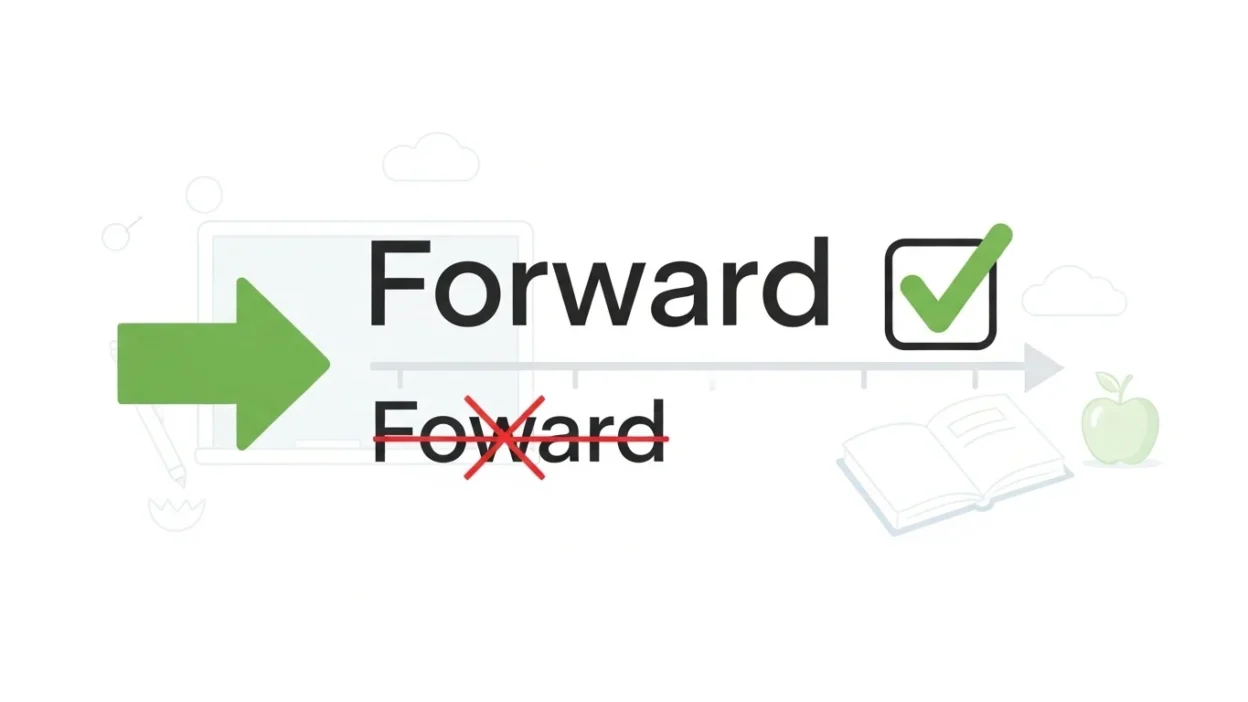
- ✅ Forward – Correct spelling; means ahead or toward the front.
- ❌ Foward – Incorrect spelling; missing the letter “r.”
- 📚 Always use forward in standard English.
- ✏️ Remember: Forward has two “r” letters.
Origin and Background
The word forward comes from Old English foreweard, which means “toward the front.” It combines two parts:
- Fore – meaning “before” or “in front”
- Ward – meaning “in the direction of”
Over time, the spelling evolved into forward, which remains the standard form today. The incorrect spelling foward occurs when one “r” is accidentally omitted.
Clear Explanation of the Difference
What Does “Forward” Mean?
Forward is a versatile word used as an adverb, adjective, verb, and noun. It generally refers to movement or progress toward the front or future.
1. As an Adverb (Direction or Progress)
- Please step forward.
- She moved forward confidently.
2. As an Adjective (Position or Advancement)
- The forward section of the ship was damaged.
- They discussed their forward plans.
3. As a Verb (To Send or Pass On)
- Please forward the email to me.
- He forwarded the message to his manager.
4. As a Noun (Sports Term)
- She is a talented forward in the football team.
What About “Foward”?
Foward is not a correct English word. It is simply a misspelling of forward and should never be used in standard writing.
❌ Foward
✅ Forward
This error usually occurs due to typing mistakes or unfamiliarity with the correct spelling.
Comparison Table
| Feature | Forward | Foward |
|---|---|---|
| Spelling | Correct | Incorrect |
| Meaning | Toward the front or ahead | No meaning in English |
| Part of Speech | Adverb, adjective, verb, noun | Not a valid word |
| Dictionary Recognition | Yes | No |
| Usage | Formal and informal English | Considered a spelling error |
| Example Sentence | She stepped forward confidently. | ❌ She stepped foward confidently. |
Which One to Use and When
Use “Forward” When:
- Indicating direction or progress
- Referring to future plans
- Sending emails or documents
- Describing positions in sports
- Writing essays, reports, and professional messages
Examples:
- Please move forward.
- He looks forward to meeting you.
- Kindly forward this email to the team.
- The company is moving forward with its plans.
- She plays as a forward on the soccer team.
Avoid “Foward”
Never use foward, as it is always incorrect in standard English.
Common Mistakes People Make
1. Dropping the Letter “R”
Writers often omit the second “r.”
❌ Foward
✅ Forward
2. Typing Too Quickly
Fast typing can result in missing letters.
3. Spelling Based on Pronunciation
Some people write the word as they hear it.
4. Lack of Proofreading
Not reviewing written work allows mistakes to remain unnoticed.
5. Confusing It with Similar Words
Learners sometimes mix up forward with toward, which may be spelled with or without an “s” in some dialects.
Everyday Real-Life Examples
Emails
- “Please forward the document to the manager.”
- “I look forward to your reply.”
School and Education
- “The student stepped forward to answer the question.”
- “The school is moving forward with its new program.”
Workplace Communication
- “We look forward to working with you.”
- “Kindly forward the report before noon.”
News and Media
- “The country is moving forward with reforms.”
- “Leaders aim to push the economy forward.”
Sports
- “She scored two goals as a forward.”
- “The forward led the attack brilliantly.”
Daily Conversations
- “Take one step forward.”
- “Let’s move forward with the plan.”
Short Learning Section for Students and Beginners
Easy Rule to Remember
Forward contains the word “ward,” which means direction.
Memory Tip
“Go FOR-WARD—never FO-WARD.”
Pronunciation Guide
- Forward: FOR-werd
Practice Exercise
Fill in the blanks with the correct word:
- Please ______ the email to me.
- He stepped ______ to receive the award.
- We look ______ to meeting you.
Answers:
- forward
- forward
- forward
Quick Quiz
Choose the correct option:
- She moved ______ confidently.
a) Foward
b) Forward - Kindly ______ the message.
a) Forward
b) Foward
Correct Answers:
- b) Forward
- a) Forward
Frequently Asked Questions (FAQs)
1. Is “foward” a correct spelling?
No, it is an incorrect spelling of forward.
2. What is the correct spelling?
The correct spelling is forward.
3. What does “forward” mean?
It means toward the front, ahead, or into the future.
4. Can “forward” be used as a verb?
Yes. It means to send or pass something on.
5. Is “forward” used in formal writing?
Yes, it is appropriate in both formal and informal contexts.
6. How do you pronounce “forward”?
It is pronounced as FOR-werd.
7. What does “look forward to” mean?
It means to eagerly anticipate something.
8. How can I remember the correct spelling?
Remember: Forward has two “r” letters and includes the word “ward.”
Conclusion
The difference between “foward” and “forward” is simple but important. Forward is the correct spelling and means toward the front, ahead, or into the future. In contrast, foward is an incorrect form caused by dropping a letter.
To avoid mistakes, remember this easy rule: Forward includes the word “ward” and has two “r” letters. Mastering this spelling will help you write clearly, confidently, and accurately in both academic and everyday communication.

Emily Carter is a content writer and editor based in the United States, specializing in lifestyle, wellness, and personal development topics. With a passion for clear and engaging storytelling, she creates content that connects with readers and delivers practical value. Emily focuses on making complex ideas easy to understand and relatable.