English learners often struggle with words that look and sound similar. One common confusion is between “recognization” and “recognition.” Both seem logical, and many people assume they mean the same thing. However, only one is correct in standard English.
This mistake usually happens because learners try to form nouns by adding “-ization” to verbs. While this works for many words, it does not apply here. This guide explains the difference in very simple English so that students, ESL learners, and beginners can understand it easily on the first read.
Quick Answer
Here is the clear and simple answer:
- ✅ Recognition – Correct spelling; widely accepted in standard English.
- ❌ Recognization – Incorrect and nonstandard; should be avoided.
- 📚 Always use recognition in academic, professional, and everyday writing.
- ✏️ Replace “recognization” with recognition to ensure accuracy.
Origin and Background
The word recognition comes from the Latin word recognitio, meaning “acknowledgment” or “identification.” It entered English through French and has been used for centuries.
It is derived from the verb recognize, which means to identify, remember, or acknowledge someone or something.
Word Formation
| Base Word | Form | Meaning |
|---|---|---|
| Recognize | Verb | To identify or acknowledge |
| Recognition | Noun | The act of identifying or acknowledging |
| Recognizable | Adjective | Easy to identify |
| Recognizably | Adverb | In a way that is easy to identify |
The form “recognization” developed as an incorrect attempt to create a noun from “recognize,” but it is not accepted in standard English.
Clear Explanation of the Difference
What Does “Recognition” Mean?
Recognition is a noun that refers to identifying, acknowledging, or appreciating someone or something. It is widely used in both formal and informal contexts.
1. Identifying Someone or Something
- Facial recognition technology is widely used today.
- She smiled in recognition of her old friend.
2. Acknowledging Achievement
- He received recognition for his hard work.
- The teacher gave her recognition for academic excellence.
3. Official Acceptance
- The country gained international recognition.
- The organization received legal recognition.
4. Expressing Appreciation
- The award was given in recognition of her service.
- Employees deserve recognition for their efforts.
What About “Recognization”?
Recognization is considered incorrect and nonstandard in modern English. While it may occasionally appear in outdated or informal contexts, it is not accepted in standard dictionaries or professional writing.
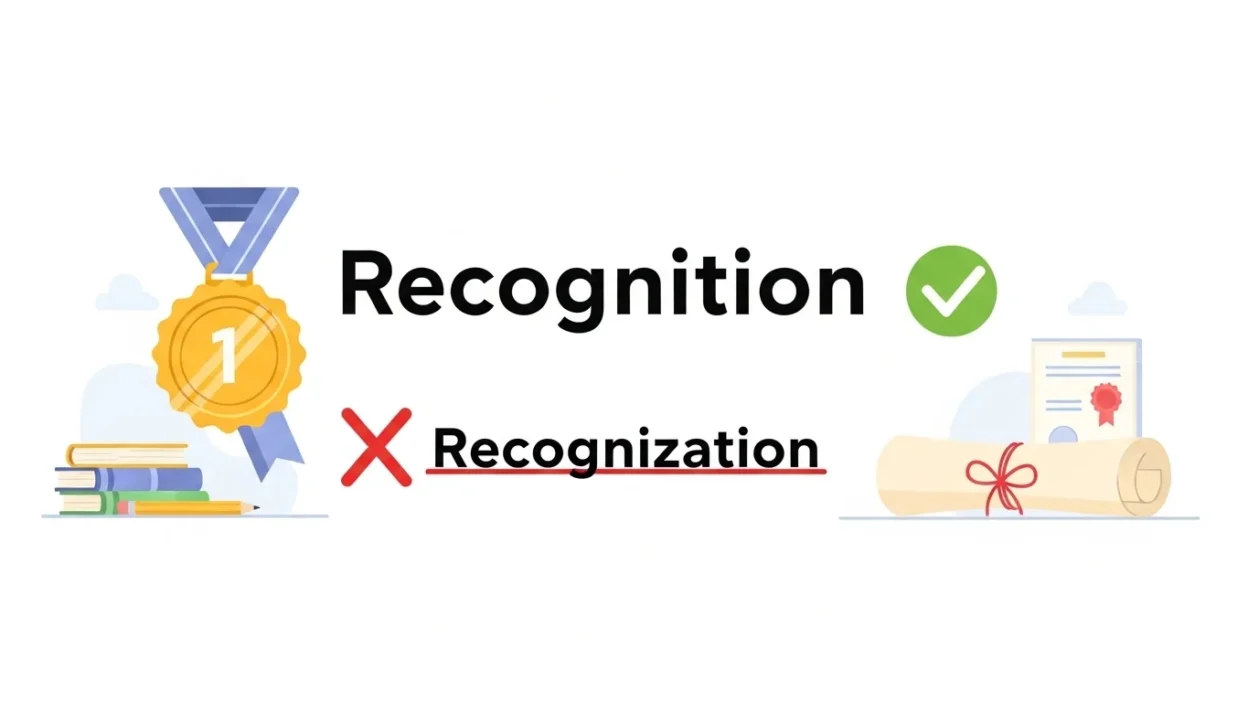
❌ Recognization
✅ Recognition
To ensure clarity and correctness, always use recognition.
Comparison Table
| Feature | Recognition | Recognization |
|---|---|---|
| Spelling | Correct | Incorrect |
| Meaning | Identification, acknowledgment, or appreciation | Nonstandard variant |
| Part of Speech | Noun | Nonstandard noun |
| Dictionary Recognition | Yes | No (not standard) |
| Usage | Formal and informal English | Avoid in standard writing |
| Acceptance | Widely accepted | Considered incorrect |
| Example Sentence | She received recognition for her work. | ❌ She received recognization for her work. |
Which One to Use and When
Use “Recognition” When:
- Identifying a person, place, or object
- Acknowledging achievements
- Referring to awards or appreciation
- Discussing technology, such as facial recognition
- Writing essays, emails, and reports
- Communicating in academic or professional settings
Examples:
- The company gained global recognition.
- He received recognition for his bravery.
- Voice recognition systems are improving.
- The artist earned recognition worldwide.
- She smiled in recognition of her teacher.
Avoid “Recognization”
Never use recognization in modern English. Replace it with recognition in all contexts.
Common Mistakes People Make
1. Adding “-ization” Incorrectly
Learners often assume the noun form of “recognize” is “recognization.”
❌ Recognization
✅ Recognition
2. Confusing Word Formation Patterns
Words like “organization” and “realization” mislead learners into using “recognization.”
3. Spelling by Logic Instead of Usage
Although “recognization” seems logical, it is not accepted in standard English.
4. Influence of Non-Native Usage
Some learners adopt incorrect forms due to translation from other languages.
5. Lack of Proofreading
Failing to check written work can allow incorrect spellings to remain unnoticed.
Everyday Real-Life Examples
Emails
- “You deserve recognition for your dedication.”
- “The team received recognition for its success.”
School and Education
- “She earned recognition for academic excellence.”
- “The student smiled in recognition of his teacher.”
Workplace Communication
- “Employees appreciate recognition for their hard work.”
- “The company gained industry recognition.”
News and Media
- “The scientist received international recognition.”
- “The film earned global recognition.”
Technology
- “Facial recognition systems enhance security.”
- “Voice recognition improves user experience.”
Daily Conversations
- “He nodded in recognition.”
- “She finally received the recognition she deserved.”
Short Learning Section for Students and Beginners
Easy Trick to Remember
Think of the verb recognize. Its correct noun form is recognition, not recognization.
Memory Tip
“I recognize your recognition.”
Pronunciation Guide
- Recognition: rek-ug-NISH-uhn
Practice Exercise
Fill in the blanks with the correct word:
- She received ______ for her achievements.
- The technology uses facial ______.
- He nodded in ______ of his friend.
Answers:
- recognition
- recognition
- recognition
Quick Quiz
Choose the correct option:
- The artist gained international ______.
a) Recognization
b) Recognition - The award was given in ______ of her service.
a) Recognition
b) Recognization
Correct Answers:
- b) Recognition
- a) Recognition
Frequently Asked Questions (FAQs)
1. Is “recognization” a real English word?
No, it is considered incorrect and nonstandard in modern English.
2. What is the correct spelling?
The correct spelling is recognition.
3. What does “recognition” mean?
It means identification, acknowledgment, appreciation, or official acceptance.
4. Why do people use “recognization”?
They mistakenly add “-ization” to the verb “recognize.”
5. Can “recognization” ever be used?
It is best avoided in academic, professional, and everyday writing.
6. What is the verb form of “recognition”?
The verb form is recognize.
7. How do you pronounce “recognition”?
It is pronounced as rek-ug-NISH-uhn.
8. Is “recognition” used in technology?
Yes. It is commonly used in terms like facial recognition and voice recognition.
Conclusion
The difference between “recognization” and “recognition” is simple yet important. Recognition is the correct and widely accepted spelling, used to describe identification, acknowledgment, or appreciation. In contrast, recognization is incorrect and should be avoided in standard English.
To avoid mistakes, remember this easy rule: Recognize becomes recognition—not recognization. By using the correct form, you can communicate clearly, confidently, and professionally in any situation.

Sophia Reynolds is a digital writer and researcher with a focus on modern trends, productivity, and online education. She enjoys exploring new ideas and presenting them in a simple, reader-friendly way. Sophia is committed to creating informative and trustworthy content that helps audiences stay informed and inspired.