Many people search online for “skiddish vs skittish” because they are unsure which spelling is correct. The confusion happens because both words sound similar in pronunciation. Students, ESL learners, and beginners often rely on how a word sounds, which can lead to spelling errors in English.
However, only one of these spellings is correct in standard English. This guide explains the difference in very simple language so you can understand it clearly and use the right word with confidence.
Quick Answer
Here is the clear and simple answer:
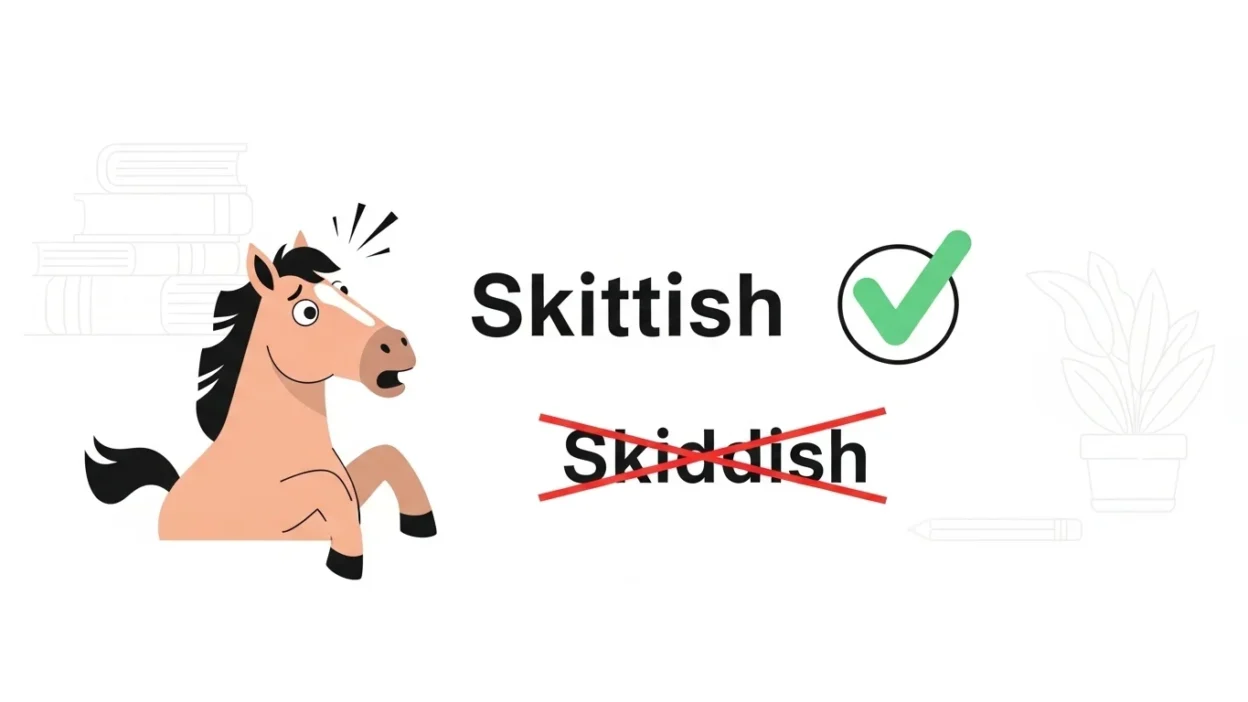
- ✅ Skittish – Correct spelling; means easily frightened or nervous.
- ❌ Skiddish – Incorrect spelling; not a standard English word.
- 📚 Always use skittish in writing and speech.
- ✏️ Remember: Skittish has double “t.”
Origin and Background
The word skittish dates back to the 15th century. It is believed to have developed from the word “skit,” meaning a light or playful movement. Over time, the meaning evolved to describe someone or something that moves suddenly due to fear or nervousness.
The incorrect spelling skiddish likely appeared because people misheard or mispronounced the word. Since English pronunciation can be misleading, learners sometimes substitute “dish” for “tish.” However, skiddish is not recognized in standard dictionaries.
Clear Explanation of the Difference
What Does “Skittish” Mean?
Skittish is an adjective used to describe someone or something that is easily startled, nervous, or unpredictable.
Common Meanings
- Easily Frightened
- The horse became skittish during the thunderstorm.
- Nervous or Anxious
- She felt skittish before her first presentation.
- Unpredictable or Restless
- Investors were skittish about the sudden market changes.
- Playful or Lively
- The puppy was skittish and full of energy.
What About “Skiddish”?
Skiddish is a misspelling of skittish. It has no meaning in standard English and should be avoided in formal and informal writing.
❌ Skiddish
✅ Skittish
This mistake usually occurs due to pronunciation confusion or incorrect assumptions about spelling.
Comparison Table
| Feature | Skittish | Skiddish |
|---|---|---|
| Spelling | Correct | Incorrect |
| Meaning | Easily frightened or nervous | No meaning in standard English |
| Part of Speech | Adjective | Not a valid word |
| Dictionary Recognition | Yes | No |
| Usage | Formal and informal English | Considered a spelling error |
| Example Sentence | The deer was skittish. | ❌ The deer was skiddish. |
Which One to Use and When
Use “Skittish” When:
- Describing animals that are easily frightened
- Talking about nervous or anxious people
- Referring to unpredictable situations
- Writing essays, stories, or reports
- Communicating in academic or professional contexts
Examples:
- The cat became skittish after hearing a loud noise.
- He felt skittish before the interview.
- The horse grew skittish in the crowd.
- Investors remained skittish during economic uncertainty.
- The child was skittish around strangers.
Avoid “Skiddish”
Never use skiddish, as it is not a correct English word.
Common Mistakes People Make
1. Spelling Based on Sound
People often write “skiddish” because it sounds similar to “skittish.”
2. Confusing Letter Patterns
Writers mistakenly replace “tish” with “dish.”
3. Dropping or Changing Double Letters
Forgetting the double “t” leads to incorrect spelling.
4. Typing Errors
Fast typing can result in accidental mistakes.
5. Lack of Proofreading
Not reviewing written work allows errors to remain unnoticed.
Everyday Real-Life Examples
Emails
- “The new employee seemed skittish during the meeting.”
School and Education
- “The student felt skittish before the exam.”
Workplace Communication
- “Investors are skittish about the uncertain market.”
News and Media
- “Markets remained skittish amid economic concerns.”
Social Media
- “My puppy gets skittish during fireworks.”
Daily Conversations
- “She became skittish after the sudden noise.”
- “The horse looked skittish near the crowd.”
Short Learning Section for Students and Beginners
Easy Rule to Remember
Skittish has two “t” letters.
Memory Tip
“A skittish kitten has double T.”
Pronunciation Guide
- Skittish: SKIT-ish
Practice Exercise
Fill in the blanks with the correct word:
- The deer became ______ at the sound of footsteps.
- The puppy was ______ during the storm.
- Investors grew ______ after the announcement.
Answers:
- skittish
- skittish
- skittish
Quick Quiz
Choose the correct option:
- The horse seemed ______.
a) Skiddish
b) Skittish - She felt ______ before the interview.
a) Skittish
b) Skiddish
Correct Answers:
- b) Skittish
- a) Skittish
Frequently Asked Questions (FAQs)
1. Is “skiddish” a real English word?
No, it is a misspelling of skittish.
2. What is the correct spelling?
The correct spelling is skittish.
3. What does “skittish” mean?
It means easily frightened, nervous, or unpredictable.
4. Can “skittish” describe animals?
Yes, it is commonly used for animals like horses, cats, and deer.
5. Can “skittish” describe people?
Yes, it can describe someone who feels anxious or uneasy.
6. How do you pronounce “skittish”?
It is pronounced as SKIT-ish.
7. Is “skittish” used in formal writing?
Yes, it is appropriate in both formal and informal contexts.
8. How can I remember the correct spelling?
Remember: A skittish kitten has double T.
Conclusion
The difference between “skiddish” and “skittish” is simple but important. Skittish is the correct spelling and means easily frightened, nervous, or unpredictable. In contrast, skiddish is an incorrect form that should never be used in standard English.
To avoid mistakes, remember this easy rule: Skittish has two “t” letters. Mastering this spelling will help you write clearly, confidently, and accurately in both academic and everyday communication.

Daniel Brooks is a technology and business writer with experience covering innovation, startups, and digital tools. His work emphasizes clarity, accuracy, and real-world application. Daniel aims to help readers understand emerging technologies and make informed decisions in a fast-changing digital landscape.