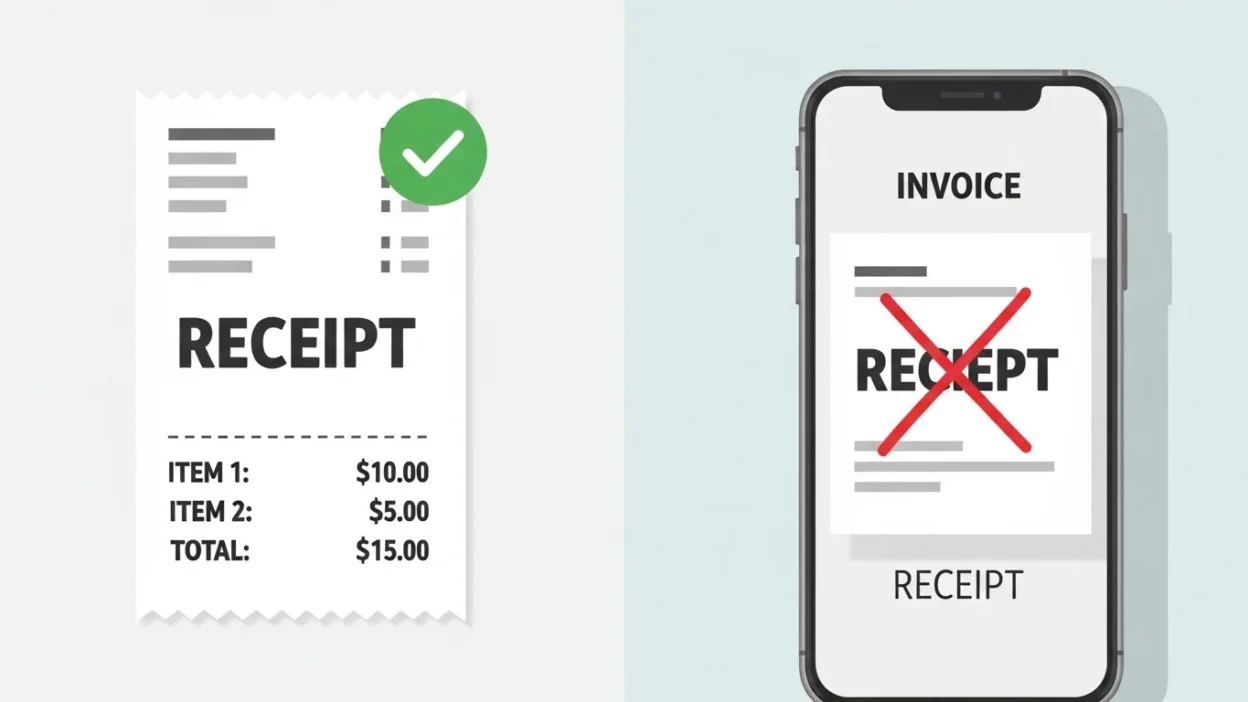
Many learners feel confused between “receipt” and “reciept.” These two words look very similar, and the difference lies only in the order of the letters “i” and “e.” Because of this, students, ESL learners, and beginners often spell the word incorrectly.
The confusion usually happens due to the famous spelling rule: “I before E except after C.” While this rule helps in many cases, it can still be tricky to remember. Understanding the correct spelling and its meaning will help you avoid mistakes in exams, emails, and daily writing.
The good news is that the answer is simple. This guide explains everything in clear, easy English so you can understand it on the first read.
Quick Answer
- Receipt = correct spelling
- Reciept = incorrect spelling
✔ Correct: Please keep the receipt for your records.
❌ Incorrect: Please keep the reciept for your records.
👉 Always use receipt.
Simple Origin and Background
The Origin of “Receipt”
The word “receipt” comes from the Latin word recepta, meaning “received.” It entered English through Old French and has been used for centuries. The silent “p” in the word reflects its historical roots and is retained in modern spelling.
Examples:
- She asked for a receipt after paying the bill.
- Keep the receipt in case you need a refund.
Why Does “Reciept” Exist?
The spelling “reciept” is a common mistake caused by:
- Confusion with the order of “i” and “e.”
- Forgetting the spelling rule “I before E except after C.”
- Fast typing or lack of proofreading.
- Mispronunciation or guesswork.
However, “reciept” is not a real English word and should never be used in correct writing.
Clear Explanation of the Difference
What Does “Receipt” Mean?
Receipt is a noun that refers to a written or digital record showing that payment has been received. It acts as proof of a transaction.
Common Meanings
- Proof of Payment
- Please keep the receipt for your purchase.
- Record of a Transaction
- The cashier handed me the receipt.
- Acknowledgment of Delivery
- Sign the receipt after receiving the parcel.
- Business and Accounting Document
- The accountant checked all receipts.
What About “Reciept”?
Reciept:
- Is an incorrect spelling.
- Does not appear in standard English dictionaries.
- Has no meaning in proper English.
- Will be marked wrong in exams and professional documents.
Always avoid using it.
Comparison Table
| Feature | Receipt | Reciept |
|---|---|---|
| Meaning | Proof of payment or transaction | No valid meaning |
| Usage | Correct and widely accepted | Incorrect |
| Spelling Rule | “I” comes after “C” | Incorrect letter order |
| Grammar | Proper English | Not accepted |
| Use in Exams | Correct | Marked wrong |
| Dictionary Status | Recognized | Not recognized |
| Silent Letter | Contains a silent “p” | Incorrect form |
Which One to Use and When
Use “Receipt”
Use receipt in any situation involving proof of payment or acknowledgment of delivery.
Examples:
- Please keep your receipt.
- The store emailed me the receipt.
- She submitted the receipt for reimbursement.
- He asked for a receipt after paying cash.
- Attach the receipt to your expense report.
Never Use “Reciept”
Avoid reciept in all forms of communication, including:
- School assignments
- Exams and essays
- Business documents
- Emails and reports
- Online forms and applications
- Social media posts
It is always incorrect.
Common Mistakes People Make
1. Reversing “I” and “E”
Incorrect:
- ❌ reciept
Correct:
- ✔ receipt
2. Forgetting the Spelling Rule
Remember the rule:
👉 “I before E, except after C.”
Since receipt has a “c,” the correct order is “ei.”
3. Ignoring the Silent “P”
Some learners misspell the word because the “p” is not pronounced.
4. Typing Too Quickly
Careless typing often results in spelling errors.
Everyday Real-Life Examples
In Emails
Correct:
- Please attach the receipt for reimbursement.
- I have emailed the receipt to you.
Incorrect:
- Please attach the reciept.
In Shopping
- Always keep the receipt for returns.
- The cashier printed a receipt.
In Banking and Business
- Submit the receipt to claim expenses.
- The accountant reviewed all receipts.
On Social Media
- Don’t forget to keep your receipt!
- Upload the receipt to enter the contest.
In School and Office Work
- Attach the receipt to your assignment.
- She submitted receipts for travel expenses.
Short Learning Section for Students and Beginners
Simple Rule to Remember
👉 Receipt is correct; reciept is wrong.
Easy Memory Trick
Think:
👉 “After C comes EI in receipt.”
This follows the rule: I before E, except after C.
Related Word Forms
| Word | Meaning |
|---|---|
| Receive | To get something |
| Received | Got something |
| Receiver | One who receives |
| Receipt | Proof of payment |
Practice Sentences
Fill in the blanks:
- Please keep the ______ for your purchase.
✔ receipt - She submitted the ______ for reimbursement.
✔ receipt - The cashier printed the ______.
✔ receipt
Mini Exercise
Choose the correct word:
- Please keep the reciept/receipt.
✔ receipt - I emailed the reciept/receipt yesterday.
✔ receipt - Attach the reciept/receipt to the form.
✔ receipt - He lost the reciept/receipt from the store.
✔ receipt
FAQ Section
1. Is “reciept” a correct spelling?
No, it is incorrect. The correct spelling is receipt.
2. What does “receipt” mean?
It is a written or digital proof of payment or delivery.
3. Why is “receipt” spelled with “ei”?
Because it follows the rule: “I before E, except after C.”
4. Is the “p” in “receipt” pronounced?
No, the “p” is silent.
5. Can I use “reciept” in exams?
No. It will be marked incorrect.
6. Is “receipt” used in formal writing?
Yes, it is widely used in business, education, and daily communication.
7. What is the plural of “receipt”?
The plural is receipts.
8. How can I remember the correct spelling?
Remember: After C comes EI — receipt.
Conclusion
The difference between receipt and reciept is simple and clear:
- Receipt is the correct spelling and means proof of payment or delivery.
- Reciept is incorrect and should never be used.
By remembering the rule “I before E, except after C,” you can avoid this common mistake and write with confidence.
👉 Final Tip: Always write “receipt,” never “reciept.”
With this knowledge, you can communicate clearly and accurately in academic, professional, and everyday English.

Daniel Brooks is a technology and business writer with experience covering innovation, startups, and digital tools. His work emphasizes clarity, accuracy, and real-world application. Daniel aims to help readers understand emerging technologies and make informed decisions in a fast-changing digital landscape.