Many learners search for “to bad vs too bad” because “to” and “too” sound exactly the same. This makes it easy to choose the wrong spelling, especially in quick writing.
But in this case, only one phrase is correct.
Quick Answer
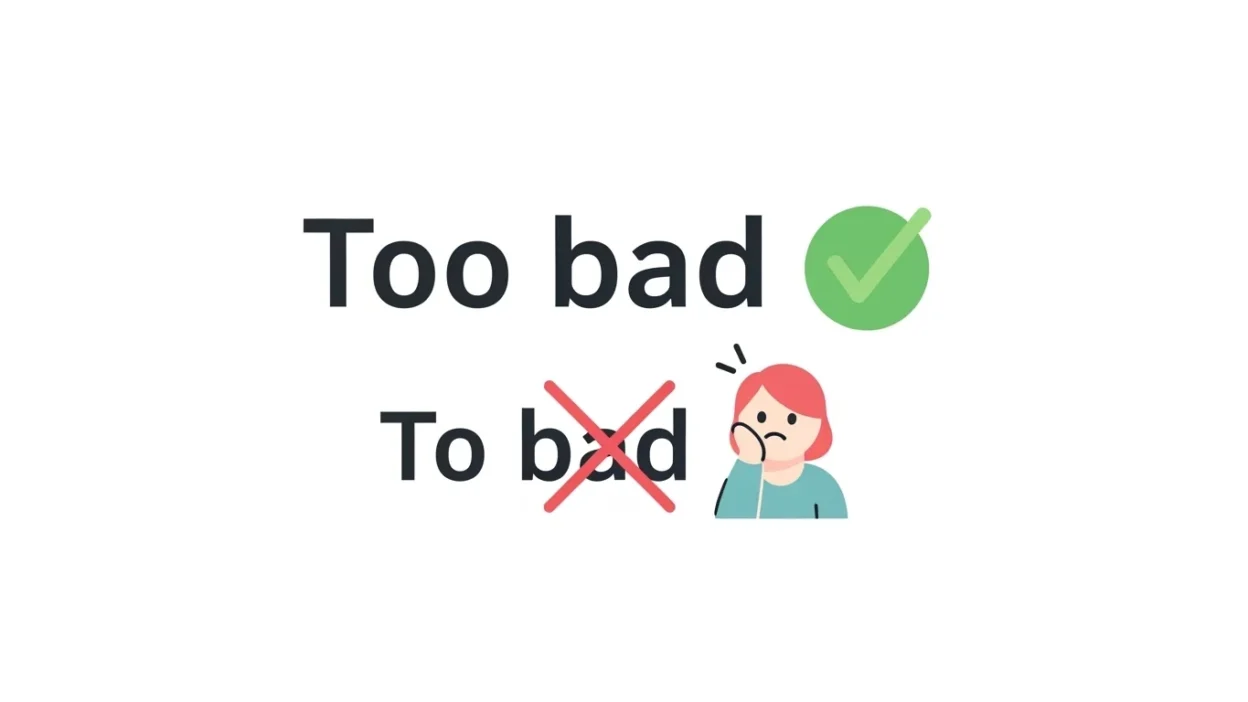
- ✅ Too bad – Correct phrase; means “unfortunate” or “sad situation”
- ❌ To bad – Incorrect phrase
- 📚 Always use too bad
- ✏️ Remember: “too” = extra meaning
Origin and Background
- Too means “very,” “also,” or “more than enough”
- To is used for direction, purpose, or infinitives
The phrase “too bad” uses too to show degree or feeling, meaning something is unfortunate.
Clear Explanation of the Difference
What Does “Too Bad” Mean?
Too bad is a common phrase used to express:
👉 disappointment
👉 sympathy
👉 something unfortunate
Examples:
- Too bad you missed the game.
- That’s too bad.
- It’s too bad we couldn’t go.
- Too bad it rained.
- That’s really too bad.
What About “To Bad”?
To bad is not correct English. It is a mistake caused by confusing to and too.
❌ To bad
✅ Too bad
You should never use to bad in proper writing.
Comparison Table
| Feature | Too bad | To bad |
|---|---|---|
| Spelling | Correct | Incorrect |
| Meaning | Unfortunate / sad | No meaning |
| Type | Phrase | Not valid |
| Usage | Everyday English | Considered an error |
| Example | That’s too bad. | ❌ That’s to bad. |
Which One to Use and When
Use “Too Bad” When:
- Expressing disappointment
- Reacting to bad news
- Showing sympathy
Examples:
- Too bad you’re leaving.
- That’s too bad.
- It’s too bad we lost.
- Too bad he couldn’t come.
- That’s really too bad.
Avoid “To Bad”
Never use to bad, as it is always incorrect.
Common Mistakes People Make
1. Confusing “To” and “Too”
They sound the same.
❌ To bad
✅ Too bad
2. Forgetting Meaning of “Too”
“Too” shows degree or feeling.
3. Typing Too Quickly
Fast typing causes mistakes.
4. Not Proofreading
Errors remain without checking.
5. Lack of Practice
Practice helps avoid confusion.
Everyday Real-Life Examples
Conversations
- “Too bad you missed it.”
- “That’s too bad.”
School
- “Too bad you forgot your homework.”
- “It’s too bad you were absent.”
Social Media
- “Too bad I couldn’t go.”
- “That’s too bad!”
Work
- “Too bad the meeting was canceled.”
- “It’s too bad we missed the deadline.”
Daily Life
- “Too bad it’s raining.”
- “That’s too bad.”
Short Learning Section for Students and Beginners
Easy Rule to Remember
Too bad = correct phrase
Memory Tip
“Too = extra feeling → too bad.”
Pronunciation Guide
- Too bad: TOO bad
Practice Exercise
Fill in the blanks:
- That’s ______ bad.
- ______ bad you missed it.
- It’s ______ bad we lost.
Answers:
- too
- Too
- too
Quick Quiz
Choose the correct option:
- That’s ______ bad.
a) To
b) Too - ______ bad you couldn’t come.
a) Too
b) To
Correct Answers:
- b) Too
- a) Too
Frequently Asked Questions (FAQs)
1. Is “to bad” correct?
No, it is incorrect.
2. What is the correct phrase?
The correct phrase is too bad.
3. What does “too bad” mean?
It means something is unfortunate.
4. Why do people write “to bad”?
Because “to” and “too” sound the same.
5. Is “too bad” informal?
It is commonly used in everyday English.
6. How do you pronounce it?
It is pronounced TOO bad.
7. Is this a common mistake?
Yes, very common.
8. How can I remember it?
Remember: Too = extra feeling.
Conclusion
The difference between “to bad” and “too bad” is simple. Too bad is the correct phrase used to express disappointment or something unfortunate. To bad is incorrect and should be avoided.
To stay correct, remember this rule:
👉 Use “too bad,” not “to bad.”
This will help you write clearly and confidently every time.

Sophia Reynolds is a digital writer and researcher with a focus on modern trends, productivity, and online education. She enjoys exploring new ideas and presenting them in a simple, reader-friendly way. Sophia is committed to creating informative and trustworthy content that helps audiences stay informed and inspired.