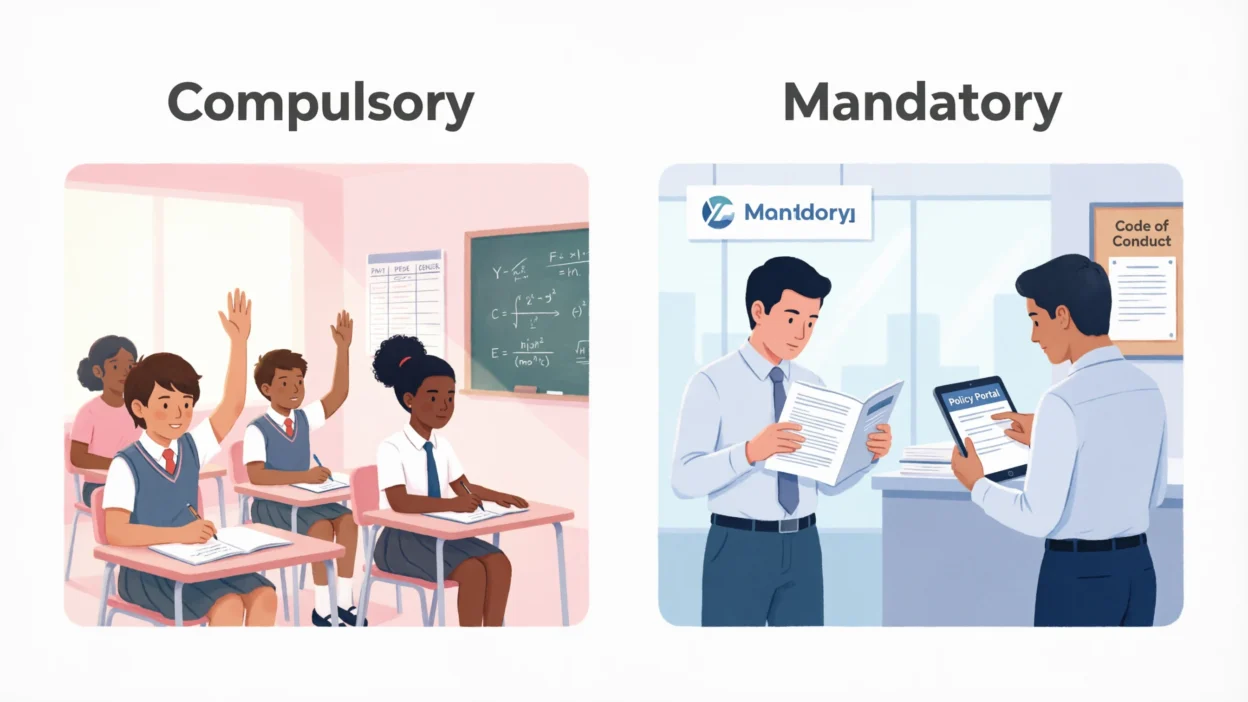
“Compulsory” and “mandatory” are often used interchangeably because both describe something that is required and not optional. However, there are slight differences in tone, context, and usage.
The key idea: required by rules vs officially enforced requirement.
Understanding the difference will help you use these words more naturally in education, law, business, and everyday English.
Quick Answer
- ✅ Compulsory – Required by rules, laws, or systems
- ✅ Mandatory – Officially required or strictly enforced
- ✏️ Remember: Compulsory = required, Mandatory = officially enforced
Clear Explanation
What Does “Compulsory” Mean?
Compulsory is an adjective.
👉 It means:
- required
- obligatory
- something you must do
Examples:
- Education is compulsory for children.
- Attendance was compulsory.
- Helmets are compulsory at the construction site.
- Students must take compulsory subjects.
- Military service is compulsory in some countries.
👉 “Compulsory” is commonly used in:
- education
- laws
- official rules
- public policies
Common Uses of “Compulsory”
1. Compulsory Education
Examples:
- compulsory schooling
- compulsory subjects
Example Sentence:
- Math is a compulsory subject in many schools.
2. Compulsory Rules
Examples:
- compulsory training
- compulsory testing
Example Sentence:
- Safety training is compulsory for all workers.
3. Legal Requirements
Examples:
- compulsory voting
- compulsory military service
Example Sentence:
- Voting is compulsory in some countries.
What Does “Mandatory” Mean?
Mandatory is also an adjective.
👉 It means:
- officially required
- enforced by authority
- not optional under regulations or policy
Examples:
- Masks became mandatory in hospitals.
- Completing the form is mandatory.
- The company introduced mandatory training.
- Seat belts are mandatory by law.
- Participation is mandatory for employees.
👉 “Mandatory” often emphasizes:
- authority
- enforcement
- official policy
Common Uses of “Mandatory”
1. Workplace Rules
Examples:
- mandatory meeting
- mandatory training
Example Sentence:
- Attendance at the seminar is mandatory.
2. Government Regulations
Examples:
- mandatory reporting
- mandatory restrictions
Example Sentence:
- Vaccination became mandatory for travelers.
3. Legal or Policy Enforcement
Examples:
- mandatory sentence
- mandatory requirement
Example Sentence:
- The law introduced mandatory penalties.
Key Difference
| Feature | Compulsory | Mandatory |
|---|---|---|
| Meaning | Required | Officially enforced requirement |
| Tone | General/legal | Stronger official authority |
| Common Contexts | Education, rules | Policies, workplace, law |
| Example | Compulsory subjects | Mandatory training |
Which One to Use and When
Use “Compulsory” When:
- Talking about rules or required participation
- Referring to education or legal obligations
Examples:
- Compulsory education
- Compulsory attendance
- Compulsory subjects
- Compulsory service
- Compulsory insurance
Example Sentences:
- Attendance was compulsory for students.
- Military service is compulsory in some nations.
- The course includes compulsory exams.
Use “Mandatory” When:
- Talking about official policies or strict enforcement
- Referring to workplace or government requirements
Examples:
- Mandatory training
- Mandatory meeting
- Mandatory policy
- Mandatory reporting
- Mandatory safety checks
Example Sentences:
- Wearing identification badges is mandatory.
- Employees completed mandatory workshops.
- The government made registration mandatory.
Common Mistakes People Make
1. Thinking the Words Are Completely Different
In many situations, both can work.
Example:
- compulsory training
- mandatory training
Both are correct.
2. Ignoring Tone Differences
“Mandatory” often sounds stricter and more official.
3. Overusing “Mandatory”
In education contexts, “compulsory” is usually more natural.
4. Confusing Formality
Both are formal words, but “mandatory” sounds more administrative.
5. Forgetting Regional Preferences
Some regions prefer one word more than the other.
Easy Memory Trick
👉 Compulsory = required by system
👉 Mandatory = enforced by authority
Think:
- compulsory subjects
- mandatory company policy
Real-Life Examples
Correct Use of “Compulsory”
- English is a compulsory subject.
- Attendance became compulsory.
- The country has compulsory military service.
Correct Use of “Mandatory”
- The workshop is mandatory for employees.
- Seat belts are mandatory by law.
- Completing the form is mandatory.
Practice Exercise
Fill in the blanks:
- Safety training is ______ for all employees.
- School attendance is ______ in many countries.
- Wearing helmets became ______ at the site.
Answers:
- mandatory
- compulsory
- mandatory
Quick Quiz
- Which word often sounds more officially enforced?
a) Compulsory
b) Mandatory - Which word is commonly used with school subjects?
a) Mandatory
b) Compulsory - Which sentence sounds most natural?
a) Mandatory school subjects
b) Compulsory school subjects
Correct Answers:
- b) Mandatory
- b) Compulsory
- b) Compulsory school subjects
Why This Confusion Happens
The confusion happens because:
- both words mean “required”
- both appear in formal English
- both describe obligations
However:
- compulsory often relates to systems or laws
- mandatory emphasizes official enforcement or authority
Helpful Tip for Better Writing
If the sentence involves:
- education or general obligations → use compulsory
- policies, regulations, or strict enforcement → use mandatory
Conclusion
The difference between “compulsory” and “mandatory” is mostly about tone and context. Compulsory refers to something required by rules or systems, while mandatory emphasizes official enforcement by authority or policy.
👉 Compulsory = required by rules
👉 Mandatory = officially enforced
Learning this distinction will help you use formal English more accurately and naturally.

Sophia Reynolds is a digital writer and researcher with a focus on modern trends, productivity, and online education. She enjoys exploring new ideas and presenting them in a simple, reader-friendly way. Sophia is committed to creating informative and trustworthy content that helps audiences stay informed and inspired.