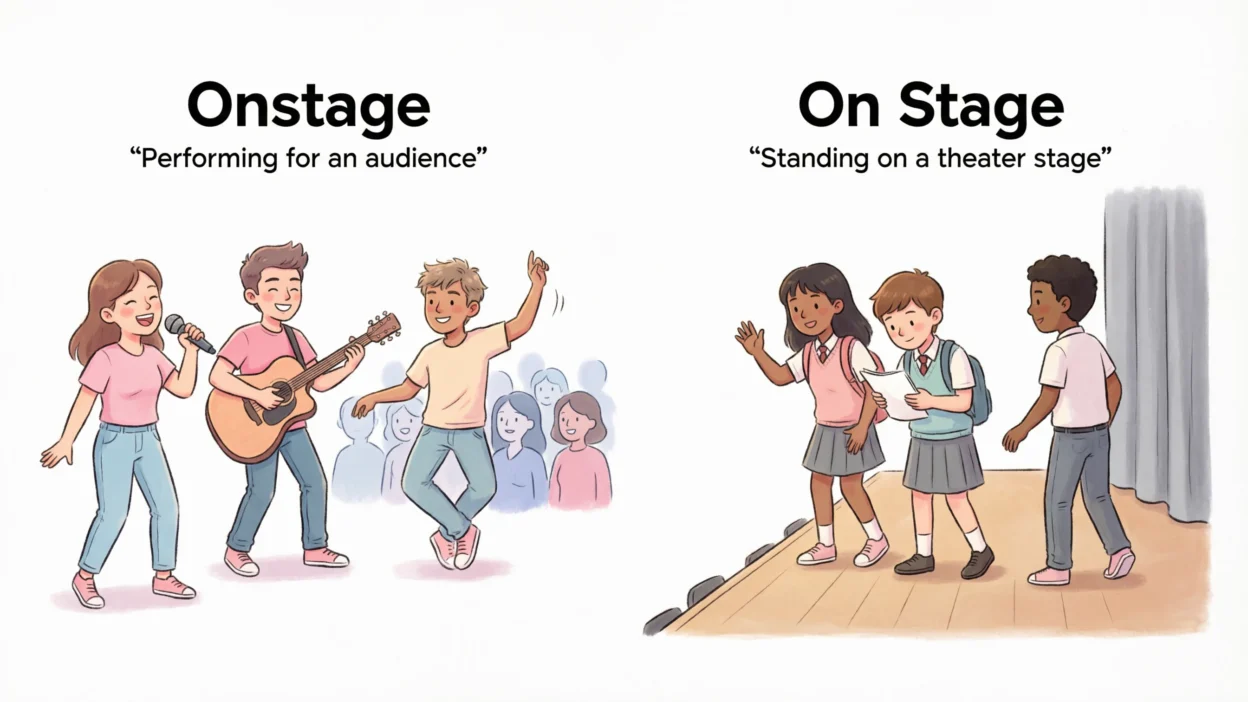
“Onstage” and “on stage” are closely related expressions in English, and many learners wonder whether they mean the same thing. Both refer to being on a performance stage, but they differ in grammar and usage.
The key idea: adjective/adverb form vs prepositional phrase.
Understanding the difference will help you write more naturally in theater, music, entertainment, and everyday English.
Quick Answer
- ✅ Onstage – Usually an adjective or adverb meaning “appearing on stage”
- ✅ On stage – A prepositional phrase meaning physically on the stage
- ✏️ Remember: Onstage = combined descriptive form, On stage = location phrase
Clear Explanation
What Does “Onstage” Mean?
Onstage is usually:
- an adjective
- sometimes an adverb
👉 It describes:
- something happening as part of a stage performance
- someone appearing before an audience
Examples:
- The actor’s onstage performance was excellent.
- She felt nervous onstage.
- Their onstage chemistry impressed the audience.
- The singer changed costumes onstage.
- The comedian looked confident onstage.
👉 “Onstage” is commonly used in:
- theater
- concerts
- acting
- entertainment writing
Common Uses of “Onstage”
1. Onstage Performance
Examples:
- onstage presence
- onstage behavior
- onstage chemistry
Example Sentence:
- The band had incredible onstage energy.
2. Describing Public Performance
Examples:
- nervous onstage
- comfortable onstage
Example Sentence:
- She becomes confident onstage.
3. Entertainment Writing
Examples:
- onstage appearance
- onstage interaction
Example Sentence:
- Fans loved the actor’s onstage personality.
What Does “On Stage” Mean?
On stage is a prepositional phrase.
👉 It literally means:
- physically located on the stage
Examples:
- The dancers walked on stage.
- He stood on stage for hours.
- There were five musicians on stage.
- The speaker stepped on stage confidently.
- Props were arranged on stage.
👉 “On stage” focuses more on:
- physical location
- movement or position
Common Uses of “On Stage”
1. Physical Position
Examples:
- standing on stage
- sitting on stage
Example Sentence:
- The actors waited on stage quietly.
2. Entering or Leaving
Examples:
- walked on stage
- ran on stage
Example Sentence:
- The singer rushed on stage.
3. Objects or People Located There
Examples:
- lights on stage
- instruments on stage
Example Sentence:
- Several microphones were placed on stage.
Key Difference
| Feature | Onstage | On Stage |
|---|---|---|
| Grammar | Adjective/adverb | Prepositional phrase |
| Focus | Performance or appearance | Physical location |
| Style | More compact/descriptive | More literal |
| Example | Onstage chemistry | Standing on stage |
Which One to Use and When
Use “Onstage” When:
- Describing performance qualities or public appearance
Examples:
- Onstage presence
- Onstage confidence
- Onstage chemistry
- Onstage performance
- Onstage personality
Example Sentences:
- The actor has amazing onstage charisma.
- She feels relaxed onstage.
- Their onstage interaction seemed natural.
Use “On Stage” When:
- Talking about physical location or movement
Examples:
- Walked on stage
- Standing on stage
- Dancing on stage
- Props on stage
- Musicians on stage
Example Sentences:
- The band walked on stage together.
- The speaker remained on stage after the show.
- There were many lights on stage.
Common Mistakes People Make
1. Using “Onstage” for Literal Location
❌ The chairs were onstage
✅ The chairs were on stage
👉 “On stage” is more natural for physical placement.
2. Using “On Stage” for Descriptive Performance Terms
❌ Her on stage presence was amazing
✅ Her onstage presence was amazing
👉 “Onstage” works better as a descriptive adjective.
3. Thinking Only One Form Is Correct
Both are correct depending on grammar and context.
4. Forgetting Style Differences
“Onstage” often sounds more polished in entertainment writing.
5. Mixing Compound and Phrase Forms
Compound words often become adjectives.
Easy Memory Trick
👉 Onstage = performance description
👉 On stage = physical stage location
Think:
- onstage charisma
- standing on stage
Real-Life Examples
Correct Use of “Onstage”
- The comedian has strong onstage confidence.
- Their onstage chemistry felt natural.
- She looked calm onstage.
Correct Use of “On Stage”
- The dancers moved on stage gracefully.
- The instruments were already on stage.
- He stepped on stage to speak.
Practice Exercise
Fill in the blanks:
- The actor’s ______ presence impressed the audience.
- Several musicians stood ______ during the concert.
- She feels confident ______.
Answers:
- onstage
- on stage
- onstage
Quick Quiz
- Which form usually describes performance qualities?
a) On stage
b) Onstage - Which form refers more to physical location?
a) Onstage
b) On stage - Which sentence sounds more natural?
a) Her onstage performance was excellent
b) Her on stage performance was excellent
Correct Answers:
- b) Onstage
- b) On stage
- a) Her onstage performance was excellent
Why This Confusion Happens
The confusion happens because:
- both expressions refer to stages and performances
- pronunciation is nearly identical
- meanings overlap slightly
However:
- onstage usually describes performance-related qualities
- on stage usually refers to physical position or movement
Helpful Tip for Better Writing
If the sentence describes:
- performance, charisma, or appearance → use onstage
- physical location or movement → use on stage
Conclusion
The difference between “onstage” and “on stage” is mainly grammatical and contextual. Onstage is usually a descriptive adjective or adverb related to performance, while on stage is a phrase referring to physical location.
👉 Onstage = performance description
👉 On stage = physical location
Learning this distinction will help your English sound more natural and polished.

Michael Anderson is a professional editor and senior contributor with a background in long-form content and strategic writing. He focuses on quality, structure, and credibility across all publications. Michael brings years of experience in content development and ensures high editorial standards for every project.